
Development of an AI-Driven Digital Platform to Support Teaching and Learning Management that Enhances Scientific Literacy for Teachers
Article Sidebar
Main Article Content
Abstract
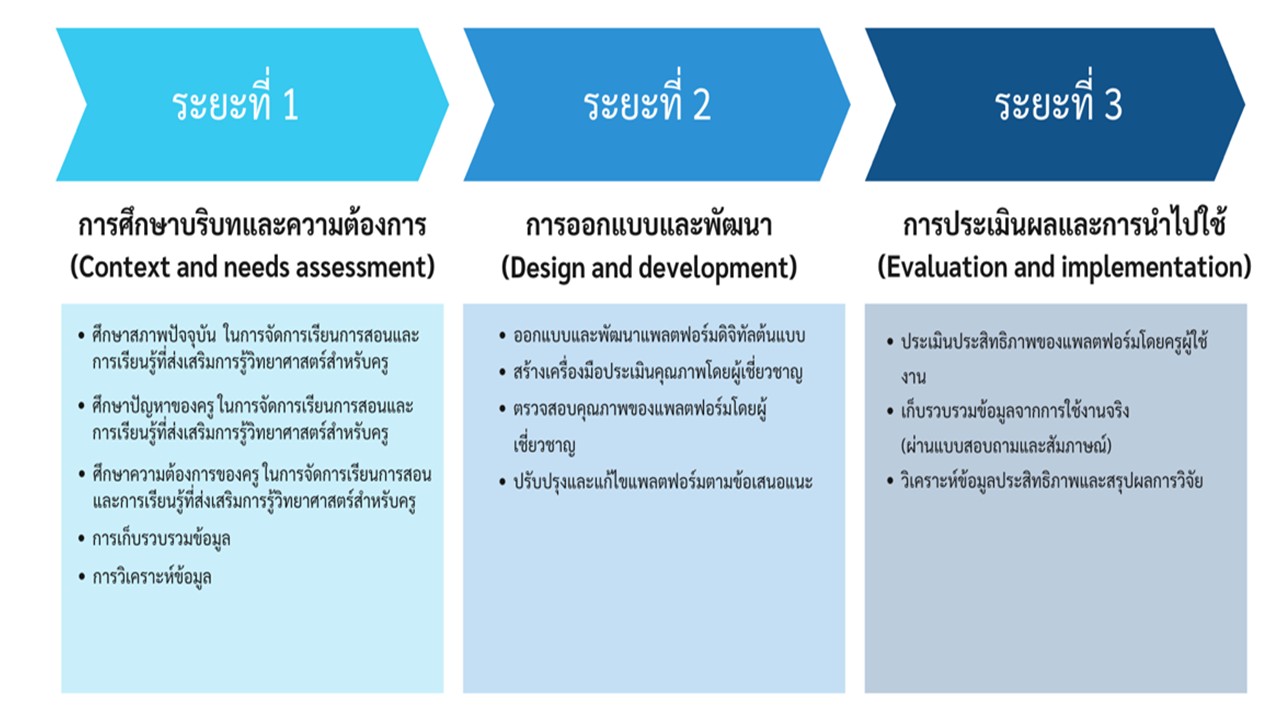
This study employed a research and development methodology to design, develop, and evaluate an AI-driven digital platform that supports teaching and promotes scientific literacy. The study involved 30 secondary school science teachers selected via purposive sampling. Data were collected through questionnaires and evaluation forms from experts and users, and analyzed using descriptive statistics. Findings revealed that teachers have a high need for support, particularly in the areas of activity design and evaluation. The developed PISA Ed Science platform, driven by Prompt Engineering, features AI tools for lesson planning and assessment creation; its design was rated as highly appropriate by experts. Teacher-users rated its overall effectiveness at the highest level, with instructional design and usability scoring highly. While experts confirmed the platform's alignment with PISA principles, they suggested further development for differentiated instruction and authentic assessment. The results demonstrate that the PISA Ed Science platform is a practical innovation for supporting teachers in promoting scientific literacy concretely.
Keywords: AI in Education, Digital Platform, Scientific Literacy
Article Details

This work is licensed under a Creative Commons Attribution-NonCommercial-NoDerivatives 4.0 International License.
References
จุฬาลงกรณ์มหาวิทยาลัย. (2562). รายงานการสังเคราะห์องค์ความรู้และนวัตกรรมด้านปัญญาประดิษฐ์เพื่อการศึกษา. สำนักพิมพ์แห่งจุฬาลงกรณ์มหาวิทยาลัย.
ทิศนา แขมมณี. (2560). ศาสตร์การสอน: องค์ความรู้เพื่อการจัดกระบวนการเรียนรู้ที่มีประสิทธิภาพ. สำนักพิมพ์แห่งจุฬาลงกรณ์มหาวิทยาลัย.
สมศักดิ์ (นามสมมติ). (2564). การประยุกต์ใช้แพลตฟอร์ม AI ในการเรียนรู้วิทยาศาสตร์. วารสารศึกษาศาสตร์, 15(2), 45-59.
สถาบันส่งเสริมการสอนวิทยาศาสตร์และเทคโนโลยี. (2565). ผลการประเมิน PISA 2022. กระทรวงศึกษาธิการ.
สุทธิศักดิ์ (นามสมมติ). (2564). แนวทางการพัฒนาทักษะการรู้วิทยาศาสตร์ในบริบทประเทศไทย. วารสารนวัตกรรมการศึกษาไทย, 8(1), 112-125.
สำนักพัฒนานวัตกรรมการจัดการศึกษา. (2563). แนวทางการจัดการเรียนรู้ในยุคดิจิทัล. สำนักงานคณะกรรมการการศึกษาขั้นพื้นฐาน.
Crawford, B. A. (2000). Embracing the essence of inquiry: New roles for science teachers. Journal of Research in Science Teaching, 37(9), 916-937.
Davis, F. D. (1989). Perceived usefulness, perceived ease of use, and user acceptance of information technology. MIS Quarterly, 13(3), 319–340.
Jenkins, G. M. (2019). The challenge of implementing inquiry-based learning in traditional classrooms. Journal of Science Teacher Education, 30(4), 345-360.
Kenan Asia. (2023). PISA 2022 insights: Unlocking Thailand's potential. Kenan Foundation Asia.
Organisation for Economic Co-operation and Development. (2019). PISA 2018 results (Volume I): What students know and can do. OECD Publishing.
Russell, S. J., & Norvig, P. (2020). Artificial intelligence: A modern approach (4th ed.). Pearson.
Sweller, J. (1988). Cognitive load during problem solving: Effects on learning. Cognitive Science, 12(2), 257–285.
Vygotsky, L. S. (1978). Mind in society: The development of higher psychological processes. Harvard University Press.
