
Physical Fitness of Female Youth Volleyball Players at Nangiw Wittayasarn School in 2021: use Field - Based Test of Assessment of Physical fitness 2017
Article Sidebar
Main Article Content
Abstract
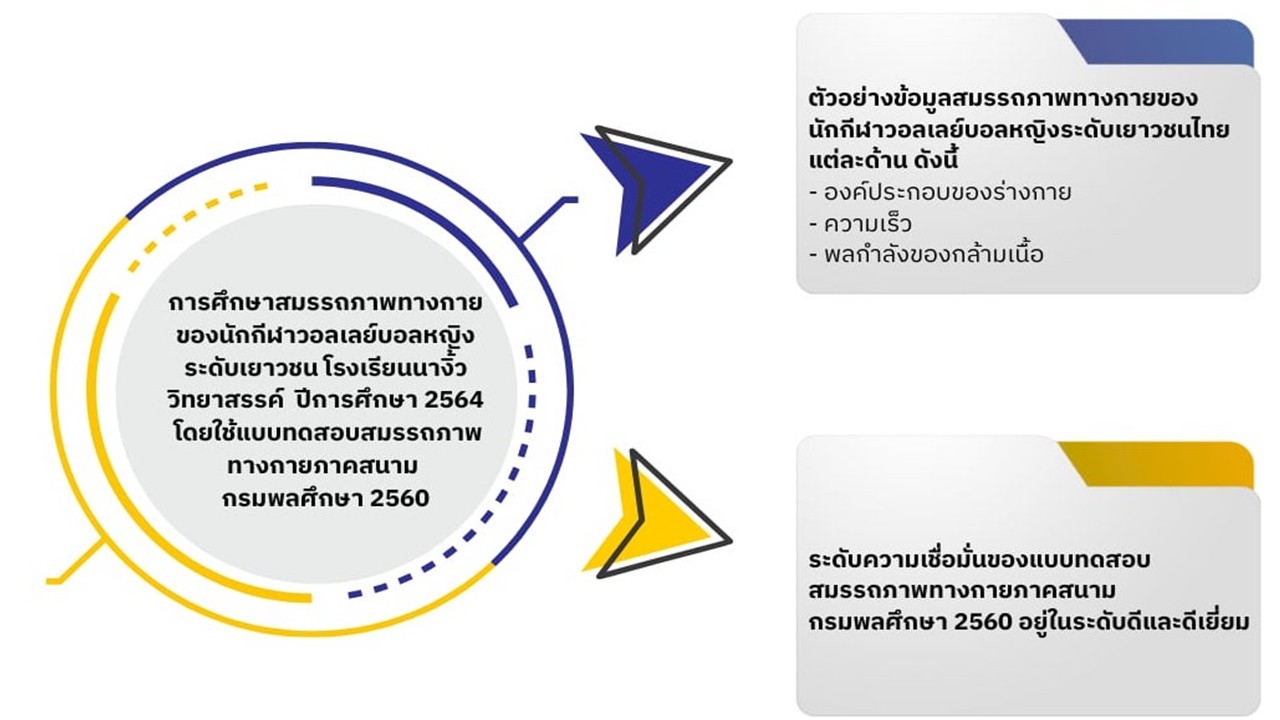
This cross-sectional study aimed to assess the physical fitness of female youth volleyball players at Nangiw Wittayasarn School, Khao Suan Kwang District, Khon Kaen Province, Thailand, during the 2021 academic year. The study focused on specific components of physical fitness relevant to volleyball training and performance, including agility, muscular power, and aerobic capacity. Additionally, the study aimed to determine the reliability of the chosen field test. Forty-three female volleyball players were purposively selected for this study. Physical Activity Readiness Questionnaire 2019 (PAR-Q), body height measurement, Tanita model MC-780 MA, and Field-Based Physical Fitness Assessment 2017 for Volleyball, including 20-yard Agility Pro Test, Spike Height Test, 3-Step Spike Height Test, Block Height Test, and 150-yard Shuttle Run Test, were used for measurement. Mean, standard deviation, and Intraclass Correlation Coefficient (ICC) were used for statistical analyses. Results revealed a variety of physical fitness levels among the female youth volleyball players at Nangiw Wittayasarn School. The 2017 Field-Based Physical Fitness Assessment for Volleyball demonstrated a high reliability level (ICC = 0.897–0.990). In conclusion, this study provided reference data on physical fitness among Thai female volleyball players for further research. The 2017 Field-Based Physical Fitness Assessment for Volleyball proved to be reliable, yielding acceptable data quality from the testing, and was deemed appropriate for further study among Thai female volleyball players.
Keywords: Physical Fitness, Reliability, Female Youth Volleyball Players
Article Details

This work is licensed under a Creative Commons Attribution-NonCommercial-NoDerivatives 4.0 International License.
References
ชูศักดิ์ เวชแพศย์, และกันยา ปาละวิวัธน์. (2536). สรีรวิทยาของการออกกําลังกาย (พิมพ์ครั้งที่ 4). กรุงเทพฯ:
ธรรกมลการพิมพ์.
วัญญา วิศาลาภรณ์. (2533). การสร้างแบบทดสอบ (พิมพ์ครั้งที่ 2). กรุงเทพฯ: คณะศึกศาสตร์ มหาวิทยาลัยศรีนครินทร์ทรวิโรฒประสานมิตร.
สุพิตร สมาหิโต และคณะ. (2549). แบบทดสอบและเกณฑ์มาตรฐานสมรรถภาพทางกายที่สัมพันธ์กับสุขภาพ สำหรับเด็กไทย อายุ 7–18 ปี. กรุงเทพฯ: คณะกรรมการส่งเสริมการออกกำลังกายและกีฬาเพื่อ
สุขภาพในสถาบันการศึกษา สำนักงานสนับสนุนการสร้างเสริมสุขภาพ (สสส.).
สำนักวิทยาศาสตร์การกีฬา กรมพลศึกษา กระทรวงการท่องเที่ยวและกีฬา. (2560). การทดสอบสมรรถภาพ
ทางกายภาคสนาม กีฬาฟุตบอล-ฟุตซอล วอลเลย์บอล แบดมินตัน. กรุงเทพฯ: ซัน แพคเกจจิ้ง จำกัด.
วิทยาลัยวิทยาศาสตร์และเทคโนโลยีการกีฬา มหาวิทยาลัยมหิดล. (2558). เกณฑ์สมรรถภาพทางกายนักกีฬา
มหาวิทยาลัยแห่งประเทศไทย. (เอกสารที่ไม่ได้ตีพิมพ์). วิทยาลัยวิทยาศาสตร์และเทคโนโลยีการ
กีฬา มหาวิทยาลัยมหิดล.
Akdoğan, E., & Güven, B. (2021). Relationship between Body Composition, Agility and Vertical
Jump Performance in Young Female Volleyball Players. Turkiye Klinikleri Journal of Sports Sciences, 13(3), 352–357. https://doi.org/10.5336/sportsci.2020-80118
Corbin, C., Welk, G., Corbin, W., & Welk, K. (2008). Concepts of Physical Fitness: Active
Lifestyles for Wellness. (14th ed.). McGraw-Hill Education.
Currell, K., & Jeukendrup, A. E. (2008). Validity, reliability and sensitivity of measures of sporting performance. Sports medicine (Auckland, N.Z.), 38(4), 297–316. https://doi.org/10.2165/00007256-200838040-00003
Gabbett, T., & Georgieff, B. (2007). Physiological and anthropometric characteristics of
Australian junior national, state, and novice volleyball players. Journal of strength and conditioning research, 21(3), 902–908. https://doi.org/10.1519/R-20616.1
Haff, G., & Triplett, N. T. (2016). Essentials of strength training and conditioning (4th ed.). Champaign, IL: Human Kinetics.
Jamshidi, M., Jahromi, M. K., Salesi, M., Chari, M. H., Mohajerani, R., & Dashtiyan, A. A. (2016).
The effect of three methods of warm-up on the anaerobic power, agility, speed, flexibility and fatigue index of elite female volleyball players. Turkish kinesiology, 2(3): 34–42. https://dergipark.org.tr/en/pub/turkjkin/issue/26721/281138
Koo, T. K., & Li, M. Y. (2016). A Guideline of Selecting and Reporting Intraclass Correlation
Coefficients for Reliability Research. Journal of chiropractic medicine, 15(2), 155–163. https://doi.org/10.1016/j.jcm.2016.02.012
Kundu, B., Bose, S., Mondal, S., Saha, S., & Islam, M. (2020). Introduction of a Test Battery for Identification of Talent in Female Volleyball Players. European Journal of Physical Education and Sport Science, 6(7). https://oapub.org/edu/index.php/ejep/article/view/3337
Malina, R. M., Bouchard, C., Bar-Or, O. (2004). Growth, maturation, and physical activity (2nd ed.). Champaign, IL: Human Kinetics.
Nikolaidis, P. T., Afonso, J., Clemente-Suarez, V. J., Alvarado, J. R. P., Driss, T., Knechtle, B., &
Torres-Luque, G. (2016). Vertical Jumping Tests versus Wingate Anaerobic Test in Female Volleyball Players: The Role of Age. Sports (Basel, Switzerland), 4(1), 9. https://doi.org/10.3390/sports4010009
Sieroń Sieroń, A., Stachoń, A., & Pietraszewska, J. (2023). Changes in Body Composition and
Motor Fitness of Young Female Volleyball Players in an Annual Training Cycle. International journal of environmental research and public health, 20(3), 2473. https://doi.org/10.3390/ijerph20032473
Warburton, D. E. R., Jamnik, V., Bredin, S. S. D., Shephard, R. J., & Gledhill, N. (2018). The 2019 Physical Activity Readiness Questionnaire for Everyone (PAR-Q+) and electronic Physical Activity Readiness Medical Examination (ePARmed-X): 2019 PAR-Q+. The Health & Fitness Journal of Canada, 11(4), 80–83. https://doi.org/10.14288/hfjc.v11i4.270
