
The Development of Music Activities to Develop Musical Skills, Behavior and Personality of The Youth in The Department of Juvenile Observation and Protection, Songkhla Province
Article Sidebar
Main Article Content
Abstract
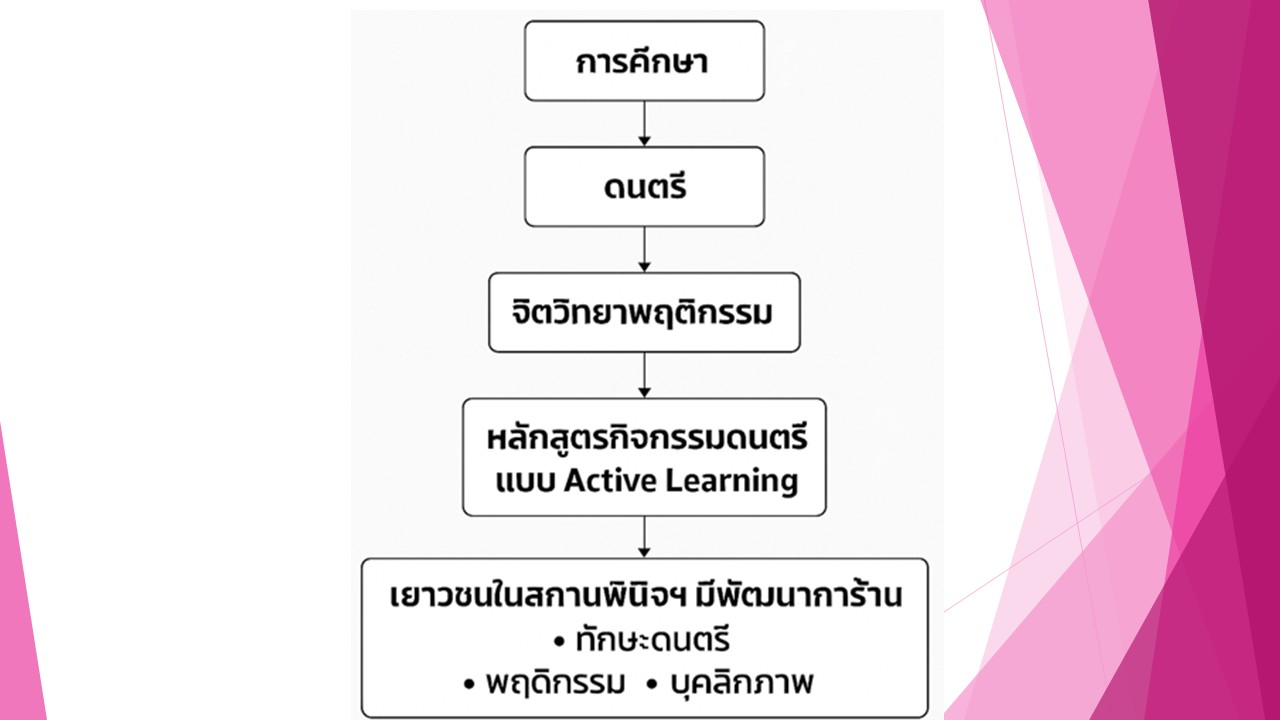
This study aimed to (1) design and develop a music activity curriculum in the form of “Active Learning” to enhance the musical skills, behavior, and personality of youths at the Songkhla Juvenile Observation and Protection Center, (2) evaluate the effectiveness of the curriculum, and (3) transfer the curriculum to relevant officers. A mixed-methods approach was employed, starting with in-depth interviews with 20 officers to gather insights for curriculum design, which five experts subsequently validated. The curriculum was then implemented with 30 youths, followed by a training program for 40 officers across seven southern provinces. Research instruments included interviews, assessment forms, and pre- and post-tests. Findings revealed that the curriculum comprised 12 activities and demonstrated high quality and effectiveness. The average pre-test score was 48.89%, and the post-test score increased to 94.11%. In comparison, formative and summative evaluations showed mean scores of 85.83% and 94.11%, respectively, indicating significant improvements in musical skills, behavior, and personality. In conclusion, the developed curriculum serves as an effective model for youth rehabilitation and development and can be transferred to officers and related agencies to sustainably enhance the quality of life and the application of music education as therapy.
Article Details

This work is licensed under a Creative Commons Attribution-NonCommercial-NoDerivatives 4.0 International License.
References
กมลวรรณ ตังธนกานนท์. (2557). การวัดและการประเมินทักษะการปฏิบัติ (พิมพ์ครั้งที่ 1). สำนักพิมพ์แห่ง จุฬาลงกรณ์มหาวิทยาลัย.
กรมพินิจและคุ้มครองเด็กและเยาวชน. (2566). สถิติเด็กและเยาวชน พ.ศ. 2566. กระทรวงยุติธรรม. https://www.voicetv.co.th
จีรญา จินกระวี, เกศริน มนูญผล, & ทิพมาศ เศวตวรโชติ. (2566). การพัฒนารูปแบบการจัดการเรียนการสอน แบบ Active learning ของครูสังกัด สำนักงานเขตพื้นที่การศึกษาประถมศึกษา สุราษฎร์ธานี เขต 1. วารสาร มจรอุบล ปริทรรศน์, 8(2), 267-276.
โจเซฟ อีเกอร์. (2550). ไวโอลินของไอน์สไตน์. แปลโดย จิตราภรณ์ ตันรัตนกุล. กรุงเทพฯ: มติชน.
ชาญคณิต กฤตยา สุริยะมณี, และ อุนิษา เลิศโตมรสกุล. (2553). ปัจจัยที่มีผลต่อการกระทำผิดซํ้าคดี
ยาเสพติด : กรณีศึกษา ผู้กระทำผิดร้ายแรงและมีโทษสูงและต้องดูแลเป็นพิเศษ. กรุงเทพฯ:
สำนักงาน คณะกรรมการป้องกันและปราบปรามยาเสพติด กระทรวงยุติธรรม. 1.
ชาญณรงค์ พรรุ่งโรจน์. (2555). เอกสารประกอบการชุมวิชาการประจำปี 2555 เรื่อง “ฝ่าวิกฤต
อุดมศึกษาไทย”. กรุงเทพฯ: สำนักงานรับรองมาตรฐานและประเมินคุณภาพการศึกษา
(องค์การมหาชน).
ณรุทธ์ สุทธจิตต์. (2561). ดนตรีศึกษา : หลักการและสาระสำคัญ (พิมพ์ครั้งที่ 10). กรุงเทพฯ: สำนักพิมพ์แห่งจุฬาลงกรณ์มหาวิทยาลัย.
ทวีศักดิ์ สิริรัตน์เรขา. (2549). ดนตรีบำบัด. สืบค้นจาก: http://www.happyhomeclinic.com/a06- musictherapy.htm.
บุญญลักษม์ ตำนานจิตร. (20) การจัดการเรียนรู้เชิงรุก (Active Learning) โดยใช้สื่อและแหล่ง เรียนรู้ใน ศตวรรษที่ 21. วารสารพัฒนาเทคนิคศึกษา (มหาวิทยาลัยเทคโนโลยีพระจอมเกล้าพระนคร เหนือ) 36(1), 3-11.
พิชิต ฤทธิ์จรูญ. (2560). หลักการวัดและประเมินผลการศึกษา (พิมพ์ครั้งที่ 11). กรุงเทพมหานคร: เฮ้าส์ออฟ เคอร์มิส จำกัด.
ราชบัณฑิตยสภา. (2556). พจนานุกรมฉบับราชบัณฑิตยสถาน พ.ศ. 2556. กรุงเทพฯ: ราชบัณฑิตยสภา.
รักชนก ภักดิ์โพธิ์. (2550). ผลของดนตรีบำบัดต่อความเครียด อาการคลื่นไส้ ขย้อนและอาเจียนใน
ผู้ป่วยสตรีมะเร็งอวัยวะสืบพันธุ์ที่ได้รับเคมีบำบัด. (วิทยานิพนธ์ปริญญาพยาบาลศาสตรมหา
บัณฑิต สาขาการพยาบาลสตรี). เชียงใหม่: มหาวิทยาลัยเชียงใหม่. 33-38.
ศูนย์เทคโนโลยีสารสนเทศ กรมพินิจและคุ้มครองเด็กและเยาวชน. (2565). รายงานสถิติคดีประจำปี พ.ศ. 2565. กรมพินิจและคุ้มครองเด็กและเยาวชน.
สถานพินิจและคุ้มครองเด็กและเยาวชนจังหวัดสงขลา. (2565). รัฐพิพากษาการพัฒนาหรือหัวข้อวิจัย [เอกสารภายใน]. สถานพินิจและคุ้มครองเด็กและเยาวชนจังหวัดสงขลา.
สถาพร พฤฑฒิกุล. (2558). การบริหารการศึกษากับการเปลี่ยนแปลงในศตวรรษที่ 21. วารสาร
ศึกษาศาสตร์. มหาวิทยาลัยบูรพา, 28 (2).
โสธิดา ผุฏฐธรรม. (2555). พฤติกรรมก้าวร้าว. สืบค้นจาก http://taamkru.com/th
อุไรรัตน์ หน้าใหญ่. (2560). การพัฒนารูปแบบกิจกรรมสร้างเสริมสุขภาวะทางปัญญาสำหรับเด็กและ
เยาวชนในสถานพินิจและคุ้มครองเด็กและเยาวชนจังหวัดปัตตานี. (วิทยานิพนธ์ปริญญาศิลป
ศาสตรมหาบัณฑิต). ปัตตานี: มหาวิทยาลัยสงขลานครินทร์. 5.
American Music Therapy Association. Music Therapy and Individuals with Diagnoses
on the Autism Spectrum. Available at: http://www.musictherapy.org. Accessed
April 5, 2005.
Chong, H. J., & Yun, J. (2020). Music therapy for delinquency involved juveniles through tripartite collaboration: A mixed method study. Frontiers in Psychology, 11, 589431. https://doi.org/10.3389/fpsyg.2020.589431 Frontiers+2PubMed+2
Flores, T.W. (1960). Fundamental in Test and Measurement. Monils: Abive Publishing
House.
Hillgard, E.R., Atkinson, R.C. and Atkinson. R.L. (1979). Introduction to psychology. (7th
ed.). New York: Harcourt.
Le, D. T., et al. (2023). Personality traits and aggressive behavior in Vietnamese adolescents: A peer-reviewed study. Psychology Research and Behavior Management, 16, 345–357. https://doi.org/10.2147/PRBM.SXXX
Lovett, M. C., Bridges, M. W., DiPietro, M., Ambrose, S. A., & Norman, M. K. (2023). How learning works: Eight research-based principles for smart teaching. John Wiley & Sons.
Tomasello, K. R. (2016). How to Make the Jailhouse Rock: An Evaluation of Effective Music Therapy Methods Among Juvenile Offenders (Senior Project). California Polytechnic State University. https://digitalcommons.calpoly.edu/musp/76
