
Technological Leadership for School Administrators under the Secondary Educational Service Area Office Khon Kaen
Article Sidebar
Main Article Content
Abstract
T
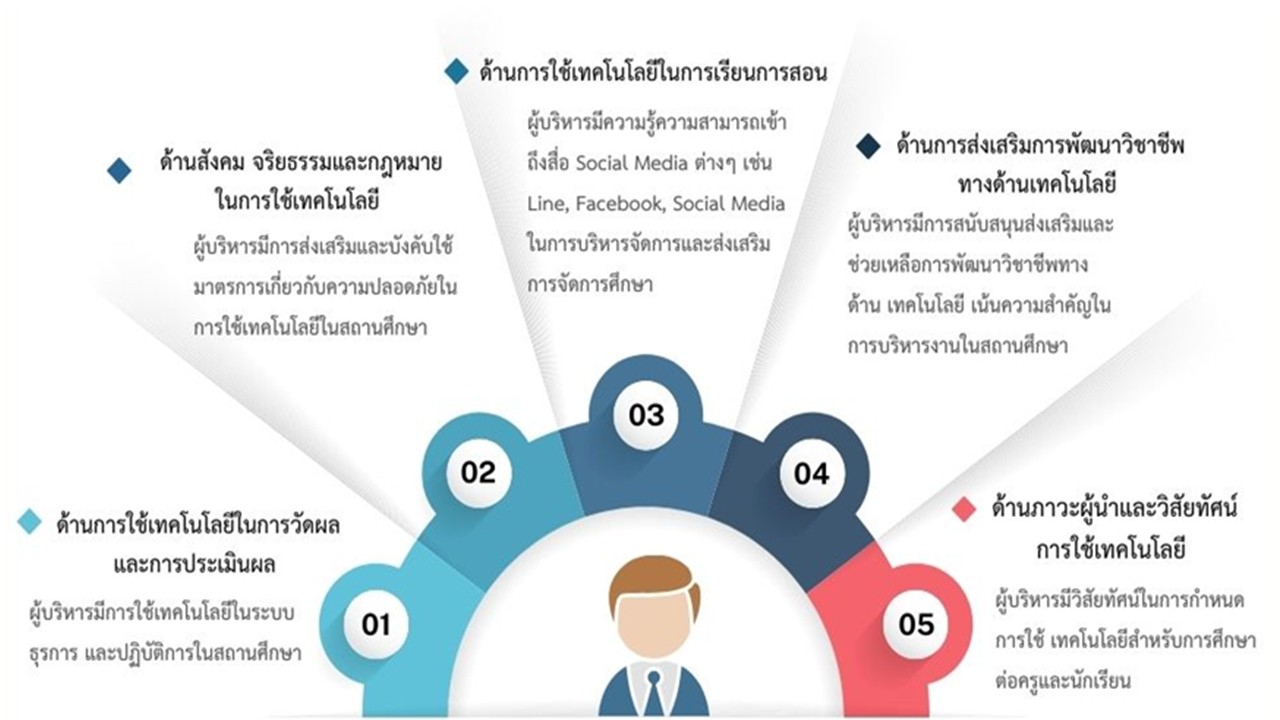
The objectives of this research were as follows: 1) to study the technological leadership of school administrators under the Khon Kaen Secondary Educational Service Area Office, and 2) to compare the technological leadership of school administrators based on teachers’ opinions, categorized by gender, age, educational level, and work experience. The sample group consisted of 343 teachers from schools under the Khon Kaen Secondary Educational Service Area Office. A total of 343 questionnaires were returned, representing a 100% response rate. The research instrument was a questionnaire. The statistics used in data analysis included frequency, percentage, mean, standard deviation, t-test, and one-way analysis of variance (One-way ANOVA). The results revealed that: 1) the overall level of technological leadership among school administrators was high ( =4.10). While considering each aspect, all aspects were also rated at a high level: aspect of the use of technology in assessment and evaluation, aspect of social, ethical, and legal use of technology, aspect of the use of technology in teaching and learning, aspect of the promotion of professional development in technology, and aspect of the leadership and vision in technology use (=4.20, =4.15, =4.10, =4.05, =4.01), respectively; and 2) the comparison of teachers’ opinions on technological leadership revealed statistically significant differences at the 0.05 level based on gender, age, education, and work experience.
Keywords: Leadership, Technological Leadership, School Administrators
Article Details

This work is licensed under a Creative Commons Attribution-NonCommercial-NoDerivatives 4.0 International License.
References
กัลยวรรธน์ ตะเภาทอง และคณะ. (2564). การศึกษาภาวะผู้นำเชิงเทคโนโลยีของผู้บริหารโรงเรียนขยายโอกาสตามทัศนะของครูสังกัดสำนักงานเขตพื้นที่การศึกษาประถมศึกษาพิจิตร เขต1.การประชุมวิชาการสหวิทยาการพุทธรัฐศาสตร์ ระดับชาติ ครั้งที่ 1 (ออนไลน์). นครปฐม:มหาวิทยาลัยมหามกุฏราชวิทยาลัย.
บุญชม ศรีสะอาด. (2560). การวิจัยเบื้องต้น. พิมพ์ครั้งที่ 10. กรุงเทพฯ : สุวีริยาสาส์น.
ปาณชนิน ตรีพรหม และชยากานต์ เรืองสุวรรณ (2566) แนวทางการพัฒนาภาวะผู้นำเชิงเทคโนโลยีของผู้บริหารสถานศึกษาสังกัดอาชีวศึกษาจังหวัดขอนแก่น. วิทยานิพนธ์ปริญญาครุศาสตรมหาบัณฑิต สาขาวิชาการบริหารจัดการการศึกษา มหาวิทยาลัยราชภัฏมหาสารคาม.
อนุรักษ์ ถอดเขี้ยว และสถิรพร เชาวน์ชัย. (2566). ภาวะผู้นำเชิงเทคโนโลยีในการบริหารงานวิชาการของผู้บริหารสถานศึกษาสังกัดสำนักงานเขตพื้นที่การศึกษาประถมศึกษาพิจิตร เขต 1. สิกขาวารสารศึกษาศาสตร์มหาวิทยาลัยนเรศวร, 10(1), 153-165.
อภิวิชญ์ สนลอย. (2565). ภาวะผู้นำทางเทคโนโลยีสารสนเทศของผู้บริหารสถานศึกษา สังกัดสำนักงานเขตพื้นที่การศึกษาประถมศึกษาสมุทรสาคร. วารสารวิชาการสถาบันพัฒนาพระวิทยากร 5(1), 96-97.
อมรรัตน์ สุริยะบุญ, กฤษดา ผ่องพิทยาและสนั่น ประจงจิตร. (2566). ภาวะผู้นำทางเทคโนโลยีของผู้บริหารสถานศึกษา สังกัดสำนักงานเขตพื้นที่การศึกษามัธยมศึกษากรุงเทพมหานคร เขต 2. วารสารสถาบันวิจัยญาณสังวร 14(1), 59-70.
อิทธิฤทธิ์ กลิ่นเดช. (2560). ความสัมพันธ์ของภาวะผู้นำเชิงเทคโนโลยีของผู้บริหารสถานศึกษา สังกัดสำนักงานส่งเสริมการศึกษานอกระบบและการศึกษาตามอัธยาศัยจังหวัดสระบุรี. วิทยานิพนธ์ปริญญาศึกษามหาบัณฑิต สาขาวิชาการบริหารการศึกษา บัณฑิตวิทยาลัย มหาวิทยาลัยเทคโนโลยีราชมงคลธัญบุรี.
American Institute for Research (AIR). (2009). Evaluation of the school technology leadership initiative: External evaluation report#2. Washington, DC: American Institutes of Research.
Creighton, T.B. (2003). The principal as technology leader. Thousand Oaks California: Corwin.
Cronbach, Lee J. (1984). Essentials of Psychological Testing. 4th ed. New York: Harper and Row Publisher.
Flanagan L. & Jacobsen M. (2003). Technology leadership for the twenty-first century principal. Journal of Education Administration, 41(2), 124-142.
International Society for Technology in Education (ISTE). (2009). Nation educational technology standards for administrators. Washington DC: Eugene, OR.
Kozloski K. C. (2006). Principal leaderships for technology integration: A study of principal technology leadership: Doctor dissertation, Drexel University.
Krejcie, R.V., & D.W. Morgan. (1970). Determining Sample Size for Research Activities. Educational and Psychological Measurement, 30(3): 607- 610.
Redish T. & Chan T. C. (2006). Technology leaderships: Aspiring administrators’ perceptions of their leadership preparation program. Doctor dissertation Kennesaw State University.
Schiller J. (2003). Working with ICT: perceptions of Australian principals. Journal of Educational Administration, 41(2), 171-185.
