
Research Tiltle Good Governance Administration of school administrators that affects the professional conduct of teachers under the Nonthaburi Secondary Educational Service Area Office
Article Sidebar
Main Article Content
Abstract
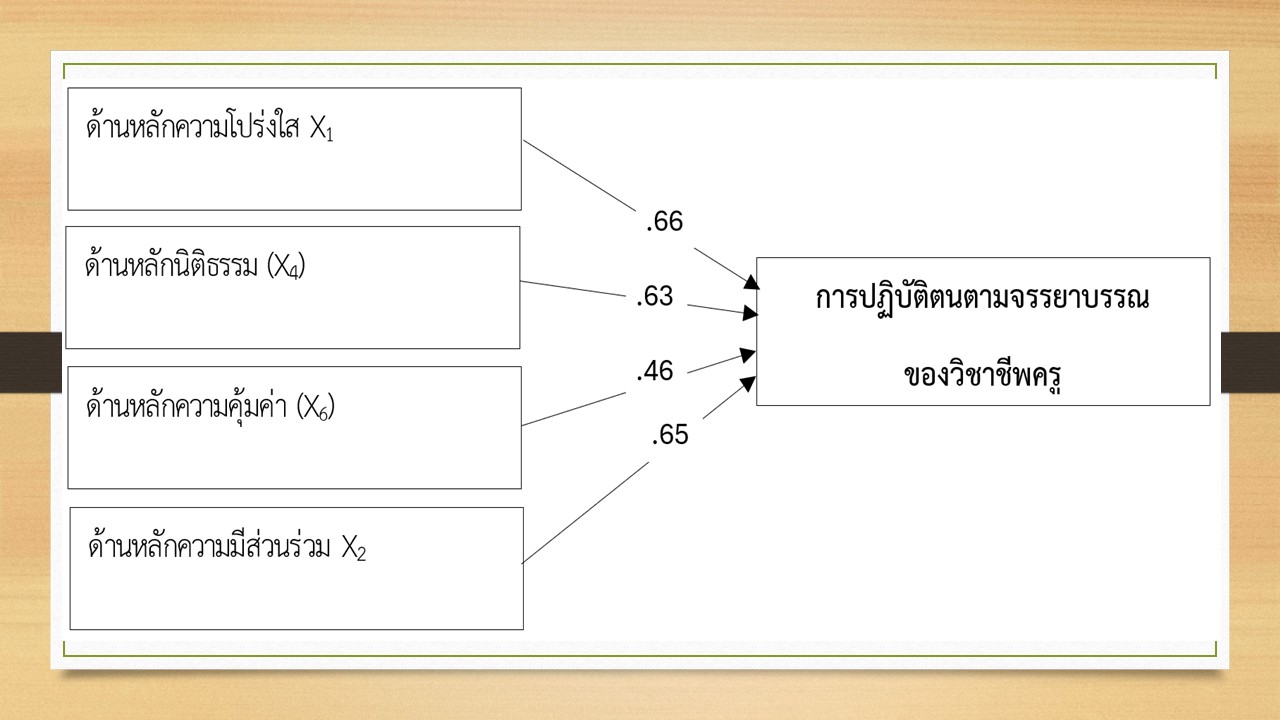
This research aimed to study 1) the level of good governance management of school administrators, 2) the level of compliance with the teaching profession's code of ethics, 3) the relationship between good governance management of school administrators and compliance with the teaching profession's code of ethics, and 4) how good governance management of school administrators influences compliance with the teaching profession's code of ethics.The sample consisted of 320 teachers in the 2023 academic year. The research instrument was a five-point rating scale questionnaire. Part 1 examined the level of good governance management and Part 2 examined compliance with the teaching profession's code of ethics, with overall reliability values of 0.88 and 0.92. Data analysis included means, standard deviations, Pearson's product moment correlation coefficients, and multiple regression analysis. The results revealed that 1) school administrators' compliance with the teaching profession's code of ethics and 2) their compliance with the teaching profession's code of ethics were at the highest level overall. with a high positive relationship and 4) the administration according to the principles of good governance of the educational institution administrators in terms of transparency (β = 0.26, p-value =.000, t = 5.65), rule of law (β = 0.25, p-value =.000, t= 5.52), value for money (β = 0.10, p-value=.000, t= 4.62), and participation (β = 0.06, p-value=.000, t= 2.48), affecting the practice of ethics of the teaching profession. They can jointly predict the effect on the practice of ethics of the teaching profession by 53.10 percent with statistical significance at the .01 level, indicating that the administration of administrators is an important factor for the development of the teaching profession.
Keywords: Good Governance, School Administrators, Professional Ethics, Secondary Educational Service Area Office
Article Details

This work is licensed under a Creative Commons Attribution-NonCommercial-NoDerivatives 4.0 International License.
References
กรรณิการ์ การวงศ์. (2566). แนวทางการพัฒนาการบริหารตามหลักธรรมาภิบาลของผู้บริหาร สถานศึกษา สังกัดสำนักงานเขตพื้นที่การศึกษาประถมศึกษาสุรินทร์ เขต 3. วิทยานิพนธ์ปริญญามหาบัณฑิต, มหาวิทยาลัยราชภัฏสุรินทร์.
กิ่งดาว กุลชา และจิติมา วรรณศรี. (2567). ความสัมพันธ์ระหว่างการปฏิบัติตามจรรยาบรรณวิชาชีพของผู้บริหารสถานศึกษา กับความผูกพันต่อองค์การของครู สังกัดสำนักงานเขตพื้นที่การศึกษามัธยมศึกษากำแพงเพชร. วารสารการบริหารการศึกษาและนวัตกรรมการศึกษา, 4(1), 1–13.
ธงชัย คล้ายแสง. (2562). หลักธรรมาภิบาลกับการบริหารจัดการภาครัฐแนวใหม่. วารสารวิจัยวิชาการ, 2(2), 177-181.
บุญชม ศรีสะอาด. (2556). วิธีการทางสถิติสำหรับการวิจัยเล่ม 1. กรุงเทพมหานคร: สุวีริยาสาส์น.
พระราชบัญญัติการอุดมศึกษา พ.ศ. 2562. (2564). ราชกิจจานุเบกษา, 136(57), 23.
ราชกิจจานุเบกษา. (2556, 4 ตุลาคม). ข้อบังคับคุรุสภาว่าด้วยจรรยาบรรณของวิชาชีพ พ.ศ. 2556.
ราชกิจจานุเบกษา, 130(พิเศษ 130 ง), 72–74.
ราชบัณฑิตยสถาน. (2556). พจนานุกรมฉบับราชบัณฑิตยสถาน พ.ศ. 2554. ราชบัณฑิตยสถาน.
วริศรา แก้วเจริญ. (2564). การปฏิบัติตนตามจรรยาบรรณของครู สังกัดสำนักงานเขตพื้นที่การศึกษาประถมศึกษานครราชสีมา เขต 1. วารสารการศึกษาท้องถิ่น, 9(3), 112–125.
สำนักงานเลขาธิการวุฒิสภา. (2560). แผนการศึกษาแห่งชาติ พ.ศ. 2561–2580. กรุงเทพมหานคร.
สำนักงานเลขาธิการสภาผู้แทนราษฎร. (2560). ธรรมาภิบาล: หลักการบริหารจัดการที่ดี. สำนักงานเลขาธิการสภาผู้แทนราษฎร.
อัญชลี โลเชียงสาย,. อรพรรณ ตู้จินดา, และ ดวงใจ ชนะสิทธิ์. (2565). การบริหารตามหลักธรรมาภิบาล ของผู้บริหารสถานศึกษาที่ส่งผลต่อประสิทธิผลของสถานศึกษา สังกัดสำนักงานเขตพื้นที่การศึกษาประถมศึกษาสุพรรณบุรีเขต 3. Journal of Institute of Trainer Monk Development, 5(1). 16-28.
อัญชลี โลเชียงสาย. (2565). การบริหารตามหลักธรรมาภิบาลของผู้บริหารสถานศึกษาที่ส่งผลต่อประสิทธิผลของสถานศึกษา สังกัดสำนักงานเขตพื้นที่การศึกษาประถมศึกษาสุพรรณบุรี เขต 3. [วิทยานิพนธ์ปริญญามหาบัณฑิต, มหาวิทยาลัยราชภัฏนครปฐม].
Best, J., & Kahn, J. V. (1993). Research in Education (7" ed.). Boston: Allyn and Bacon.
Boston: Jones and Bartlelt.
Garcia, A., & Ching, B. (2024). Ethical leadership as a mediator of transparency and trust in school governance: Its direct effect on organizational transparency culture. European Journal of Education, 59(1), 125-140.
Krejcie, R. V., & Morgan D W. (1970). Determining Sample Size for Research Activities. Educational and Psychological Measurement, 30(3): 608.
Likert, R. (1967). The Human Organization. New York: McGraw Hill.
Rovinelli, R. J., & Hambleton, R. K. (1977). On the use of content specialists in the assessment of criterion-referenced test item validity. Dutch Journal of Educational Research, 2(2), 49-60.
