
A Model for Developing Quality Administration of Private Vocational Colleges in the Northeast Region
Article Sidebar
Main Article Content
Abstract
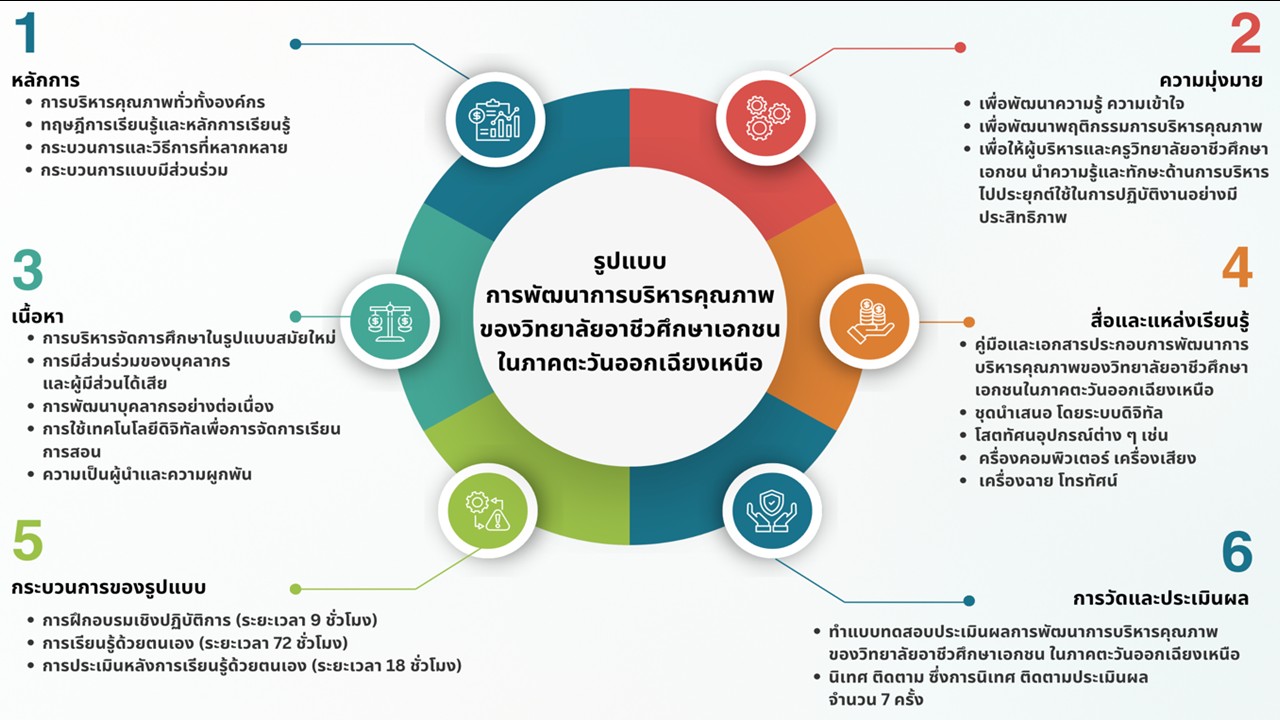
This study aimed to: (1) examine the components of quality management in private vocational colleges in the Northeast Region; (2) develop a quality management model for the private vocational colleges in the Northeast Region; and (3) evaluate the developed model. The research employed a Research and Development (R&D) approach in three phases: analyzing quality management components through a survey of 274 administrators in the 2024 academic year, and the sample size was determined using the Krejcie and Morgan table. Developing the model and assessing its effectiveness. Data were collected using structured and unstructured interviews and rating-scale questionnaires. Statistical methods included frequency, percentage, mean, standard deviation, and index of item-objective congruence. The findings revealed that: (1) quality management consisted of five major components, 20 subcomponents, and 80 indicators, with the most critical areas being modern educational management, stakeholder participation, continuous personnel development, the use of digital technology in teaching and learning, and leadership with commitment; (2) the developed model comprised principles, objectives, content, development processes, learning resources, and evaluation methods, and was rated highly appropriate; and (3) evaluation by nine experts confirmed the model’s validity, appropriateness, feasibility, and usefulness at the highest level
Keywords: Development Model, Quality Administration, Private Vocational Colleges
Article Details

This work is licensed under a Creative Commons Attribution-NonCommercial-NoDerivatives 4.0 International License.
References
เอกสารอ้างอิง
เกสรา บุญครอบ. (2565). การพัฒนาบุคลากรที่ส่งผลต่อประสิทธิภาพการทํางานของ บริษัท มติ ซุย พรีซิสชั่นไทย จำกัด. วารสารวิทยาการจัดการปริทัศน์. 24(2). 51-62.
ยุพิน ทองส่งโสม (2560,รูปแบบการบริหารจัดการด้านการบริการวิชาชีพสำหรับ สถานศึกษาอาชีวศึกษาเอกชน.วารสารวิจัยทางการศึกษาคณะศึกษาศาสตร์ มหาวิทยาลัยศรนี ครินทรวิโรฒ. 10(1).หน้า 114-128)
วิชัย วงษ์ใหญ่ และ มารุต พัฒผล. (2563). จากการเรียนรู้ออนไลน์สู่การสร้างสรรค์ นวัตกรรม.กรุงเทพฯ: ศูนย์ผู้นำนวัตกรรมหลักสูตรและการเรียนรู้.
วีรศักดิ์ มุงคุณ. (2559). หน้า 65-80). การพัฒนารูปแบบการบริหารคุณภาพของ วิทยาลัยอาชีวศึกษาเอกชน.วารสารวิชาการและวิจัยสังคมศาสตร์.10(28). 65-80.
สมัย ชารมาลย์. (2560). รูปแบบการบริหารงานวิชาการที่มีประสิทธิผลของโรงเรียน เอกชน ประเภทสามัญศึกษาในภาคตะวันออกเฉียงเหนือ. วิทยานิพนธ์ ค.ด. (ภาวะผนู้ ําทางการบริหารการศึกษา). สกลนคร: มหาวิทยาลัยราชภัฏสกลนคร.
สมาน อัศวภูมิ. (2561). ทบทวนแนวคิดและวิธีวิจัยเกี่ยวกับรูปแบบและการพัฒนารูปแบบ. วารสารบริหารการศึกษาบัวบัณฑติ . 18 (1), 1-13.
สานิตย์ หนูนิล. (2561). การสร้างความผูกพันกับผู้มีส่วนได้ส่วนเสีย: ปัจจัยสู่ความสำเร็จ ในการรับผิดชอบต่อสังคมขององค์กร. วารสารนักบริหาร. 38(1). 37-45
สายชล นิติพงศ์. (2563). การพัฒนาผนู้ําและความผูกพันของบุคลากรในองค์กร.วารสารบริหารธุรกิจ, 15(2), 45–58.
สำนักงานคณะกรรมการอาชีวศึกษา. (2552, 23 เมษายน). ระเบียบสำนักงาน คณะกรรมการการอาชีวศึกษาว่าด้วยการบริหารสถานศึกษา. คําสั่งที่ ศธ. 0601/1843
สำนักงานคณะกรรมการการอาชีวศึกษา.(2561).แนวทางการประเมินคุณภาพการศึกษา ของสถานศึกษาตามมาตรฐานการอาชีวะศึกษา.กรุงเทพฯ:กระทรวงศึกษาธิการ.
สำนักงานคณะกรรมการการอาชีวศึกษา กระทรวงศึกษาธิการ. (2562). การจัดการอาชีวศึกษา.กรุงเทพมหานคร:วิทยาลัยเทคนิคมนีบุรี.
สำนักงานเลขาธิการสภาการศึกษา. (2560). แผนการศึกษาแห่งชาติ พ.ศ. 2560 – 2579. กรุงเทพมหานคร: พริกหวานกราฟฟิค จ ากัด.
สำนักงานคณะกรรมการการศึกษาเอกชน. (2554). พระราชบัญญัติโรงเรยี นเอกชน พ.ศ. 2550 แก้ไขเพิ่มเติม( ฉบับที่ 2) พ.ศ. 2554. เข้าถึงได้จาก http://www.opec.go.th/ckfinder/userfiles/files/KN/KSS-KN/LAW/001.pdf. 8 สิงหาคม 2565.
อดิพล เปียทอง. (2559). TQM กับการบริหารสถานศึกษาเอกชน. วารสารวิจัยราชภัฏ พระนคร, 11(1), 242 – 251.
อำนวย มีราคา. (2565). การบริหารจัดการศึกษายุคใหม่: แนวทางและความท้าทาย. วารสาร มจร อุบลปริทรรศน์. 10(1). 3137-3150.
Bardo and Hartman. (2016). Chapter two: lessons about separateness. Journal of Heart Centered Therapies, 10(2), 115-253.
Boonyasak Kumpliw. (2025). Model Development for Effective Vocational Education Management of Bachelor Degree Program in Institute of Vocational Education in the Northeast. Higher Education Studies. 15(2). 294-306.
De Cenzo, D.A.& Bobbins, S.P. (2005). Human Resource Management. (5th ed). NewYork: John wiley & Sons.
Kouzes, J. M., & Posner, B. Z. (2017). The leadership challenge: How to make extraordinary things happen in organizations (6th ed.). Hoboken, NJ: Wiley.
Kujala, J., Sachs, S., Leinonen, H., Heikkinen, A., & Laude, D. (2022). Stakeholder engagement: Past, present, and future. Business & Society, 61(5), 1136-1196.
McCarthy, A. M. (2023). Digital transformation in education: Critical components for successful implementation. Education and Information Technologies, 28(5), 1234–1250. https://doi.org/10.1007/s10639-023-11345-6.
Nuraini, S., & Humaidi, A. (2024, January). The Influence of Audio-Visual Media on Improving Learning Outcomes of Adab Material For Parents And Teachers In Class VIII-A Mts Al Karim Gondang Nganjuk Academic Year 2023/2024. In Proceeding International Conference on Education (pp. 863-867).
Oakland, J.S. (2018). Total Quality Management. (2nd ed). Oxford: Butterworth- Heinemann.
Yamani, A. Z. (2022). Needs assessment in quality improvement management in vocational education (Case study in Southwest Sumba, Indonesia). Remics Journal, 3(2), 85–92. https://portal.xjurnal.com/index.php/REMICS/article/view/1
