
The Development of a Blended Learning Model Integrated with Artificial Intelligence to Enhance Learning and Innovation Skills for Lower Secondary School Students.
Article Sidebar
Main Article Content
Abstract
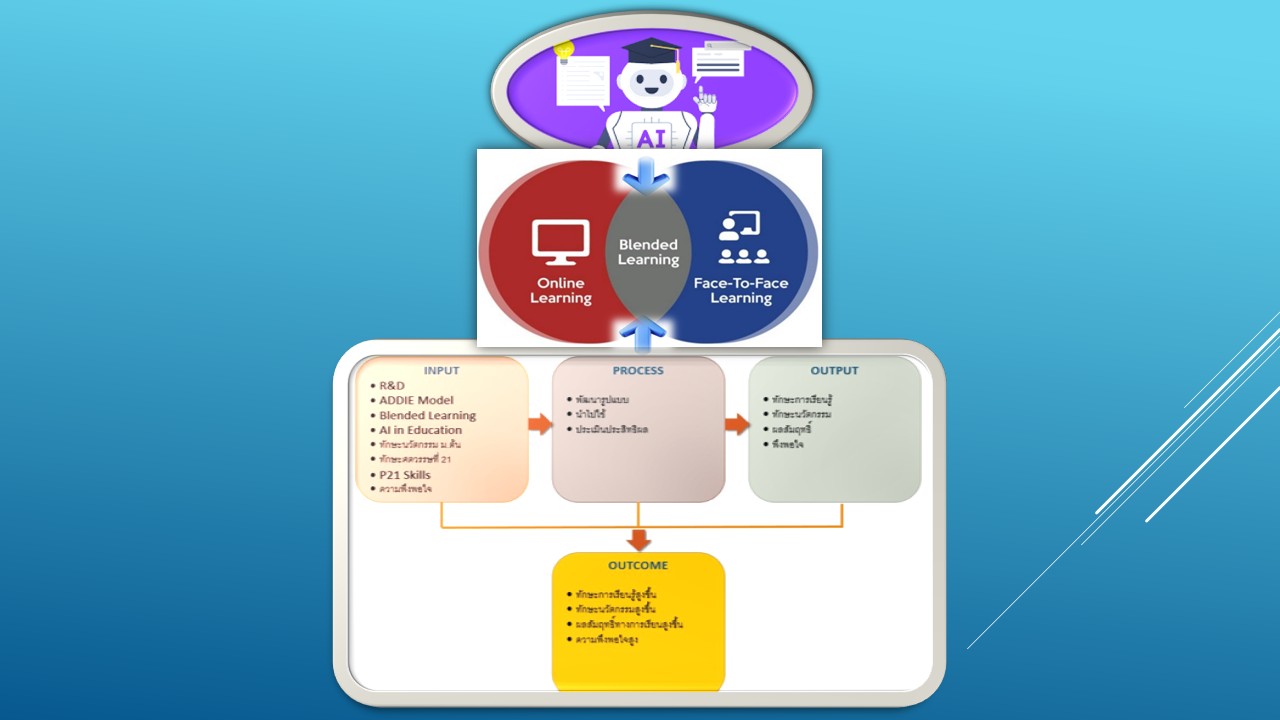
This research aimed to develop a blended learning model integrated with Artificial Intelligence (AI) to enhance learning and innovation skills among lower secondary school students. The specific objectives were: (1) to design and develop the blended learning model integrated with AI, (2) to evaluate students’ learning and innovation skills after implementing the model, (3) to compare students’ academic achievement in the Design and Technology subject before and after using the model, and (4) to assess students’ satisfaction with the developed instructional approach. The target population consisted of 501 Grade 8 students from Janokrong School, Phitsanulok Province, under the Secondary Educational Service Area Office Phitsanulok-Uttaradit, during the 2024 academic year. The sample group was purposively selected and consisted of 38 students from class 2.7. The data were analyzed using percentage, mean, standard deviation, and t-test. The findings revealed that the developed blended learning model integrated with AI was rated as highly appropriate. Students’ self-assessment of learning and innovation skills, based on the Basic Education Core Curriculum B.E. 2551 (A.D. 2008), improved from a moderate level before learning to a high level afterward. Their core competencies rose from a fair to an excellent level. The average academic achievement increased significantly from 32.05 to 52.26 after the intervention, with a statistically significant difference at the .05 level (t = 25.60). Furthermore, students expressed the highest level of satisfaction with the instructional model.
Keywords: Blended Learning, Artificial Intelligence, Learning and Innovation Skills, Secondary Education
Article Details

This work is licensed under a Creative Commons Attribution-NonCommercial-NoDerivatives 4.0 International License.
References
ประพรรธน์ พละชีวะ. (2550). การนำเสนอรูปแบบการเรียนแบบผสมผสานด้วยการเรียนรู้ร่วมกันในโครงงานวิทยาศาสตร์สำหรับการฝึกแก้ปัญหา ของนักเรียนชั้นมัธยมศึกษาปีที่ 1. โสตทัศนศึกษา, ครุศาสตร์มหาบัณฑิต หลักสูตรการสอน และเทคโนโลยีการศึกษา, จุฬาลงกรณ์มหาวิทยาลัย.
พรรณี ชูทัย เจนจิต. (2550). จิตวิทยาการเรียนการสอน (พิมพ์ครั้งที่ 5). กรุงเทพฯ: เมธีทิปส์.
วิชัย วงษ์ใหญ่. (2557). การพัฒนาหลักสูตรและการสอน: มิติใหม่ (พิมพ์ครั้งที่ 3). มหาวิทยาลัยศรีนครินทรวิโรฒ.
สำนักงานนวัตกรรมแห่งชาติ. (2563). แผนที่นำทางการส่งเสริมนวัตกรรมสำหรับประเทศไทย. กรุงเทพฯ: สำนักงานนวัตกรรมแห่งชาติ.
อนุศร หงษ์ขุนทด. (2561). การพัฒนารูปแบบการเรียนการสอนแบบผสมผสาน ตามแนวคิดทักษะการเรียนรู้แห่งศตวรรษที่ 21 โดยใช้กระบวนการเรียนรู้ด้วยโครงงาน เพื่อส่งเสริมทักษะการเรียนรู้และนวัตกรรม สำหรับนักเรียนชั้นมัธยมศึกษาตอนปลาย. นครราชสีมา: โรงเรียนด่านขุนทด.
Bloom, B.S. (Ed). (1956). Taxonomy of educational objectives: The classification of educational goals. Handbook I: Cognitive domain. Longmans, Green and Co.
Branch, R.M. (2009). Instructional design: The ADDIE approach. Springer Science & Business Media.
Cronbach, L. J. (1970). Essentials of psychological testing (3rd ed.). Harper & Row.
Fullan, M., & Langworthy, M. (2014). A rich seam: How new pedagogies find deep
learning. London: Pearson. Retrieved from https://www.michaelfullan.ca/wp-
content/uploads/2014/01/3897.Rich_Seam_web.pdf
Graham, C. R. (2012). Blended learning systems: Definition, current trends, and future directions. In C. J. Bonk & C. R. Graham (Eds.), The handbook of blended learning: Global perspectives, local designs (pp. 3-21). San Francisco,
Holmes, W., Bialik, M., & Fadel, C. (2019). Artificial Intelligence in Education: Promises and Implications for Teaching and Learning. Boston, MA: Center for Curriculum Redesign.
Kemp, J. E., Morrison, G. R., & Ross, S. M. (2011). Designing effective instruction
(6th ed.). John Wiley & Sons.
