
External Quality Assessment Model That Promotes Education Towards Excellence of Schools under Bangkok Metropolitan Administration
Article Sidebar
Main Article Content
Abstract
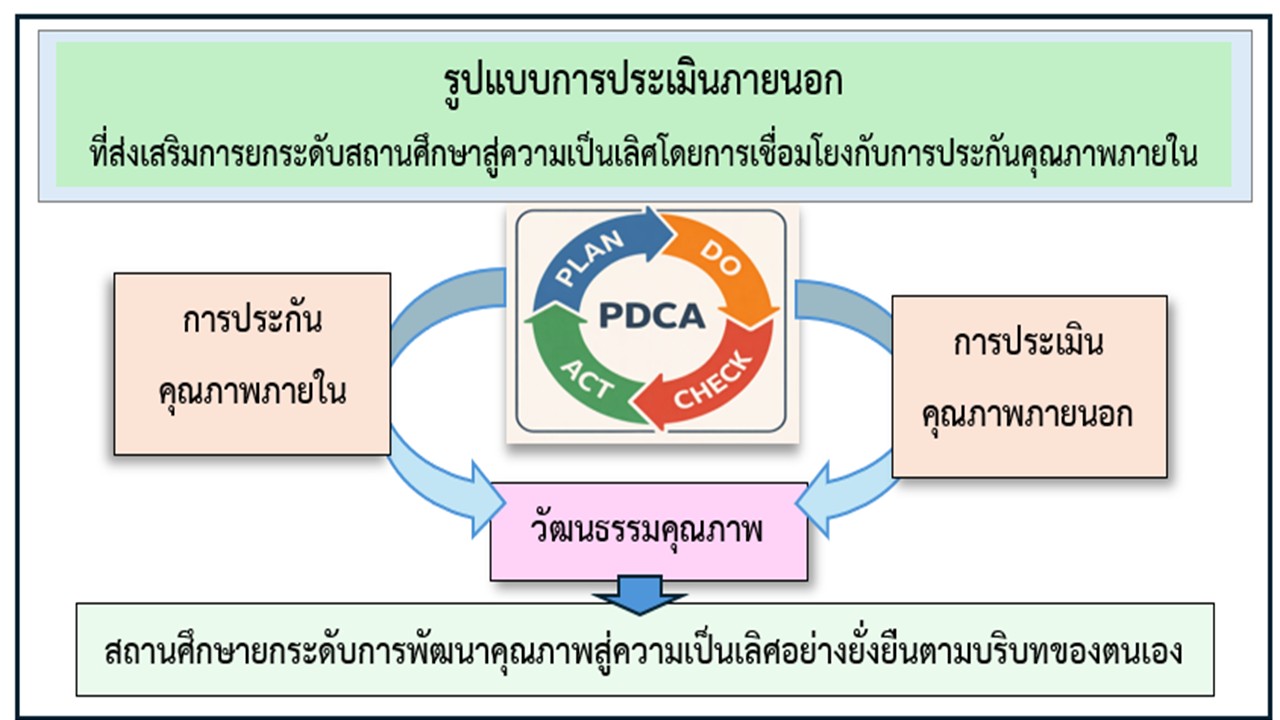
The objectives of this research were: 1) to develop an external quality assessment (EQA) model, and 2) to evaluate the quality of the developed model. The research methodology consisted of model development and quality evaluation. The sample and informants comprised two groups: experts for model evaluation and relevant stakeholders for a focus group discussion. The research instruments included a model evaluation form and focus group discussion protocols. Data were analyzed using descriptive statistics (mean and standard deviation) and content analysis. Research Findings: 1. The development of the EQA model resulted in the “External Quality Assessment Promoting Excellence - Bangkok Metropolitan Administration Schools” (EQAPEX-BMA) model. This model promotes excellence by integrating internal quality assurance through the P-D-C-A quality cycle, ultimately advancing the goal of a “Culture of Quality”. The core principles of the model include: the application of excellence development based on institutional context, utility-focused evaluation, responsiveness to diverse administrative management, and meta-evaluation. The model comprises three components: 1) Defining and developing school excellence, 2) Conducting external quality assessments, and 3) Utilizing EQA results to promote educational excellence. Furthermore, four critical success factors were identified as essential to achieving the assessment. 2. The evaluation of the model by experts—based on the criteria of utility, feasibility, propriety, accuracy, and accountability—revealed that its quality was at the highest level (Mean = 4.74). Furthermore, the model critique confirmed that the developed model is accurate, appropriate, and practical for implementation.
Keywords: External Quality Assessment, Excellence, Bangkok Metropolitan Administration School
Article Details

This work is licensed under a Creative Commons Attribution-NonCommercial-NoDerivatives 4.0 International License.
References
กระทรวงศึกษาธิการ. (2553). พระราชบัญญัติการศึกษาแห่งชาติ พ.ศ. 2542 และที่แก้ไขเพิ่มเติม (ฉบับที่ 2) พ.ศ. 2545 และ (ฉบับที่ 3) พ.ศ. 2553. โรงพิมพ์องค์การรับส่งสินค้าและพัสดุภัณฑ์ (ร.ส.พ.).
กลุ่มส่งเสริมการสื่อสารสังคม. (2566). สถานศึกษานำร่องในพื้นที่นวัตกรรมการศึกษา. สำนักงานบริหารพื้นที่นวัตกรรมการศึกษา. http://www.edusandbox.com
จตุพล ยงศร. (2566). การพัฒนาระบบการประเมินคุณภาพภายนอกโดยใช้กระบวนการอิงผู้มีส่วนได้ส่วนเสียเพื่อยกระดับคุณภาพอุดมศึกษาไทย. สำนักงานรับรองมาตรฐานและประเมินคุณภาพการศึกษา (องค์การมหาชน). http://www.onesqa.or.th/th/contentlist/1211
จันทร์สุดา บุตรชาติ. (2555). การพัฒนารูปแบบการประกันคุณภาพภายในสถานศึกษาขั้นพื้นฐานสังกัดสำนักงานเขตพื้นที่การศึกษาประถมศึกษาสกลนคร เขต 1. วารสารสหวิทยาการวิจัย ฉบับบัณฑิตศึกษา, 1(1), 96-104.
จุฬาลักษณ์ โสระพันธ์. (2565). แนวทางพัฒนาการประกันคุณภาพการศึกษาขั้นพื้นฐานตามแนวคิดการบริหารสถานศึกษาสู่การเป็นองค์การสมรรถนะสูงที่เสริมสร้างสมรรถนะผู้เรียนในโลกพลิกผัน. สำนักงานรับรองมาตรฐานและประเมินคุณภาพการศึกษา (องค์การมหาชน). http://www.onesqa.or.th/th/contentlist/1211
ทวิกา ตั้งประภา, ดวงใจ สีเขียว, & จุลศักดิ์ สุขสบาย. (2568). รูปแบบการประเมินคุณภาพภายนอกที่ส่งเสริมการศึกษาสู่ความเป็นเลิศของโรงเรียนในสังกัดกรุงเทพมหานคร (รายงานการวิจัย). กรุงเทพฯ.
บุญชม ศรีสะอาด. (2542). การวิจัยเบื้องต้น. ภาควิชาพื้นฐานการศึกษา คณะศึกษาศาสตร์ มหาวิทยาลัยมหาสารคาม.
พระเมธีปริยัติธาดา, พระมหาสิริวัฒนา สิริวัชรวรกุล, สิริกาญจน์ ธนวุฒิพรพินิต, & ชมพูนุช ช้างเจริญ. (2564). การประกันคุณภาพการศึกษา. วารสารครุศาสตร์ปริทรรศน์ฯ, 8(1), 375-389.
พระราชบัญญัติพื้นที่นวัตกรรมการศึกษา พ.ศ. 2562. (2562). ราชกิจจานุเบกษา.
สำนักงานรับรองมาตรฐานและประเมินคุณภาพการศึกษา (องค์การมหาชน). (2567). ประกาศคณะกรรมการสำนักงานรับรองมาตรฐานและประเมินคุณภาพการศึกษา เรื่อง กรอบแนวทางการประกันคุณภาพภายนอกสถานศึกษาการศึกษาปฐมวัย ระดับการศึกษาขั้นพื้นฐาน และด้านการอาชีวศึกษา (พ.ศ. 2567–2571) ฉบับปรับปรุงเพิ่มเติม.
https://www.onesqa.or.th/upload/download/202403261133169.pdf
สำนักการศึกษา. (2561). สำนักการศึกษา (สนศ): Department of Education, Bangkok Metropolitan Administration. http://www.oic.go.th/Ginfo/@dmin.asp
สุวิชญา สิริยานนท์, & รุ่งฤดี กล้าหาญ. (2564). การประเมินอภิมาน. วารสารการวัดผลการศึกษา, 38(104).
วารินทร์ สินสูงสุด. (2543). การประกันคุณภาพการศึกษา. สยามมิตรการพิมพ์.
วัชระ จตุพร. (2561). รูปแบบการประกันคุณภาพการศึกษาเชิงรุกเพื่อบริหารความเสี่ยงในศตวรรษที่ 21 ของสถานศึกษาขั้นพื้นฐาน. สำนักงานรับรองมาตรฐานและประเมินคุณภาพการศึกษา (องค์การมหาชน). http://www.onesqa.or.th/th/contentlist/1211
Arellano, A., Halsall, T., Forneris, T., & Gaudet, C. (2018). Results of a utilization-focused evaluation of a Right To Play program for Indigenous youth. Evaluation and Program Planning, 66, 156–164. https://doi.org/10.1016/j.evalprogplan.2017.08.001
Hakkola, L., Allan, E. J., & Kerschner, D. (2019). Applying utilization-focused evaluation to high school hazing prevention: A pilot intervention. Evaluation and Program Planning, 75, 61–68. doi: 10.1016/j.evalprogplan.2019.05.005
Patton, M. Q. (2008). Utilization-focused evaluation (4th ed.). London: Sage Publication, Inc.
Quality Assurance Agency for Higher Education (QAA). (2017). Quality Assurance Handbook. QAA. https://www.qaa.ac.uk/
Ramírez, R., & Brodhead, D. (2013). Utilization focused evaluation: A primer for evaluators. Penang, Malaysia: Southbound.
Stufflebeam, D. L. (2001). The meta evaluation imperative. American Journal of Evaluation, 22(2), 183–209. https://doi.org/10.1177/109821400102200203
Wu, J., et al. (2025). Utilization-focused evaluation in state-funded preschool decision-making: Community-engaged design, process, and implementation. Journal of Community Engagement and Scholarship, 18(1), 1-13.
