
ปัจจัยที่ส่งผลต่อการยอมรับเทคโนโลยี ChatGPT ในบริษัท ฮิวแมนิก้า จำกัด
Article Sidebar
Main Article Content
บทคัดย่อ
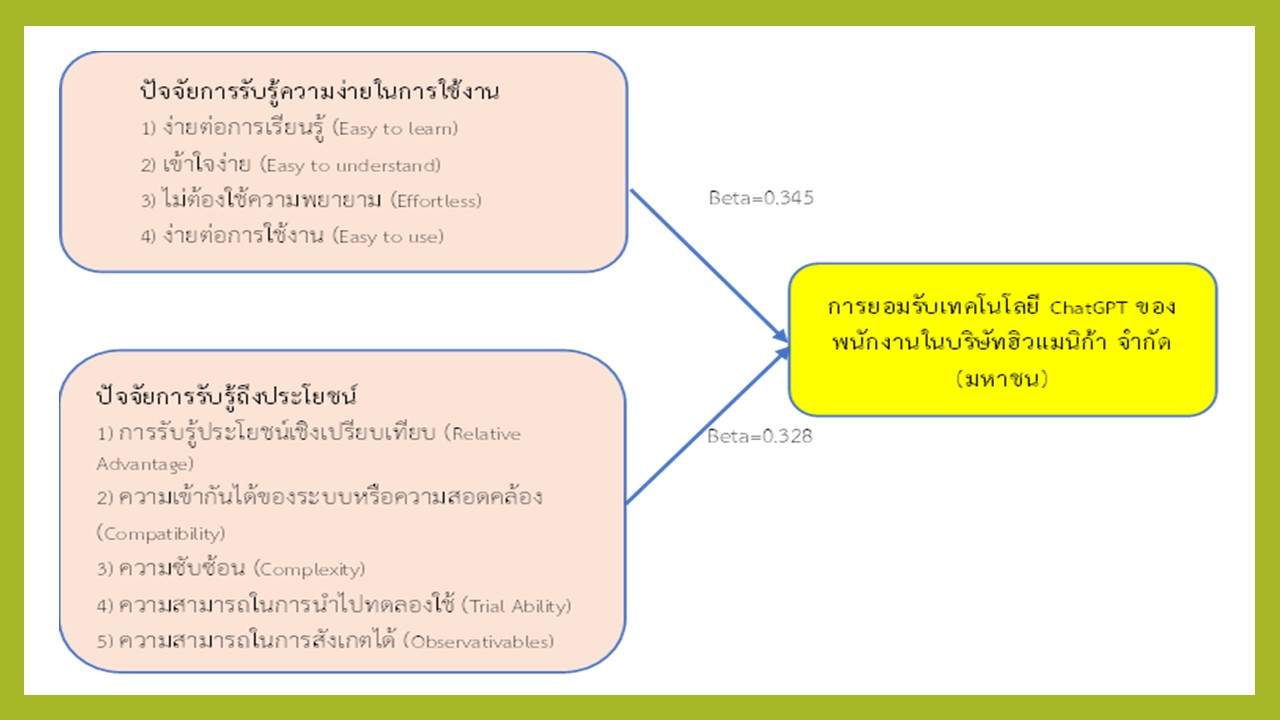
การศึกษาเรื่อง ปัจจัยที่ส่งผลต่อการยอมรับเทคโนโลยี ChatGPT กรณีศึกษาบริษัท ฮิวแมนิก้าจำกัด (มหาชน) มีวัตถุประสงค์ในการวิจัย ได้แก่ (1) เพื่อศึกษาลักษณะการยอมรับเทคโนโลยี ChatGPT ของพนักงานในบริษัท ฮิวแมนิก้า จำกัด (มหาชน) (2) เพื่อศึกษาปัจจัยการรับรู้ความง่ายต่อการใช้งาน และการรับรู้ถึงประโยชน์ ChatGPT ของพนักงานในบริษัท ฮิวแมนิก้า จำกัด (มหาชน) (3) เพื่อศึกษาปัจจัยที่ส่งผลต่อการยอมรับการใช้ ChatGPT ของพนักงานในบริษัท ฮิวแมนิก้า จำกัด (มหาชน) กลุ่มตัวอย่างที่ใช้ในการวิจัยในครั้งนี้ คือ พนักงานบริษัทบริษัท ฮิวแมนิก้า จำกัด (มหาชน) จำนวน 228 คน เครื่องมือที่ใช้ในการศึกษาได้แก่ แบบสอบถาม สถิติที่ใช้ในการวิเคราะห์ได้แก่ ความถี่ ร้อยละ ค่าเฉลี่ย ค่าเบี่ยงเบนมาตรฐาน การทดสอบ t-test การวิเคราะห์ความแปรปรวน (ANOVA) การวิเคราะห์ถดถอยพหุคูณ ผลการศึกษาพบว่า 1) การรับรู้ความง่ายในการใช้งานของ ChatGPT ในบริษัท ฮิวแมนิก้าจำกัด (มหาชน) ภาพรวม พบว่า อยู่ในระดับมาก 2) การรับรู้ถึงประโยชน์ ChatGPTในบริษัท ฮิวแมนิก้า จำกัด (มหาชน) ภาพรวม พบว่า อยู่ในระดับมาก 3) ลักษณะการยอมรับเทคโนโลยี ChatGPT ในบริษัท ฮิวแมนิก้า จำกัด (มหาชน) พบว่า ภาพรวมอยู่ในระดับมาก 4) บุคลากรที่มีเพศ อายุ การศึกษา ประสบการณ์การทำงาน รายได้ต่อเดือน และฝ่ายงานที่แตกต่างกันมีการยอมรับการใช้ ChatGPT ของพนักงานในบริษัท ฮิวแมนิก้า จำกัด (มหาชน) ไม่แตกต่างกันที่ระดับนัยสำคัญ 0.05 5) ปัจจัยการรับรู้ความง่ายในการใช้งาน และปัจจัยการรับรู้ถึงประโยชน์ สามารถร่วมกันอธิบายการยอมรับการใช้ ChatGPT ของพนักงานในบริษัท ฮิวแมนิก้า จำกัด (มหาชน) ได้ร้อยละ 35.50 (Adj. R2 = 0.355) โดยปัจจัยการรับรู้ความง่ายในการใช้งาน และปัจจัยการรับรู้ถึงประโยชน์ ส่งผลอย่างมีนัยสำคัญทางสถิติที่ระดับ 0.01
คำสำคัญ: การยอมรับเทคโนโลยี, การรับรู้ความง่าย, การรับรู้ถึงประโยชน์, ChatGPT
Article Details

อนุญาตภายใต้เงื่อนไข Creative Commons Attribution-NonCommercial-NoDerivatives 4.0 International License.
เอกสารอ้างอิง
ชีวรัตน์ ชัยสำโรง. (2561). การยอมรับเทคโนโลยีการเรียนภาษาผ่านแอปพลิเคชันออนไลน์ของผู้บริโภคในเขตกรุงเทพมหานครและปริมณฑล [วิทยานิพนธ์ปริญญามหาบัณฑิต, มหาวิทยาลัยธรรมศาสตร์]. คณะพาณิชยศาสตร์และการบัญชี. http://ethesisarchive.library.tu.ac.th/thesis/2018/TU_ 2018_6002030259_9845_9783.pdf
ดวงพร รัดสินทร. (2562). การรับรู้เทคโนโลยีที่มีผลต่อความตั้งใจใช้บริการการชำระเงินผ่านคิวอาร์โค้ดของผู้บริโภคในเขตกรุงเทพมหานคร [วิทยานิพนธ์ปริญญามหาบัณฑิต, มหาวิทยาลัยศรีนครินทรวิโรฒ]. คณะวิทยาศาสตร์. https://so03.tci-thaijo.org/index.php/JMND/article/view/277526
นวพรรษ จันทร์คำ. (2568). การพัฒนาแพลตฟอร์มแนะแนวการศึกษาอัจฉริยะด้วย AI Chatbot เพื่อส่งเสริมการประชาสัมพันธ์หลักสูตรเทคโนโลยีและสื่อสารการศึกษา. วารสารมนุษยศาสตร์และสังคมศาสตร์ มหาวิทยาลัยนครพนม, 15(1), 214–228. https://so03.tci-thaijo.org/index.php/npuj
ปิยะ ขุนทองเอก. (2566). ปัจจัยที่ส่งผลต่อการยอมรับการใช้งาน ChatGPT ในธุรกิจ [ออนไลน์]. เข้าถึงได้จาก https://kip.kmitl.ac.th/projects/cln8rfkeo00p6qn9yy2b5x6s0
วรรณิดา กอเงินกลาง. (2567). ปัจจัยที่มีอิทธิพลต่อการยอมรับและพฤติกรรมการใช้งานปัญญาประดิษฐ์แชทจีพีทีอย่างต่อเนื่อง. วารสารมหาจุฬานาครทรรศน์, 11(2), 120–129. https://so03.tci-thaijo.org/index.php/JMND/article/download/275311/182358/1124555
ศูนย์เทคโนโลยีสารสนเทศและการสื่อสาร. (2564). รายงานเทคโนโลยีสารสนเทศและการสื่อสารประจำปี 2564. กระทรวงดิจิทัลเพื่อเศรษฐกิจและสังคม.
สุพัตรา เพชรศรี. (2566). ทัศนคติ ความตั้งใจ และพฤติกรรมการใช้ ChatGPT ในบริบทด้านการทำงานของGeneration Y [วิทยานิพนธ์เศรษฐศาสตรมหาบัณฑิต, มหาวิทยาลัยธรรมศาสตร์]. คณะเศรษฐศาสตร์. https://digital.library.tu.ac.th/tu_dc/frontend/Info/item/dc:315807
Abeer S. Almogren. (2024). Exploring factors influencing the acceptance of ChatGPT in higher education: A smart education perspective. Heliyon, 10, e31887. https://doi.org/10.1016/j.heliyon.2024.e31887
Aggelidis, V. P., & Chatzoglou, P. D. (2016). Using a modified technology acceptance model in hospitals. International Journal of Medical Informatics, 78(2), 115–126. https://doi.org/10.1016/j.ijmedinf.2015.12.003
Amaro, S., & Duarte, P. (2015). An integrative model of consumers’ intentions to purchase travel online. Tourism Management, 46, 64–79. https://doi.org/10.1016/j.tourman.2014.06.006
Davis, F. D. (1989). Perceived usefulness, perceived ease of use, and user acceptance of information technology. MIS Quarterly, 13(3), 319–340. https://doi.org/10.2307/249008
George, A.S., et al. (2023). A review of ChatGPT AI’s impact on several business sectors. Partners Universal International Innovation Journal, 1(1), 9–23. https://doi.org/10.5281/zenodo.7644359
Hart, O. A., Nwibere, B. M., & Inyang, B. J. (2015). Demographic determinants of electronic commerce (EC) adoption by SMEs: A twist by location factors. Journal of Enterprise Information Management, 28(3), 326–345. https://doi.org/10.1108/JEIM-05-2013-0027
Junadi, S. (2015). A model of factors influencing consumer’s intention to use e-payment system in Indonesia. Procedia Computer Science, 59, 214–220. https://doi.org/10.1016/j.procs.2015.07.557
Keng-Boon Ooi; Garry Wei-Han Tan. (2025). Mobile Technology Acceptance Model: An Investigation Using Mobile Users to Explore Smartphone Credit Card. Expert Systems with Applications, 59, 33–46. https://doi.org/10.1016/j.eswa.2016.04.015
Latinovic, Z., & Chatterjee, A. (2022). Achieving the promise of AI and ML in delivering economic and relational customer value in B2B. Journal of Business Research, 144, 966–974. https://doi.org/10.1016/j.jbusres.2022.01.052
Neuendorf, K. A., & Valdiseri, J. (2016). Content analysis in communication research. Journal of Communication Research, 5(1), 35–48.
Ni Putu Cempaka Dharmadewi Atmaja, Ni Made Dwi Puspitawati. (2022). Antecedents of using electronic money application on technology communication during covid-19 pandemic. International Journal of Communication and Society, 4(1), 72–81. https://doi.org/10.31763/ijcs.v4i1.418
Ooi, K. B., & Tan, G. W. H. (2016). Mobile technology acceptance model: An empirical study. Journal of Mobile Communication Studies, 7(3), 112–129.
Park, S. Y. (2010). An analysis of the technology acceptance model in understanding university students' behavioral intention to use e-learning. Educational Technology & Society, 13(3), 150–162. https://www.researchgate.net/publication/220374248
Puspitasari, R., Widayanto, A., & Nugraha, R. (2021). Digital transformation in banking: Adoption and impact on customer experience. Journal of Digital Business Research, 8(2), 203–219.
Sadi, M. A., & Noordin, M. F. (2011). Factors influencing the adoption of e-commerce: A study on Saudi SMEs. Journal of Internet Commerce, 10(2), 127–154. https://doi.org/10.1080/15332861.2011.558456
Venkatesh, V. (2000). Determinants of perceived ease of use: Integrating perceived behavioral control, computer anxiety and enjoyment into the technology acceptance model. Information Systems Research, 11, 342–365. https://doi.org/10.1287/isre.11.4.342.11872
Zhang, X., Li, Y., & Wang, J. (2014). The role of trust in e-commerce adoption: A meta-analysis. Journal of Business Research, 9(4), 134–156.
Zuniarti, A., Hidayat, R., & Wibowo, A. (2021). Understanding consumer behavior in digital payment adoption. Journal of Economics & Business Innovation, 7(2), 99–115.
