
Transformational Leadership of Teachers in a Private School in Samut Prakan Province
Article Sidebar
Main Article Content
Abstract
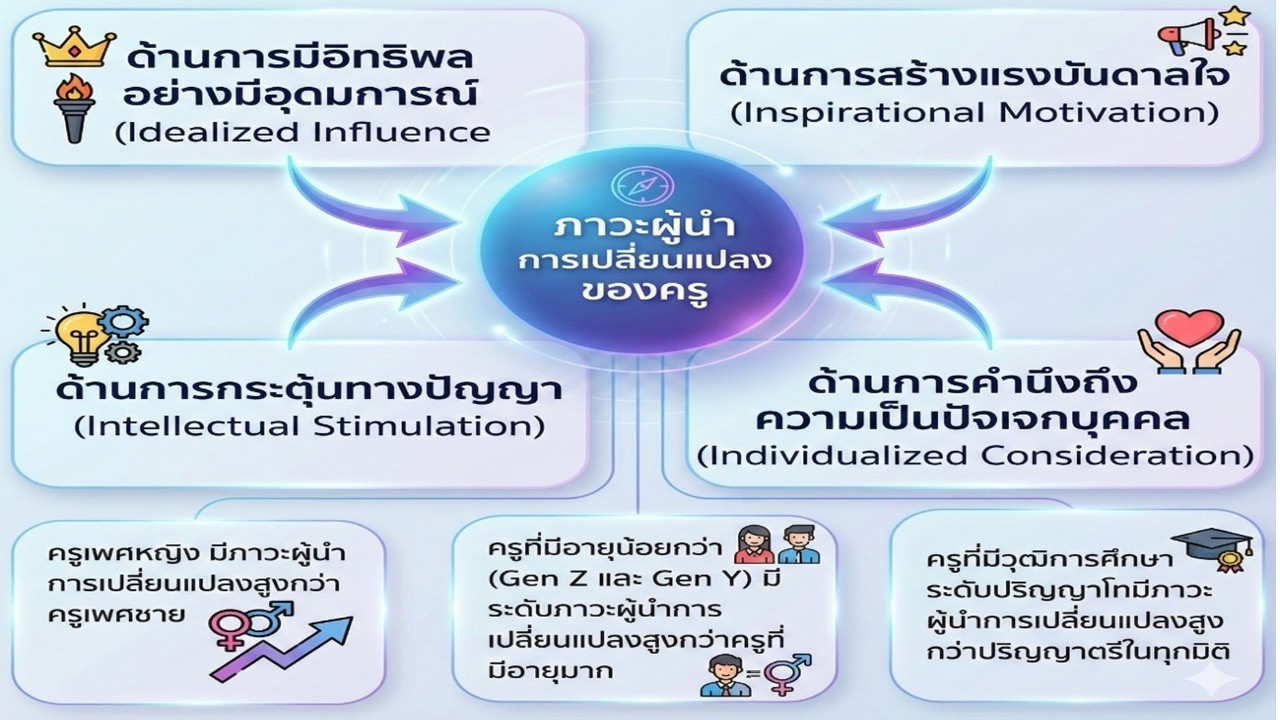
The objective of this research was to examine and compare the levels of transformational leadership among teachers, classified by gender, age, current position, educational background, and work experience, using a quantitative research methodology. Data were collected from a sample of 113 teachers at a private school in Samut Prakan province using stratified random sampling. The instrument used was a 5-point rating scale questionnaire with an overall reliability coefficient of 0.85. Data were analyzed using t-test, One-way ANOVA, and Scheffé's pairwise comparison test. The research findings revealed that the transformational leadership of teachers, both overall and in individual aspects, was at a high level. Specifically, the aspect of Individualized Consideration had the highest mean, followed by Inspirational Motivation, Idealized Influence, and Intellectual Stimulation, respectively. Upon comparing the variables, statistically significant differences were found at the 0.05 level; that is, female teachers exhibited higher leadership than male teachers; teachers of different ages possessed different leadership levels, with the age group under 30 years having the highest mean; and teachers with a Master’s degree scored higher than those with a Bachelor’s degree. In contrast, the variables of current position and work experience showed no statistical differences.
Keywords: Transformational Leadership, Private School Teachers, Samut Prakan, Group Comparison
Article Details

This work is licensed under a Creative Commons Attribution-NonCommercial-NoDerivatives 4.0 International License.
References
กระทรวงศึกษาธิการ. (2568). รมว.ศธ.แถลงนโยบายการศึกษา “เรียนดีมีความสุข”. https://www.moe.go.th/law-7-2568/?name&sf_paged=19
จารุวรรณ นูสา และสิทธิชัย สอนสุภี. (2564). องค์ประกอบภาวะผู้นำการเปลี่ยนแปลงของผู้บริหารสถานศึกษา สังกัดสำนักงานเขตพื้นที่การศึกษาประถมศึกษาหนองคาย เขต 2. การประชุมวิชาการเสนอผลงานวิจัยระดับบัณฑิตศึกษาแห่งชาติ ครั้งที่ 22 (902-911). ขอนแก่น: มหาวิทยาลัย ขอนแก่น.
ชณันภัสร์ ปิยะภัทรวิรัตน์. (2563). ภาวะผู้นำการเปลี่ยนแปลงของผู้บริหารสถานศึกษาสังกัดสำนักบริหารงานการศึกษาพิเศษจังหวัดยะลา (ปริญญาศึกษาศาสตรมหาบัณฑิต). บัณฑิตวิทยาลัย มหาวิทยาลัยราชภัฏยะลา.
ชูขวัญ รัตนพิทักษ์ธาดา และประทุมทอง ไตรรัตน์. (2566). สมรรถนะของผู้นำทางการศึกษาเพื่อการอยู่รอดและเติบโตในยุค BANI World. วารสารวิชาการสถาบันวิทยาการจัดการแห่งแปซิฟิค, 9(1), 16-28.
ดวงพร ธนังธีรพงษ์. (2564). ความสัมพันธ์ระหว่างภาวะผู้นำการเปลี่ยนแปลงของผู้บริหารกับการบริหารสถานศึกษาตามทัศนะของครูสังกัดสำนักงานเขตพื้นที่การศึกษาประถมศึกษาสงขลา เขต 3 (วิทยานิพนธ์ศึกษาศาสตรมหาบัณฑิต) บัณฑิตวิทยาลัย มหาวิทยาลัยหาดใหญ่).
ทรงกลด เจนจิรวรกานต์. (2563). ภาวะผู้นำการเปลี่ยนแปลงของครูที่ ส่งผลต่อชุมชนแห่งการเรียนรู้ทางวิชาชีพในสถานศึกษา สังกัดสำนักงานเขตพื้นที่การศึกษามัธยมศึกษา กรุงเทพมหานคร เขต 2 (ปริญญานิพนธ์การศึกษามหาบัณฑิต). คณะศึกษาศาสตร์ มหาวิทยาลัยศรีนครินทรวิโรฒ.
บุญชม ศรีสะอาด. (2545). การวิจัยเบื้องต้น (พิมพ์ครั้งที่ 7). กรุงเทพฯ: สุวีริยาสาส์น.
ผกามาศ บัวพงษ์ . (2564). ภาวะผู้นำของครูและสภาพแวดล้อมในการทำงานที่มีอิทธิพลต่อประสิทธิภาพในการปฏิบัติงานของครูในระดับมัธยมศึกษา (วิทยานิพนธ์บริหารธุรกิจมหาบัณฑิต). บัณฑิตวิทยาลัยมหาวิทยาลัยเทคโนโลยีราชมงคลธัญบุรี.
พระครูปลัดปริยัติวัฒน์ (ไพชน สิริธมฺโม). (2564). ภาวะผู้นำการเปลี่ยนแปลงการศึกษายุคใหม่. วารสารอนัมนิกาย, 1(2), 1-7.
วัชรพล ยงวณิชย์. (2566). เมื่อครูเป็นหนี้: การศึกษารูปแบบ โครงสร้างและวงจรหนี้สินข้าราชการครู ผ่านการวิเคราะห์กลไกระบบราชการ (วิทยานิพนธ์รัฐศาสตรดุษฎีบัณฑิต). คณะรัฐศาสตร์ จุฬาลงกรณ์มหาวิทยาลัย.
สำนักงานเขตพื้นที่การศึกษาประถมศึกษาสมุทรปราการ เขต 1. การประเมินสถานศึกษา. สมุทรปราการ: กลุ่มนโยบายและแผน.
สุจิตรา ทิพย์บุรี, โสภณ ขำทัพ และเกศริน มนูญผล. (2564). ปัญหาและอุปสรรคในการบริหารจัดการโรงเรียนอนุบาลเอกชนของผู้บริหารในสังกัดสำนักงานศึกษาธิการจังหวัดนนทบุรีตามนโยบายไทยแลนด์ 4.0.วารสารพุทธสังคมวิทยาปริทรรศน์, 6(4), 109-123.
Bass, B.M. & Avolio, B.J. (1994). Transformational leadership development: Manual for the multifactor leadership questionnaire. Palo Alto CA: Consulting Psychologists Press.
Bass, B.M. & Riggio, R.E. (2006). Transformational Leadership (2ndEdition). New York: Psychology Press.
Kirschner, P.A. & De Bruyckere, P. (2017). The myths of the digital native and the multitasker. Teaching and Teacher Education, 67, 135-142.
Krejcie, R.V., & Morgan, D.W. (1970). Determining Sample Size for Research Activities. Educational and Psychological Measurement, 30(3), 607-610.
Patel, A., Van der Merwe, J., & Martinez, S. (2024). A Critical literature Review of Age and Leadership: from two different perspectives including age and age difference. PSSA, 2(1), 1-20.
