
A Study of the Components of Brain-Based Learning Instructional Process
Article Sidebar
Main Article Content
Abstract
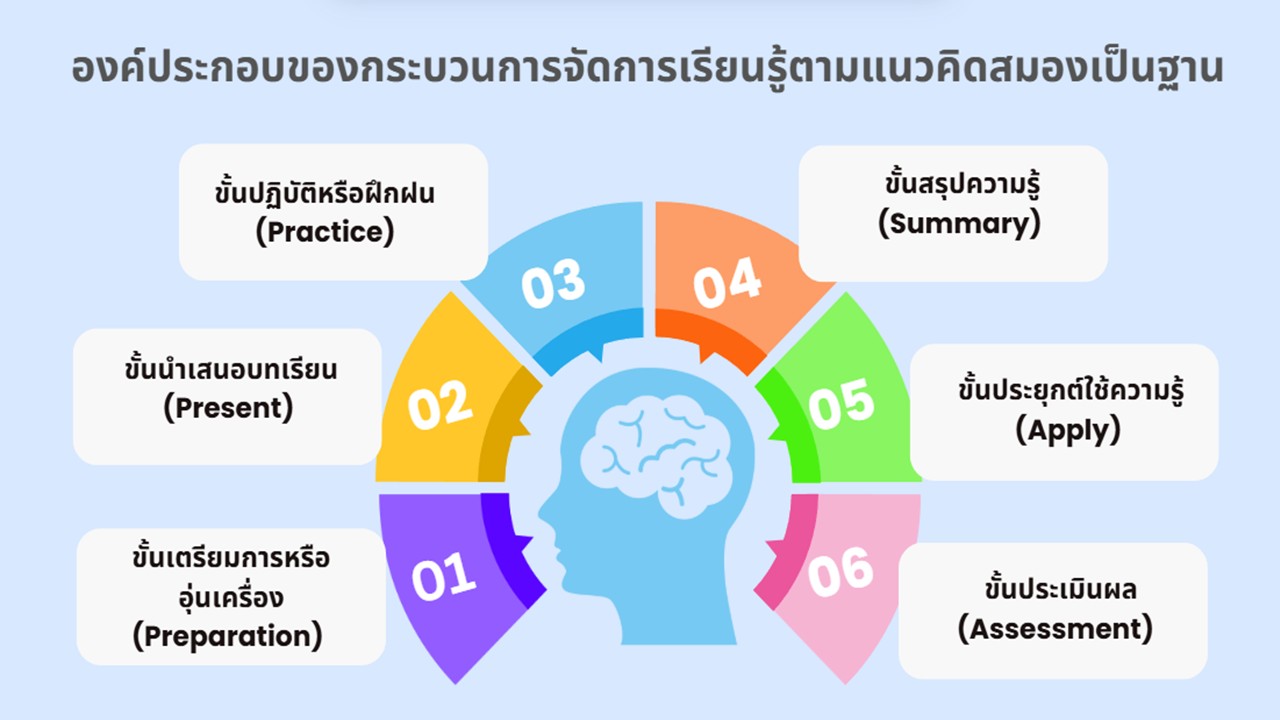
The objectives of this research were to investigate the components of the brain-based learning (BBL) instructional process. The study was divided into two phases. Phase 1 involved synthesizing the components of brain-based learning from ten relevant documents and research studies. Phase 2 examined the appropriateness of these components as evaluated by five experts, including university instructors in Thai language teaching, award-winning Thai language teachers, and educational supervisors. The research instruments included a document synthesis form and a five-point Likert-scale questionnaire. Data were analyzed using frequency, percentage, mean, and standard deviation. The research findings revealed that the brain-based learning instructional process comprised six components: (1) Preparation, (2) Presentation, (3) Practice, (4) Summary, (5) Application, and (6) Assessment. The overall appropriateness of these components, as evaluated by experts, was at the highest level. When considering each component individually, the highest mean scores were found in the following order: Summary, Application, Assessment, Practice, and Preparation, while the lowest mean score was in the Presentation component.
Keywords: Process, Learning Instruction, Brain-Based Learning
Article Details

This work is licensed under a Creative Commons Attribution-NonCommercial-NoDerivatives 4.0 International License.
References
กุสุมา คำผาง. (2559). ผลของการจัดการเรียนการสอนเขียนสะกดคำภาษาไทยโดยใช้สมองเป็นฐานที่มีต่อทักษะ
การเขียนสะกดคำของนักเรียนในระดับชั้นประถมศึกษา.วิทยานิพนธ์ ค.ม. กรุงเทพมหานคร:
จุฬาลงกรณ์มหาวิทยาลัย.
ทรายแพรว ไชยมัชชิม. (2563). การพัฒนากิจกรรมการเรียนรู้วิทยาศาสตร์ตามแนวคิดการใช้สมองเป็นฐานร่วมกับการสอนแบบสืบเสาะหาความรู้ (5Es) เรื่องน้ำเพื่อชีวิตและอากาศรอบตัวเรา กลุ่มสาระการเรียนรู้วิทยาศาสตร์ สำหรับนักเรียนชั้นประถมศึกษาปีที่ 3. วิทยานิพนธ์ ค.ม. สกลนคร: มหาวิทยาลัยราชภัฏสกลนคร.
ธัญญรัตน์ อุยโต. (2561). การพัฒนาทักษะการเขียนกลุ่มสาระการเรียนรู้ภาษาไทยโดยการจัดการเรียนรู้แบบใช้สมอง
เป็นฐานของนักเรียนชั้นประถมศึกษาปีที่ 3. วิทยานิพนธ์ กศ.ม. กรุงเทพ: มหาวิทยาลัยศรีนครินทรวิโรฒ.
บุญชม ศรีสะอาด. (2560). หลักการวิจัยเบื้องต้น. พิมพ์ครั้งที่ 10. กรุงเทพฯ : สุวิริยาสาส์น.
พรพิไล เลิศวิชา. (2558). การพลิกโฉมโรงเรียน ป.1 อ่านออกเขียนได้ใน 1 ปี. กรุงเทพมหานคร: โรงพิมพ์
ชุมนุมสหกรณ์การเกษตรแห่งประเทศไทย.
ภัทราพร ทำคาม. (2560). การพัฒนาทักษะการคิดวิเคราะห์และผลสัมฤทธิ์ทางการเรียนคณิตศาสตร์ของ
นักเรียนชั้นประถมศึกษาปีที่ 6 ด้วยการจัดการเรียนรู้โดยใช้สมองเป็นฐาน (BBL) ร่วมกับแผนผังความคิด. วิทยานิพนธ์ ศษ.ม. ปทุมธานี: มหาวิทยาลัยราชภัฏวไลยอลงกรณ์.
ภาวิณี ศรีทอง. (2563). การจัดการเรียนรู้โดยใช้สมองเป็นฐาน: กลไกใหม่ของการพัฒนาผู้เรียน.วารสารวิชาการ
ครุศาสตร์, 1(2), 55-68.
รัตนาภรณ์ บุราญรมย์ และ วายุ กาญจนศร. (2566). ผลของการจัดการเรียนรู้โดยใช้สมองเป็นฐาน (Brain-Based
Learning: BBL) ต่อผลสัมฤทธิ์ทางการเรียนและการคิดเชิงวิเคราะห์. ในรายงานสืบเนื่องจากการประชุม
วิชาการระดับชาติ มหาวิทยาลัยขอนแก่น (น. 1-10). มหาวิทยาลัยขอนแก่น.
วทันยา กฤตติกานนท์. (2562). การศึกษาผลสัมฤทธิ์ทางการเรียนและความสามารถในการสื่อสารทางคณิตศาสตร์
ของนักเรียนชั้นประถมศึกษาปีที่ 3 โดยการจัดการเรียนรู้แบบการใช้สมองเป็นฐาน (BBL) ร่วมกับเทคนิค STAD. วิทยานิพนธ์ ค.ม. ปทุมธานี: มหาวิทยาลัยราชภัฏวไลยอลงกรณ์ ในพระบรมราชูปถัมภ์.
อนุตรศักดิ์ วิชัยรัตน์. (2566). การพัฒนารูปแบบการเรียนการสอนภาษาไทยตามแนวคิดการเรียนรู้โดยใช้สมอง
เป็นฐานร่วมกับแนวคิดสมดุลภาษา สำหรับนักเรียนชั้นประถมศึกษาปีที่ 1. วิทยานิพนธ์ ปร.ด. สกลนคร:
มหาวิทยาลัยราชภัฏสกลนคร.
อัจฉรา ใจสุต๊ะ. (2562). การพัฒนาหลักสูตรส่งเสริมความสามารถการอ่านภาษาไทยตามหลักการเรียนรู้โดยใช้
สมองเป็นฐาน สำหรับนักเรียนชั้นประถมศึกษาปีที่ 1. วิทยานิพนธ์ ค.ม. ลำปาง: มหาวิทยาลัยราชภัฏลำปาง.
อรเกษม ศรีเวียง. (2561). การพัฒนาผลสัมฤทธิ์ทางการเรียน และการคิดวิเคราะห์ กลุ่มสาระการเรียนรู้วิทยาศาสตร์ เรื่องพลังงานความร้อน ชั้นมัธยมศึกษาปีที่ 1 ด้วยการจัดการเรียนรู้โดยใช้สมองเป็นฐาน. วิทยานิพนธ์ ค.ม. ชัยภูมิ: มหาวิทยาลัยราชภัฏชัยภูมิ.
Caine, R. N., & Caine, G. (1991). Making Connections: Teaching and the Human Brain. Virginia: ASCD.
Call, N. (2003). The Thinking Child: Brain-based Learning for the Foundation stage.Stafford: Network Educational Press.
D’Arcangelo, M. (2005). The brain at school: Educational neuroscience in the classroom. Educational Leadership, 62(7), 14-19.
Immordino-Yang, M. H., & Damasio, A. (2007). We feel, therefore we learn: The relevance of affective and social neuroscience to education. Mind, Brain, and Education, 1(1), 3–10. https://doi.org/10.1111/j.1751-228X.2007.00004.x
Jensen, E. (2000). Brain-based Learning. San Diego, CA: The Brain Store Publishing.
Jensen, E. (2017). Teaching with the brain in mind (3rd ed.). ASCD.
OECD. (2018). The Future of Education and Skills: Education 2030. OECD Publishing.
Sousa, D. A. (2017). How the brain learns (5th ed.). Corwin Press.
Tokuhama‑Espinosa, T. (2011). Mind, Brain, and Education Science: A Comprehensive Guide to the New Brain-based Teaching. New York: W. W. Norton & Company.
