
Guidelines for the Development of Transformational Leadershipof School Administrators under the Office of Khon Kaen Primary Educational Service Area Office 2
Article Sidebar
Main Article Content
Abstract
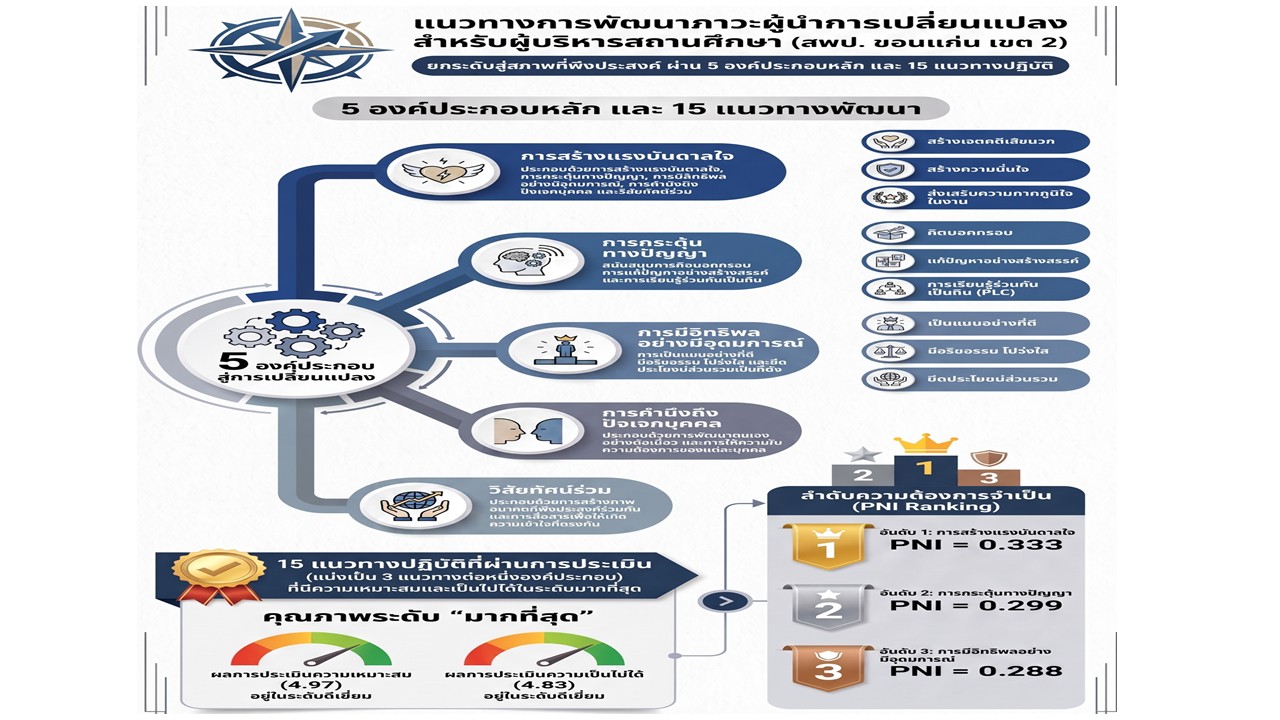
The objectives of this study were: 1) to examine the current conditions, desirable conditions, and needs regarding transformational leadership among school administrators. Affiliated to the Khon Kaen Primary Education Area Office, District 2, and 2) Study on the Transformational Leadership Development Guidelines of School Administrators Affiliated to the Khon Kaen Primary Education Area Office, District 2 is a mixed-methods research. The research is divided into 2 phases: Phase 1 examines the current and desirable conditions, as well as the needs for transformational leadership among school administrators. Affiliated with the Khon Kaen Primary Education Area Office, District 2, the sample group for this study comprises the directors of educational institutions. 325 teachers affiliated to the Khon Kaen Primary Education Area Office, District 2.Sample Size) According to the table. Krejcie and Morgan: Using specific selection methods and random stratification of landscapes. The tools used in the study included estimator questionnaires with 5 levels and dual-response characteristics. The data analysis had a confidence of 0.931. Essential Demand Priority Index (PNI-modified) and Content Analysis, Phase 2: studying the transformational leadership development approach of school administrators affiliated with the Khon Kaen Primary Education Area Office, District 2, through interviews with qualified individuals. 9 people evaluated the guidelines by qualified people. 12 people were selected by a specific selection. The tools used in the study were a semi-structured interview form and an assessment of the suitability and feasibility of the transformational leadership development approach of school administrators. The statistics used in the data analysis were frequency, percentage, mean, standard deviation, and techniques. Modified priority Needs index. In prioritizing the needs of the need. The results of the study showed that 1) the current situation of the change leadership of school administrators affiliated to the Khon Kaen Primary Education Area Office, Khon Kaen District 2, overall and individually, the average is at a high level. The desirable condition of the transformational leadership of school administrators affiliated to the Khon Kaen Primary Education Area Office, Khon Kaen District 2, overall and individual. The average value is at the highest level. 2) Guidelines for the development of transformational leadership of school administrators affiliated with the Khon Kaen Primary Education Area Office, District. 2. Yes, 5 Composition 15 Guidelines. Appropriateness and possibilities are at the highest level. By sorting according to the detailed requirements. As follows: 1. Inspiration: There are 3 approaches. 2. Cognitive stimulation: There are 3 approaches. 3. In terms of ideological influence, there are 3 approaches. 4. Individuality: There are 3 approaches, and 5. 3 Guidelines
Keywords: Development Guidelines, Transformational Leadership, School Administrators
Article Details

This work is licensed under a Creative Commons Attribution-NonCommercial-NoDerivatives 4.0 International License.
References
กระแส ชนะวงศ์. (2566). นวัตกรรมภาวะผู้นำการเปลี่ยนแปลงของ ศาสตราจารย์ ดร. นพ. กระแส ชนะวงศ์. วารสารวิทยาลัยบัณฑิตเอเซีย, 13(3), 45-55.
ชาญชัย อาจินสมาจาร. (2555). การบริหารการเปลี่ยนแปลงและการพัฒนาองค์การ. ชานเมืองการพิมพ์. (APA 7 ตัดชื่อจังหวัดออก)
ชีวิน อ่อนลออ. (2553). การพัฒนาตัวบ่งชี้ภาวะผู้นำการเปลี่ยนแปลงของผู้บริหารมหาวิทยาลัยเอกชนในประเทศไทย [วิทยานิพนธ์ปริญญาดุษฎีบัณฑิต, มหาวิทยาลัยขอนแก่น].
ชีวิน อ่อนลออ. (2563). ภาวะผู้นำยุคดิจิทัล สำหรับนักบริหารการศึกษา. วารสารวิทยาลัยบัณฑิตเอเซีย, 10(1), 108-119. (APA 7 ไม่ใช้ขีดหรือจุดไข่ปลาแทนชื่อผู้แต่งกรณีผู้แต่งซ้ำ)
รังสรรค์ ประเสริฐศรี. (2551). ภาวะผู้นำ (Leadership). ธนธัชการพิมพ์.
รัตนะ บัวสนธ์. (2554). วิธีการวิจัยผสมผสานทางการศึกษา (Mix Methods in Educational Research). วารสารศิลปากรศึกษาศาสตร์วิจัย.
รุ่งรัตน์ พลชัย. (2563). ภาวะผู้นำกับการบริหารในยุคดิจิทัล. วารสารมนุษยศาสตร์และสังคมศาสตร์ มมร.วิทยาเขตอีสาน.
สุเทพ พงศ์ศรีวัฒน์. (2550). ภาวะความเป็นผู้นำ. เอ็กซเปอร์เน็ท.
สุวัฒน์ จุลสุวรรณ์. (2562). การบริหารการเปลี่ยนแปลงในสถานศึกษา. ตักสิลาการพิมพ์.
Bass, B. M. (1985). Leadership and performance beyond expectations. The Free Press.
Bass, B. M. (1997). New paradigm of leadership: An inquiry into transformational leadership. (ชื่อเรื่องอ้างอิงตามข้อมูลที่ปรากฏในแหล่งข้อมูล)
Bass, B. M., & Avolio, B. J. (1994). The four Is transformational leadership. Journal of European Industrial Training, 15(2), 2-6.
Bass, B. M., & Avolio, B. J. (1994). Improving organizational effectiveness through transformational leadership. Sage. (รายการนี้ในแหล่งข้อมูลให้ข้อมูลไม่ครบถ้วน จึงปรับตามรูปแบบหนังสือ)
Bass, B. M., & Riggio, R. E. (2006). Transformational leadership (2nd ed.). Erlbaum Associates.
Bass, B. M. (1999). Two decades of research and development in transformational leadership. European Journal of Work and Organizational Psychology, 8(1), 11-32.
Burns, J. M. (1978). Leadership. Harper and Row.
Creswell, J. W., & Plano Clark, V. L. (2011). Designing and conducting mixed methods research. Sage.
