
High Competency Vocational Educational Management Model to Improve Students’ Professional Competencies of Schools under The Office of Vocational Education Commission
Article Sidebar
Main Article Content
Abstract
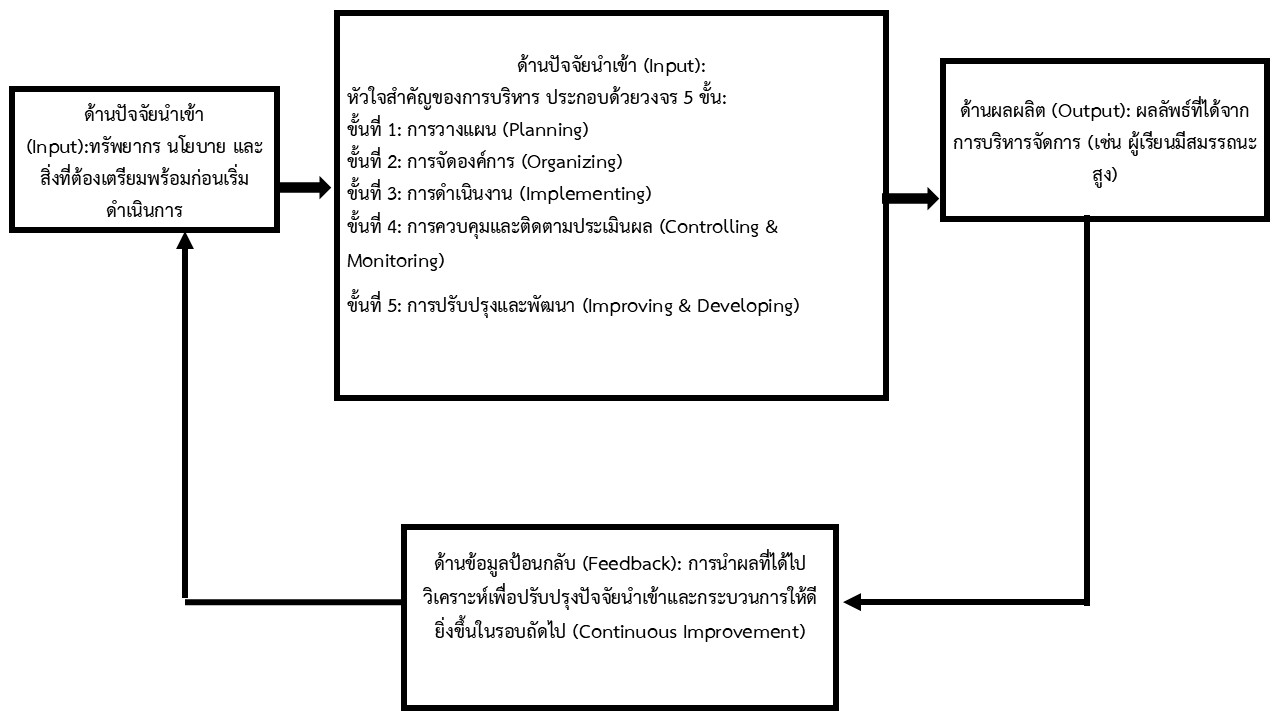
The objectives of this article were to: 1) study the current conditions and components of high-performance vocational education management for developing students’ professional competencies in institutions under the Office of the Vocational Education Commission; 2) presentation of the High Competency Vocational Educational Management Model to improve students’ professional competencies in schools under the Office of Vocational Education Commission. The study findings revealed that the developed model comprised four main components: Input, Process, Output, and Feedback for improvement. The Process component consisted of five steps: 1) planning, 2) organizing, 3) implementing, 4) controlling, monitoring, and evaluating, and 5) improving and developing.
Keywords: Model, High Competency, Vocational Education Management, Students’ Professional Competencies
Article Details

This work is licensed under a Creative Commons Attribution-NonCommercial-NoDerivatives 4.0 International License.
References
กิดานันท์ มลิทอง. (2557). เทคโนโลยีทางการศึกษาร่วมสมัย. กรุงเทพฯ : จุฬาลงกรณ์มหาวิทยาลัย.
ณัฐธิดา เอื้อประเสริฐ. (2564). การนำนโยบายการผลิตและพัฒนาคุณภาพกำลังคนอาชีวศึกษาไป
ปฏิบัติ กรณีศึกษา : สถาบันการอาชีวศึกษากรุงเทพมหานคร. กรุงเทพฯ : สถาบัน
บัณฑิตพัฒนบริหารศาสตร์
ณัฐสิฏ รักษ์เกียรติวงศ์. (2564). การปฏิรูปอาชีวศึกษาของประเทศไทย. https://tdri.or.th/2016/08/
vocational-education-reform/. (15 มิถุนายน 2566).
ทิพวรรณ์ วงศ์วิเชียร (2566). การพัฒนาสมรรถนะผู้เรียนอาชีวศึกษาสู่การเป็นผู้ประกอบการและ
การมีรายได้ระหว่างเรียนของสำนักงานคณะกรรมการการอาชีวศึกษา. https://bsq.vec.go.th/
Portals/9/ Dowload/B8%B1your67/Business/13-2-67/13-2-67.pdf. (10 ธันวาคม 2567).
ไพฑูรย์ สินลารัตน์. (2559). การศึกษาไทย 4.0 เป็นยิ่งกว่าการศึกษา. กรุงเทพฯ: โรงพิมพ์แห่งจุฬาลงกรณ์
มหาวิทยาลัย.
นิรันดร์ สมมุติ. (2565). รูปแบบการพัฒนาสมรรถนะผู้เรียนหลักสูตรวิชาชีพระยะสั้นกลุ่มงาน
เสริมสวย โดยการมีส่วนร่วมกับสถานประกอบการ ของวิทยาลัยเทคนิคนครอุบลราชธานี.
https://research.otepc.go.th/files/3ytoe.pdf. (19 พฤษภาคม 2567).
ภูวเรศ อับดุลสตา และวรรณี สุทธินรากร. (2562). การพัฒนาระบบทวิภาคีของอาชีวศึกษา.
กรุงเทพฯ : สำนักพิมพ์สยาม.
ยศพล เวณุโกเศศ. (2566). รายงานประจำปี 2566 สำนักงานคณะกรรมการการอาชีวศึกษา
กระทรวงศึกษาธิการ. สำนักงานคณะกรรมการการอาชีวศึกษา กระทรวงศึกษาธิการ.
ศิริพันธ์ ชุมนุม. (2561). การวิจัยและพัฒนาหลักสูตรอาชีวศึกษา. กรุงเทพฯ: สำนักวิจัยและพัฒนาการ
อาชีวศึกษา.
ศูนย์เทคโนโลยีสารสนเทศและกำลังคนอาชีวศึกษา. (2566). สถิติข้อมูลนักเรียนนักศึกษา ปีการศึกษา
http://techno.vec.go.th/Defaul. (24 สิงหาคม 2566).
สำนักงานเลขาธิการสภาการศึกษา. (2563). แนวทางการพัฒนาสมรรถนะครูอาชีวศึกษาเพื่อรองรับ
อุตสาหกรรมเป้าหมาย. กรุงเทพฯ: พริกหวานกราฟฟิค.
สำนักงานคณะกรรมการการอาชีวศึกษา. (2565). โครงการยกระดับสมรรถนะกำลังคนวัยแรงงาน
เพื่ออนาคต (Upskill/Reskill). https://www.ops.go.th/th/flagship-project-driven/
item/6791-upskill-reskill. (20 มีนาคม 2566)
_______. (2567). ประกาศสำนักงานคณะกรรมการการอาชีวศึกษา เรื่อง นโยบายพัฒนาอาชีวศึกษา
ของสำนักงานคณะกรรมการการอาชีวศึกษา ประจำปีงบประมาณ พ.ศ. 2567. https://www.
vec.go.th/ArticleId/41687/ language/th-TH/41687.aspx. (2 เมษายน 2567)
สำนักงานคณะกรรมการพัฒนาการเศรษฐกิจและสังคมแห่งชาติ. (2560). ยุทธศาสตร์ชาติ
พ.ศ. 2561-2580. สำนักงานเลขานุการของคณะกรรมการยุทธศาสตร์ชาติ สำนักงาน
คณะกรรมการพัฒนาการเศรษฐกิจและสังคมแห่งชาติ.
ไสว สีบูจันดี. (2565). รูปแบบการเสริมสร้างสมรรถนะผู้เรียนอาชีวศึกษาในศตวรรษที่ 21
โดยการบริหารแบบมุ่งผลสัมฤทธิ์ วิทยาลัยอาชีวศึกษาสระบุรี. วารสารวิจัยและนวัตกรรม
สถาบันการอาชีวศึกษากรุงเทพมหานคร, 5(1), 126 – 147.
Branch, R. M. (2009). Instructional design: The ADDIE approach. New York: Springer.
Bovee, C. L. et al. (1993). Management. New York : Mc Graw-Hill.
Deming, Edward. W. (1986). Out of The Crisis. USA: The Massachusetts Institute
of Technology Center for Advanced Engineering Study.
Ludwig Von Bertalanffy. (1972). General System Theory. New York : George Braziller.
Lunenburg, F. C. and Ornstein, A. C., (2008). Educational administration: Concepts and
practice, 3rded., Australia: Wadsworth.
Strickland, B. F. (2006). A study of factor affecting administrative unit of North
California. Dissertation Abstracts International. 23(12), 4598-4599.
