
แนวทางการพัฒนาภาวะผู้นำดิจิทัลของผู้บริหารสถานศึกษาสู่ความเป็นเลิศ สังกัดสำนักงานเขตพื้นที่การศึกษาประถมศึกษาขอนแก่น เขต 5
Article Sidebar
Main Article Content
บทคัดย่อ
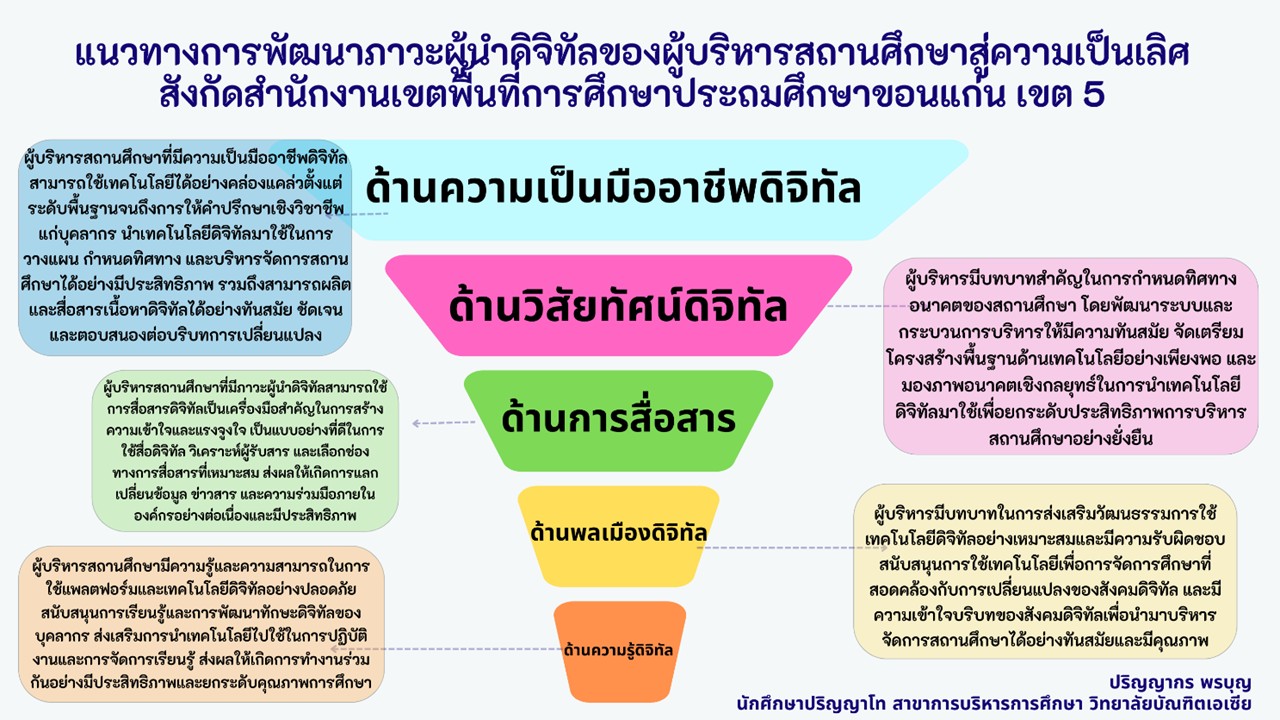
ในยุคที่มีการเปลี่ยนแปลงอย่างรวดเร็วที่อาศัยอยู่ภายใต้ความก้าวล้ำแห่งเทคโนโลยี ต้องมีการพัฒนาศักยภาพของตนเองให้เกิดสามารถก้าวทันการเปลี่ยนแปลงที่เกิดขึ้นอยู่ตลอดเวลา ผู้บริหารสถานศึกษาถือเป็นผู้มีบทบาทสำคัญในการเป็นผู้นำเทคโนโลยีดิจิทัลมาใช้ในสถานศึกษาให้เกิดประสิทธิภาพ จากสภาพดังกล่าว จึงทำให้ต้องการหาแนวทางในการส่งเสริมเกี่ยวกับการใช้เทคโนโลยีดิจิทัลของโรงเรียนสอดคล้องกับการจัดการเรียนรู้ในศตวรรษที่ 21 รวมทั้งผู้สามารถนำไปใช้ประโยชน์ประยุกต์ใช้ในการจัดการเรียนรู้ด้วยเทคโนโลยีดิจิทัล เพื่อให้ทันต่อการเปลี่ยนแปลง มีวัตถุประสงค์เพื่อ (1) ศึกษาสภาพปัจจุบัน และสภาพที่พึงประสงค์ของแนวทางการพัฒนาภาวะผู้นำดิจิทัลของผู้บริหารสถานศึกษาสู่ความเป็นเลิศ สังกัดสำนักงานเขตพื้นที่การศึกษาประถมศึกษาขอนแก่น เขต 5 และ (2) ศึกษาแนวทางการพัฒนาภาวะผู้นำดิจิทัลของผู้บริหารสถานศึกษาสู่ความเป็นเลิศ สังกัดสำนักงานเขตพื้นที่การศึกษาประถมศึกษาขอนแก่น เขต 5 โดยวิจัยแบบผสมผสาน แบ่งเป็น 2 ระยะ คือ ระยะที่ 1 ศึกษาสภาพปัจจุบัน สภาพที่พึงประสงค์ของแนวทางการพัฒนาภาวะผู้นำดิจิทัลของผู้บริหารสถานศึกษาสู่ความเป็นเลิศ ระยะที่ 2 แนวทางการพัฒนาภาวะผู้นำดิจิทัลของผู้บริหารสถานศึกษาสู่ความเป็นเลิศ ผลการวิจัยพบว่า (1) สภาพปัจจุบัน สภาพที่พึงประสงค์และความต้องการจำเป็นของภาวะผู้นำดิจิทัลของผู้บริหารสถานศึกษาสู่ความเป็นเลิศ พบว่า สภาพปัจจุบัน โดยรวมและรายด้าน อยู่ในระดับมาก ส่วนสภาพที่พึงประสงค์ โดยรวมและรายด้าน อยู่ในระดับมาก และความต้องการจำเป็นโดยรวม มีค่าดัชนีความต้องการจำเป็น PNIModified เท่ากับ 0.19 (2) แนวทางการพัฒนาภาวะผู้นำดิจิทัลของผู้บริหารสถานศึกษาสู่ความเป็นเลิศ ประกอบด้วย 5 ด้าน 15 แนวทาง
คำสำคัญ: ภาวะผู้นำดิจิทัลของผู้บริหารสถานศึกษา, ผู้บริหารสถานศึกษา, เทคโนโลยีดิจิทัล
Article Details

อนุญาตภายใต้เงื่อนไข Creative Commons Attribution-NonCommercial-NoDerivatives 4.0 International License.
เอกสารอ้างอิง
กัญญารัตน์ สุขแสน. (2564). รูปแบบการพัฒนาภาวะผู้นำด้านดิจิทัลของผู้บริหารโรงเรียนในเครือมูลนิธิคณะ
เซนต์คาเบรียลแห่งประเทศไทย. วิทยาลัยครูสุริยเทพ มหาวิทยาลัยรังสิต.
เกสรา ศักดิ์มณีวงศา. (2561). การเตรียมความพร้อมให้กับองค์กรยุคดิจิทัล. กรุงเทพมหานคร: ดีลอยท์ ทู้ช โธมัทสุ.
ชุติรัตน์ กาญจนธนชัย. (2562). ตัวบ่งชี้ภาวะผู้นำดิจิตอลของผู้บริหารสถานศึกษา สังกัดสำนักงาน
คณะกรรมการการศึกษาขั้นพื้นฐาน. มหาวิทยาลัยมหามกุฏราชวิทยาลัย.
ทวีสันต์ วิชัยวงษ์ และยุภาพร ยุภาศ. (2562). ภาวะผู้นำและทักษะในการบริหารงานในองค์การ.
วารสารวิชาการแสงอีสาน, 16(2), 667–680.
ดาวรุวรรณ ถวิลการ. (2564). ภาวะผู้นำดิจิทัล Digital Leadership. ขอนแก่น: มหาวิทยาลัยขอนแก่น.
ณัฐธิดา ทิศาภาค. (2566). แนวทางการพัฒนาภาวะผู้นำดิจิทัลของผู้บริหารสถานศึกษา สังกัดสำนักงานเขต
พื้นที่การศึกษาประถมศึกษาสุพรรณบุรี เขต 1. วิทยาลัยครูสุริยเทพ.
ปณิดา สุภารมย์ และกุหลาบ ปุริสาร. (2566). แนวทางการพัฒนาภาวะผู้นำดิจิทัลของผู้บริหารสถานศึกษา
สังกัดสำนักงานเขตพื้นที่การศึกษาประถมศึกษาขอนแก่น เขต 5. วารสารวิชาการและวิจัย
มหาวิทยาลัยภาคตะวันออกเฉียงเหนือ, 13(1), 128–142.
ปุณณิฐฐา มาเชค. (2565). การบริหารองค์กรทางการศึกษาในยุคดิจิทัล. คณะศึกษาศาสตร์ มหาวิทยาลัยบูรพา.
พันธศักดิ์ พลสารัมย์. (2540). การพัฒนากระบวนการบริหารงานสถาบันอุดมศึกษาตามแนวคิดการบริหารงาน
แบบมุ่งคุณภาพทั้งองค์การ. จุฬาลงกรณ์มหาวิทยาลัย.
ภานุเดช แสงลุน และชยากานต์ เรืองสุวรรณ. (2565). แนวทางการพัฒนาภาวะผู้นำด้านดิจิทัลของผู้บริหาร
สถานศึกษา สังกัดสำนักงานเขตพื้นที่การศึกษาประถมศึกษาขอนแก่น เขต 5. วารสารการบริหาร
การศึกษาและภาวะผู้นำ, 11(41), 175–184.
มูฮำหมัดรุซลัน ลือบากะลูติง และนิรันดร์ จุลทรัพย์. (2565). ภาวะผู้นำดิจิทัลของผู้บริหารสถานศึกษา สังกัด
สำนักงานเขตพื้นที่การศึกษามัธยมศึกษาตรัง–กระบี่. การประชุมหาดใหญ่วิชาการ ครั้งที่ 13.
ราตรี ศรีไพรวรรณ. (2556). การพัฒนากลยุทธ์การบริหารสู่ความเป็นเลิศของโรงเรียนมาตรฐานสากล ระดับ
ประถมศึกษา. มหาวิทยาลัยอุบลราชธานี.
รุจเรขา วิทยาวุฑฒิกุล. (2562). มาตรฐานด้านทักษะความเข้าใจและการใช้เทคโนโลยีดิจิทัล (Digital
Literacy). สืบค้นจาก https://km.li.mahidol.ac.th/digital-literacy/
สำนักงานคณะกรรมการข้าราชการพลเรือน. (2560). แนวทางพัฒนาทักษะดิจิทัลของข้าราชการและบุคลากร
ภาครัฐ. สืบค้นจาก https://www.ocsc.go.th/digital_skills
สำนักงานเลขาธิการสภาการศึกษา. (2562). รายงานผลการวิเคราะห์ภาวะผู้นำทางการศึกษาในยุคดิจิทัล.
กรุงเทพฯ: กระทรวงศึกษาธิการ.
สุกัญญา แช่มช้อย. (2560). การบริหารสถานศึกษาในยุคดิจิทัล. กรุงเทพฯ: สำนักพิมพ์แห่งจุฬาลงกรณ์มหาวิทยาลัย.
สุกัญญา แช่มช้อย. (2562). การบริหารสถานศึกษาในยุคดิจิทัล. กรุงเทพมหานคร: สำนักพิมพ์จุฬาลงกรณ์มหาวิทยาลัย.
สุชญา โกมลวานิช. (2563). องค์ประกอบของภาวะผู้นำดิจิทัลของผู้บริหารสถานศึกษา. การประชุมวิจัย
บัณฑิตศึกษา ครั้งที่ 21 มหาวิทยาลัยขอนแก่น.
สุวิมล ว่องวาณิช. (2558). การวิจัยประเมินความต้องการจำเป็น. กรุงเทพฯ: สำนักพิมพ์แห่งจุฬาลงกรณ์มหาวิทยาลัย.
ออระญา ปะภาวะเต และบุญชม ศรีสะอาด. (2564). แนวทางการพัฒนาภาวะผู้นำยุคดิจิทัลของผู้บริหาร
สถานศึกษา สังกัดสำนักงานเขตพื้นที่การศึกษาประถมศึกษาบุรีรัมย์ เขต 2. มหาสารคาม:
มหาวิทยาลัยมหาสารคาม.
บงกช ทองเอี่ยม. (2560). การพัฒนาตัวชี้วัดทักษะการรู้ดิจิทัลของนักศึกษาวิชาชีพครู. วารสารวิชาการสถาบัน
เทคโนโลยีสุวรรณภูมิ, 4(1), 291–302.
วิโรจน์ สารรัตนะ. (2545). การบริหารหลักการ ทฤษฎี และประเด็นทางการศึกษา. พิมพ์ครั้งที่ 3. กรุงเทพฯ: พิมพ์พิสุทธิ์.
Akkaya, A. (2023). Digital leadership in education: Transforming schools in the 21st century.
Educational Technology Journal, 45(2), 112–128.
Bolstad, R. (2020). Leading change with digital technologies in schools. New Zealand Council for
Educational Research.
Creswell, J. W., & Plano Clark, V. L. (2018). Designing and conducting mixed methods research (3rd ed.).
Thousand Oaks, CA: Sage Publications.
Greg, B. (1994). Beyond total quality management: Toward the emerging paradigm. McGraw-Hill.
Hall, G. E., & Hord, S. M. (2020). Implementing change: Patterns, principles, and potholes (4th ed.). Pearson.
International Society for Technology in Education (ISTE). (2009). National educational
technology standards for administrators. Eugene, OR.
ISTE Standards: Education Leaders. (n.d.). Explore the ISTE Education Leader Standards. ISTE.
Kotter, J. (1996). Leading change. Harvard Business Review Press.
Northouse, P. G. (2022). Leadership: Theory and practice (9th ed.). Sage.
OECD. (2019). Digital education outlook 2019: Driving innovation with technology. OECD Publishing.
Petry, T. (2016). Digital leadership: Erfolgreiches Führen in Zeiten der Digital Economy. Haufe.
Robbins, S. P., & Judge, T. A. (2008). Essential organizational behaviour. Pearson Education.
Schein, E. (2010). Organizational culture and leadership. Jossey-Bass.
Schrum, L., & Levin, B. B. (2019). Leadership for digital learning. Routledge.
Sheninger, E. C. (2014). Digital leadership: Changing paradigms for changing times. Corwin.
Weigel, R. (2012). Management skills for the 21st century: Preparing school leaders. NASSP.
Westerman, G., Bonnet, D., & McAfee, A. (2014). Leading digital: Turning technology into
business transformation. Harvard Business Review Press.
Zaccaro, S. J., & Banks, D. (2004). Leader visioning and adaptability: Bridging the gap between
research and practice on developing the ability to manage change. Human Resource
Management, 43(3), 367–380.
