
Influence of Motivation Factors Affecting Employee Engagement in Real Estate Businesses in Bangkok
Article Sidebar
Main Article Content
Abstract
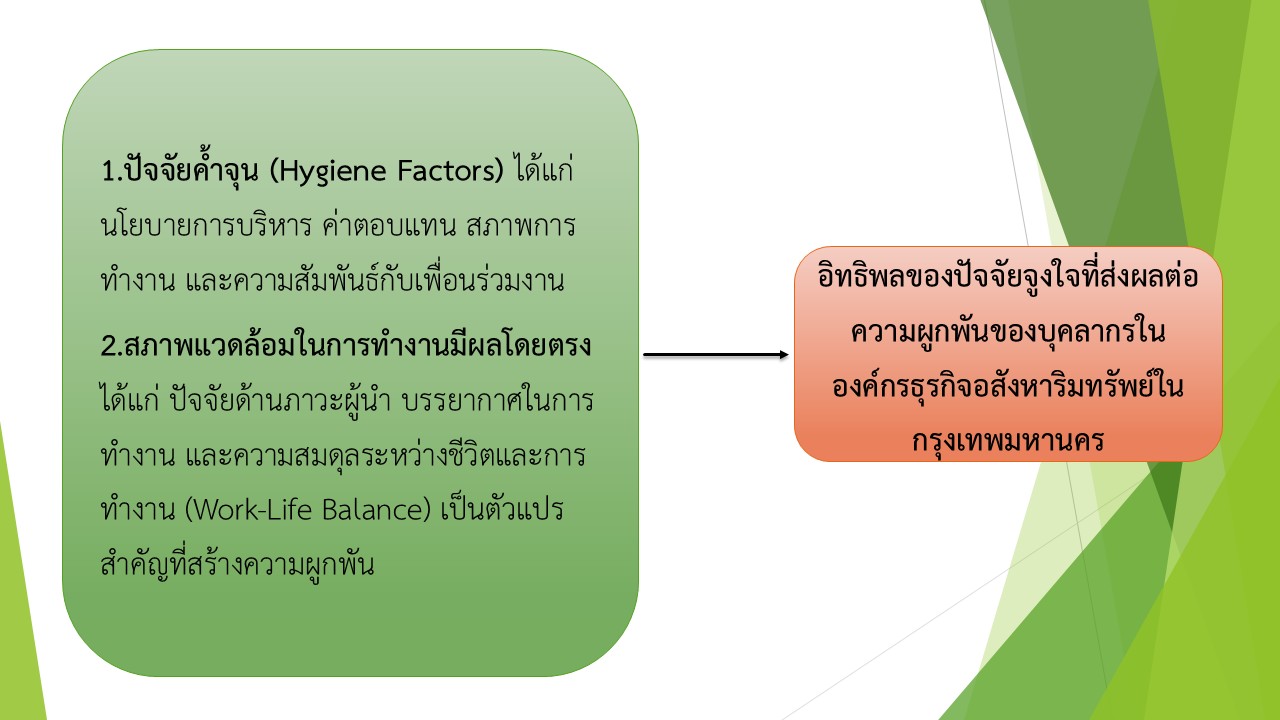
This research aimed to 1) study the demographic factors that influence employee engagement in real estate businesses, and 2) examine the motivational factors that affect employee engagement in organizations within the real estate sector in Bangkok. It is a descriptive research study that collected data via a questionnaire from employees at the top 10 registered real estate businesses listed on the Stock Exchange of Thailand, using purposive sampling to obtain a sample of 400 individuals. The statistical analyses employed include descriptive statistics such as frequency, percentage, mean, and standard deviation, as well as inferential statistics, including one-way analysis of variance (ANOVA) and multiple regression analysis. The research findings indicate that personal characteristics influencing employee engagement in real estate organizations include education level, which has a statistically significant effect. In contrast, gender, age, marital status, and length of employment do not significantly impact employee engagement. Regarding motivational factors affecting employee engagement, hygiene factors and the work environment had a statistically significant influence on employee attachment to the organization at the 0.05 level, whereas motivational factors did not affect engagement in this context. These findings suggest that organizations should prioritize creating job security, fair policies, and a positive work environment to retain their employees.
Keywords: Demography, Motivation Factors, Hygiene Factors, Personal Characteristics, Work Environment, Organizational Commitment
Article Details

This work is licensed under a Creative Commons Attribution-NonCommercial-NoDerivatives 4.0 International License.
References
กรมพัฒนาฝีมือแรงงาน. (2566). รายงานสถานการณ์แรงงานประจำปี 2566. สืบค้นจาก https://www.dsd.go.th
กิติศักดิ์ สิรหทัยวรกิจ. (2564). อิทธิพลของความผูกพันต่อองค์กรในฐานะตัวแปรคั่นกลางที่เชื่อมโยงแรงจูงใจสู่ประสิทธิภาพในการปฏิบัติงานของพนักงานบริษัทพัฒนาอสังหาริมทรัพย์แห่งหนึ่งในเขตกรุงเทพมหานคร. วารสารวิชาการมหาวิทยาลัยราชภัฏเพชรบุรี, 11(3), 19-25.
กิติศักดิ์ สิรหทัยวรกิจ. (2564). อิทธิพลของความผูกพันต่อองค์กรในฐานะตัวแปรคั่นกลางที่เชื่อมโยงแรงจูงใจสู่ประสิทธิภาพในการปฏิบัติงานของพนักงานบริษัทพัฒนาอสังหาริมทรัพย์แห่งหนึ่งในเขตกรุงเทพมหานคร. วารสารวิชาการมหาวิทยาลัยราชภัฏเพชรบุรี, 11(3), 55–69.
จุฑาพร จูประจบ. (2566). การศึกษาปัจจัยความผูกพันที่มีผลต่อประสิทธิภาพการทำงานของพนักงาน ในธุรกิจอสังหาริมทรัพย์. สารนิพนธ์หลักสูตรปริญญาการจัดการมหาบัณฑิต วิทยาลัยการจัดการ มหาวิทยาลัยมหิดล. chrome-extension://efaidnbmnnnibpcajpcglclefindmkaj/https:// archive.cm.mahidol.ac.th/bitstream/123456789/5399/1/TP%20HOM.035%202566.pdf
ณิชารีย์ หาญแสวงสิน, และ พรลภัส สุวรรณรัตน์. (2567). ปัจจัยที่มีผลต่อความพึงพอใจในการปฏิบัติงานของพนักงานสำนักงานคณะกรรมการกำกับและส่งเสริมการประกอบธุรกิจประกันภัย. วารสารสมาคมนักวิจัย, 29(2), 50–60.
นริศรา ฉัตรเจริญศิริ. (2562). ปัจจัยที่มีอิทธิพลต่อความผูกพันองค์กรของพนักงานที่ปฏิบัติงานด้านโลจิสติกส์ในพื้นที่กรุงเทพมหานคร. สารนิพนธ์ปริญญาการจัดการมหาบัณฑิต, วิทยาลัยการจัดการ มหาวิทยาลัยมหิดล.
ปวีณา ราศี. (2561). ปัจจัยจูงใจและการธํารงรักษาทีส่งผลต่อความผูกพันของพนักงานในองค์กรธุรกิจอสังหาริมทรัพย์ จังหวัดชลบุรี. https://dspace.spu.ac.th/items/2513800c-4691-4bd1-bc9e-4288cf01b953
พัชร์หทัย จารุทวีผลนุกูล, ธัญวฤณ วัทโล, และ วิลาสิณี สุดประเสริฐ. (2563). ปัจจัยที่ส่งผลต่อความผูกพันต่อองค์การของพนักงาน บริษัท เอสเอสเค โลจิสติกส์ จำกัด. วารสารวิจัยมหาวิทยาลัยรังสิต (ฉบับสังคมศาสตร์), 2(3), 45–56.
ลี่ เหมิง. (2565). การศึกษาปัจจัยแรงจูงใจ คุณภาพชีวิตทำงาน และภาวะผู้นำ ส่งผลต่อความผูกพันของพนักงานระดับบริการธุรกิจ SME ในเขตกรุงเทพมหานคร. การค้นคว้าอิสระบริหารธุรกิจมหาบัณฑิต, มหาวิทยาลัยกรุงเทพ.
อารีรัตน์ เสสตะญาติ และกฤษฎา มูฮัมหมัด. (2566). ปัจจัยที่มีผลต่อความผูกพันในองค์การของพนักงานบริษัทเอกชน กลุ่มเจนเนอเรชั่นซี ในเขตกรุงเทพมหานครและปริมณฑล. วารสารวไลยอลงกรณ์ปริทัศน์ (มนุษยศาสตร์และสังคมศาสตร์), 13(2), 161-176.
Belch, G. E., & Belch, M. A. (2005). Advertising and Promotion: An Integrated Marketing Communications Perspective (6th ed.). New York, NY: McGraw-Hill/Irwin.
Herzberg, F. (1959). The Motivation to Work. New York: Wiley.
Kotler, P. (2000). Marketing Management: The Millennium Edition (10th ed.). Upper Saddle River, NJ: Prentice Hall.
Meyer, J. P., & Allen, N. J. (1991). A three-component conceptualization of organizational commitment. Human Resource Management Review, 1(1), 61-89.
Meyer, J.P. & Allen, J,A. (1991). A three-component conceptualization of organizational commitment. Human Resource Management Review, 1(1), 61-89. https://www.sciencedirect.com/science/article/abs/pii/105348229190011Z?utm_source=chatgpt.com
Robbins, S. P., & Judge, T. A. (2019). Organizational behavior (18th ed.). Pearson
