
Development of Constructivist-Based Mathematics Activities Collaborated with GSP Program on Creating Geometry topic for Grade 7 Students of Suranari Witthaya School
Article Sidebar
Main Article Content
Abstract
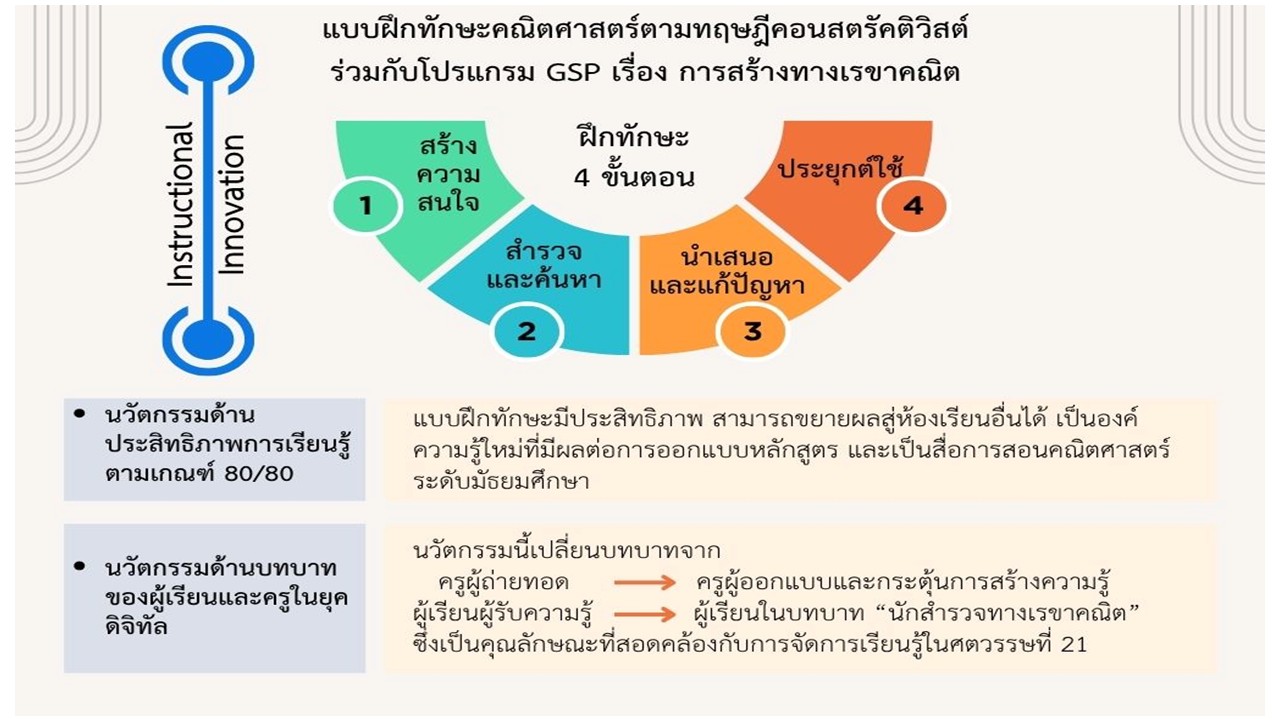
The objectives of this research were to (1) develop mathematical skills exercises based on constructivist theory in conjunction with the GSP program on geometric construction for Grade 7 students to be effective according to the 80/80 criteria, and (2) to compare the academic achievement before and after learning with these skills. The sample group consists of 40 students in Grade 1/6, obtained through simple random sampling. The tools used included 8 skill exercises, 8 learning management plans, and 4 multiple-choice tests with 20 questions. The research is divided into two phases: Phase 1, the development and verification of the effectiveness of skill training. The experiment was conducted with 5 individual students, 9 in groups, and 40 in the field, and the performance values were analyzed against the 80/80 criterion. The results showed that the developed mathematical skills exercises achieved performance values above the specified threshold, and the effectiveness of the results exceeded the efficiency of the process. It shows the suitability for practical use. In addition, academic achievement after the class was statistically significantly higher than before the class at the .05 level. This contributes to students' development in learning geometric construction.
Keywords: Mathematics Skills Exercises, Constructivist
Article Details

This work is licensed under a Creative Commons Attribution-NonCommercial-NoDerivatives 4.0 International License.
References
ชญานี หาญรบ. (2561). ผลการใช้กิจกรรมการเรียนรู้ตามแนวคิดคอนสตรักติวิสต์ร่วมกับการคิดเชิงมโนทัศน์ เพื่อส่งเสริมความสามารถในการคิดเชิงวิเคราะห์ วิชาประวัติศาสตร์ ชั้นประถมศึกษาปีที่ 6 (วิทยานิพนธ์ศึกษาศาสตรมหาบัณฑิต). มหาวิทยาลัยบูรพา.
ณัฐจรินทร์ แพทย์สูงเนิน, & ชนกกานต์ สหัสทัศน์. (2562). การพัฒนาผลสัมฤทธิ์ทางการเรียนคณิตศาสตร์ เรื่อง อสมการเชิงเส้นตัวแปรเดียว โดยใช้แบบฝึกทักษะตามทฤษฎีคอนสตรัคติวิสต์. วารสารศึกษาศาสตร์ มหาวิทยาลัยขอนแก่น, 42(3), 211–226.
ทิศนา แขมมณี. (2566). ศาสตร์การสอน: องค์ความรู้เพื่อการจัดกระบวนการเรียนรู้ที่มีประสิทธิภาพ. สำนักพิมพ์แห่งจุฬาลงกรณ์มหาวิทยาลัย.
ธัชชา สามพิมพ์, วิรัตน์ ธรรมาภรณ์, & หรรษา นิลวิเชียร์. (2560). การพัฒนาการสอนโดยใช้แบบฝึกทักษะ เรื่อง รูปสี่เหลี่ยม รูปสามเหลี่ยม และรูปวงกลม ด้วยโปรแกรม GSP. วารสารครุศาสตร์, 45(2), 101–115.
บรรพต สุวรรณประเสริฐ. (2544). การจัดการเรียนรู้คณิตศาสตร์ตามแนวคอนสตรัคติวิสต์. สำนักพิมพ์แห่งจุฬาลงกรณ์มหาวิทยาลัย.
ประวิทย์ การินทร์. (2561). การพัฒนารูปแบบการเรียนการสอนตามทฤษฎีคอนสตรัคติวิสต์ร่วมกับโปรแกรม The Geometer’s Sketchpad (GSP) และ Facebook เพื่อส่งเสริมความสามารถในการให้เหตุผลทางคณิตศาสตร์และผลสัมฤทธิ์ทางการเรียนของนักเรียนชั้นมัธยมศึกษาปีที่ 2. วารสารศึกษาศาสตร์ มหาวิทยาลัยสงขลานครินทร์, 29(3), 197–210. https://so04.tci-thaijo.org/index.php/eduku/article/view/201968
พเยาว์ ยินดีสุข. (2559). ทฤษฎีการเรียนรู้และการนำไปใช้ในชั้นเรียน. สำนักพิมพ์มหาวิทยาลัยศรีนครินทรวิโรฒ.
วันซัลมา ปานากาเซ็ง, อภิสิทธิ์ ภคพงศ์พันธุ์, & รักพร ดอกจันทร์. (2559). กิจกรรมการเรียนรู้คณิตศาสตร์ตามทฤษฎีคอนสตรัคติวิสต์ เรื่อง กำหนดการเชิงเส้น โดยใช้โปรแกรม The Geometer’s Sketchpad. วารสารครุศาสตร์อุตสาหกรรม, 13(1), 25–37.
วันซัลมา ปานากาเซ็ง. (2560). กิจกรรมการเรียนรู้คณิตศาสตร์ตามทฤษฎีคอนสตรัคติวิสต์เพื่อการพัฒนาผลสัมฤทธิ์ทางการเรียนและความพึงพอใจ เรื่อง กำหนดการเชิงเส้นของนักเรียนชั้นมัธยมศึกษาปีที่ 5 โรงเรียนบ้านชะอวด สังกัดสำนักงานเขตพื้นที่การศึกษามัธยมศึกษา เขต 12 (วิทยานิพนธ์ศึกษาศาสตรมหาบัณฑิต). มหาวิทยาลัยบูรพา.
ศศินภา ธรรมกุล. (2565). การพัฒนากิจกรรมการเรียนรู้คณิตศาสตร์ตามแนวคิดทฤษฎีการสร้างความรู้ด้วยตนเองควบคู่กับโปรแกรม The Geometer’s Sketchpad เรื่อง ฟังก์ชัน ชั้นมัธยมศึกษาปีที่ 4. วารสารบัณฑิตศึกษา มหาวิทยาลัยราชภัฏสกลนคร, 19(84), 51–63. https://so02.tci-thaijo.org/index.php/SNGSJ/article/view/250230
ศุภสิริ พิทักษ์สายชล. (2560). การพัฒนาบทเรียนคอมพิวเตอร์ช่วยฝึกอบรมตามแนวทฤษฎีคอนสตรัคติวิสต์ เรื่องการปฐมนิเทศครูและบุคลากรใหม่ของโรงเรียนอัสสัมชัญศรีราชา (วิทยานิพนธ์ศิลปศาสตรมหาบัณฑิต). มหาวิทยาลัยบูรพา.
สุคนธ์ สินธุพานนท์. (2553). นวัตกรรมการเรียนรู้และการจัดการชั้นเรียน. สำนักพิมพ์แห่งจุฬาลงกรณ์มหาวิทยาลัย.
สุวนันท์ เชี่ยวดี. (2567). การพัฒนากิจกรรมการเรียนรู้ทางคณิตศาสตร์ตามแนวคิดทฤษฎีคอนสตรัคติวิสต์ร่วมกับการใช้สื่ออิเล็กทรอนิกส์เพื่อส่งเสริมความสามารถการแก้ปัญหาเรื่องรูปสามเหลี่ยมสำหรับนักเรียนชั้นประถมศึกษาปีที่ 6 (วิทยานิพนธ์วิทยาศาสตรมหาบัณฑิต). มหาวิทยาลัยมหาสารคาม.
อัมพร ม้าคนอง. (2546). คณิตศาสตร์: การสอนและการเรียนรู้. ศูนย์ตำราและเอกสารทางวิชาการ คณะครุศาสตร์ จุฬาลงกรณ์มหาวิทยาลัย.
Bruner, J. S. (1990). Acts of meaning. Harvard University Press.
Bybee, R. W. (1997). The 5E instructional model and constructivism. BSCS.
Cibukciu, B. (2025). The impact of constructivist methods on students’ mathematical problem-solving. Discover Education, 4, Article 83. https://doi.org/10.1007/s44217-025-00475-w
Dewey, J. (1938). Experience and education. Macmillan.
Glasersfeld, E. von. (1995). Radical constructivism: A way of knowing and learning. Falmer Press.
Hodiyanto, H., & Santoso, R. H. (2020). How Geometer’s Sketchpad (GSP) develops geometry concept understanding. Jurnal Pendidikan Matematika Raflesia, 5(2), 118–129. https://repository.ikippgriptk.ac.id/id/eprint/906/
Karplus, R., & Thier, H. (1967). A new look at elementary school science. Rand McNally.
Kotu, A., & Weldeyesus, K. M. (2022). Instructional use of Geometer’s Sketchpad and students’ geometry learning motivation and problem-solving ability. Eurasia Journal of Mathematics, Science and Technology Education, 18(11), 1–13. https://www.ejmste.com/download/instructional-use-of-geometers-sketchpad-and-students-geometry-learning-motivation-and-12710.pdf
Larochelle, M., Bednarz, N., & Garrison, J. (Eds.). (1998). Constructivism and education. Cambridge University Press.
Omotayo, S. A., & Adeleke, J. O. (2017). The 5E instructional model: A constructivist approach for enhancing students’ learning outcomes in mathematics. Journal of Education and Practice, 8(8), 29–35. https://files.eric.ed.gov/fulltext/EJ1176946.pdf
Piaget, J. (1970). Science of education and the psychology of the child. Viking.
Steffe, L. P., & Gale, J. (Eds.). (2012). Constructivism in education. Routledge.
Vintere, A. (2018). A constructivist approach to the teaching of mathematics to boost competences needed for sustainable development. Rural Sustainability Research, 39(334), 1–7. https://doi.org/10.2478/plua-2018-0001
Vygotsky, L. S. (1978). Mind in society: The development of higher psychological processes. Harvard University Press.
