
A Study of the Relationship between Stress Management Skills and Academic Stress among Nursing Students
Article Sidebar
Main Article Content
Abstract
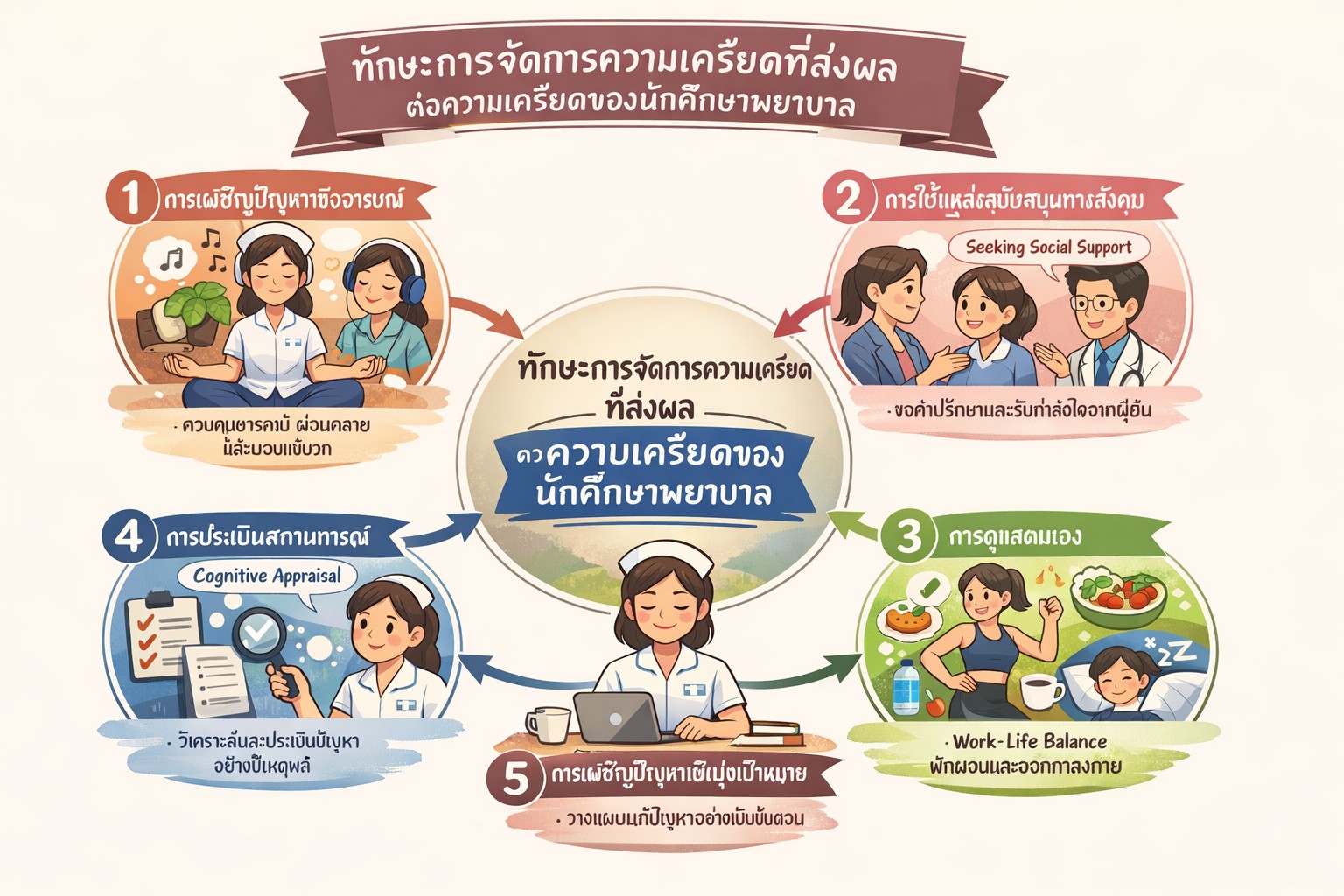
This research aimed to (1) study the level of academic stress among nursing students, (2) study the level of stress management skills among nursing students, and (3) study the relationship between stress management skills and academic stress among nursing students. The sample consisted of 200 undergraduate nursing students in their 1st-4th years from the Faculty of Nursing, Bangkok Thonburi University, during the 2025 academic year, second semester. The research instrument was a questionnaire. Content validity was checked by three experts, and reliability was tested using Cronbach's alpha coefficient. The reliability of the questionnaire for stress management skills was 0.875, and for academic stress, 0.882. The statistical analyses employed included frequency, percentage, mean, standard deviation, Pearson correlation, and multiple regression. The research findings revealed that the overall level of academic stress among nursing students was high (mean = 4.02), and their overall stress management skills were also high (mean = 3.94). Multiple regression analysis showed that the five aspects of stress management skills collectively explained 50.70% of the variance in academic stress (Adj. R² = 0.507), and the model was statistically appropriate (F = 41.866, p < .01). Variables significantly influencing academic stress included situational assessment (Beta = 0.167, p < .01), goal-oriented coping (Beta = 0.153, p < .01), emotional coping (Beta = 0.336, p < .01), utilization of social support (Beta = 0.214, p < .01), and self-care (Beta = 0.195, p < .01). These findings highlight the importance of promoting holistic stress management skills coupled with social support systems and academic task management to reduce academic stress among nursing students and enhance academic success.
Keywords: Stress Management Skills, Study Stress, Nursing Students
Article Details

This work is licensed under a Creative Commons Attribution-NonCommercial-NoDerivatives 4.0 International License.
References
กัญญาวีณ์ โมกขาว. (2564). ปัจจัยที่มีความสัมพันธ์กับความเครียดของนักศึกษาพยาบาล. วารสารพยาบาลศาสตร์และสุขภาพ, 44(2), 60-71.
ชฎาพร คงเพ็ชร์. (2566). ความเครียดและการจัดการความเครียดของนักศึกษาพยาบาลในสถานการณ์การแพร่ระบาดโควิด 19. วารสารวิจัยเพื่อการส่งเสริมสุขภาพและคุณภาพชีวิต, 3(2), 37-46.
ทัศนีย์ หอมกลิ่น. (2565). อิทธิพลของความเครียดในการเรียนที่มีผลต่อผลการเรียนและความ ผูกพันในการเรียนของนักศึกษาระดับปริญญาตรี. วารสารปัญญาภิวัฒน์, 14(2), 277-292.
วิสุทธิ์ โนจิตต์. (2563). ปัจจัยทำนายความเครียดและวิธีการจัดการความเครียดของนักศึกษาหลักสูตรพยาบาลศาสตรบัณฑิต. วารสารวิชาการมหาวิทยาลัยราชภัฏเพชรบุรี, 10(1), 118-128.
สืบตระกูล ตันตลานุกุล. (2560). ความเครียดและการจัดการความเครียดของนักศึกษาพยาบาล. วารสารวิทยาลัยพยาบาลบรมราชชนนี อุตรดิตถ์, 9(1), 81-92.
สิริทรัพย์ สีหะวงษ์. (2561). ปัจจัยที่ส่งผลต่อความเครียดของนักศึกษาคณะพยาบาลศาสตร์ มหาวิทยาลัยอุบลราชธานี. วารสาร มฉก.วิชาการ, 21(42), 93-106.
Carver C.S., Scheier M.F., Weintraub, J.K. (1989). Assessing coping strategies: a theoretically based approach. J Pers Soc Psychol. 56(2), 267-283. doi: 10.1037//0022-3514.56.2.267. PMID: 2926629.
Dubrin. (1990). Effective Business Psychology. 3rd ed. Englewood: Cliffs N.J: Prentice Hall.
Folkman & Lazarus. (1980). An analysis of coping in a middle-aged community sample. Journal of Health and Social Behavior, 21(3), 219-239.
Frain, M. and Valiga, T.M. (1979). The multiple dimensions of stress. Topics in Clinical Nursing, 1(1), 43-52.
