
A Model for Developing Instructional Leadership of Digital – Era Teachers in Primary Schools in the Northeast Region
Article Sidebar
Main Article Content
Abstract
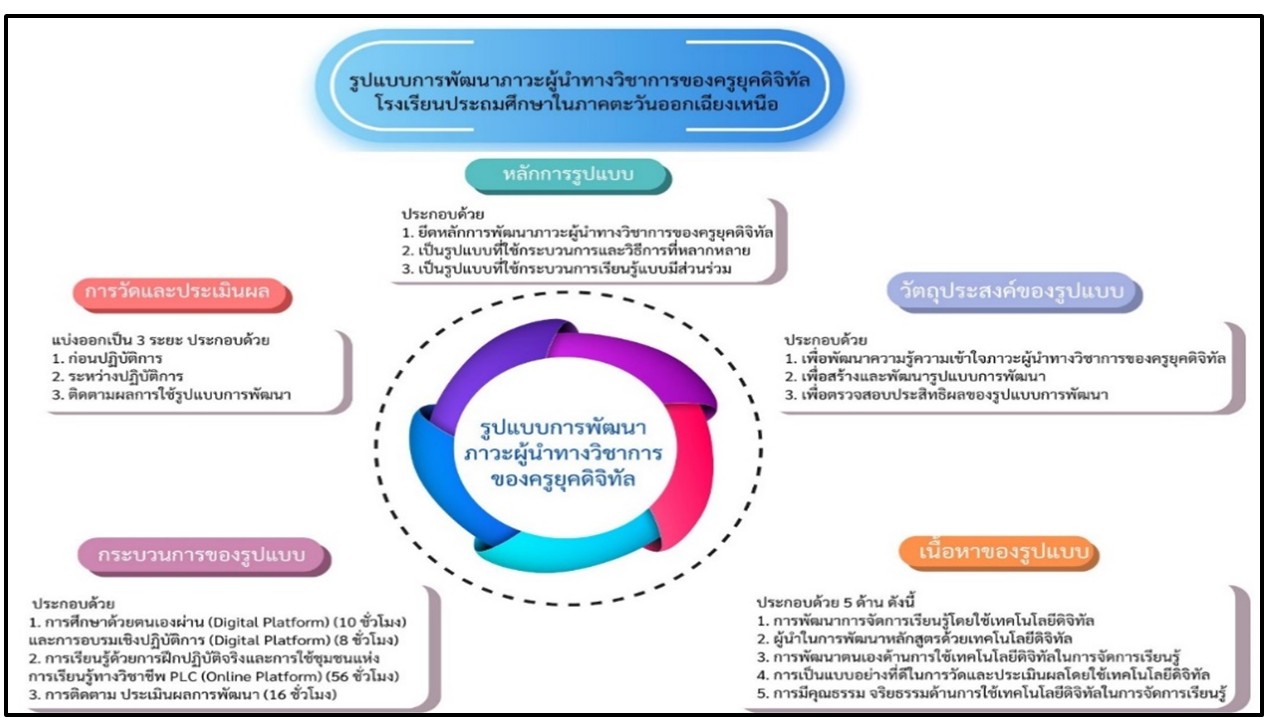
This research aims to 1) study the components of academic leadership of digital - age teachers, 2) create and develop a model for developing academic leadership of digital - age teachers, and 3) examine the effectiveness of the model for developing academic leadership of digital-age teachers. The research was conducted in three phases: Phase 1, studying the components of academic leadership of digital -age teachers, included steps 1: reviewing relevant literature and research, 2: validating the components of academic leadership of digital - age teachers with nine experts, and 3: studying the needs for developing academic leadership of digital - age teachers. The sample consisted of 370 primary school teachers in the Northeast region during the 2025 academic year. The research instrument was a questionnaire with a discrimination index ranging from 0.31 to 0.96 and a reliability coefficient of 0.98. Phase 2, creating and developing the model for developing academic leadership of digital -age teachers, included steps 1: drafting the model and 2: creating and validating the model. By nine experts, Phase 3 of the study on the effectiveness of the pilot application of the academic leadership development model for digital-age teachers involved the following steps: Step 1: Conducting a pilot test of the model. The target group consisted of 32 primary school teachers from 4 schools under the Nong Khai Primary Educational Service Area Office 1. Step 2: Summarizing the results of the pilot application of the academic leadership development model for digital - age teachers. The results of the research were as follows: 1. The components of academic leadership for teachers in the digital age consist of five elements: 1) Developing learning management using digital technology; 2) Leadership in curriculum development using digital technology; 3) Self-development in the use of digital technology in learning management; 4) Serving as a good role model in measurement and evaluation using digital technology; and 5) Possessing morality and ethics in the use of digital technology in learning management. 2. The model for developing academic leadership skills among teachers in the digital age was found to consist of the following components: 1) principles of the model, 2) objectives of the model, 3) content of the model, 4) development process, and 5) measurement and evaluation. The overall assessment of the appropriateness of these model components showed that they were at the highest level. 3. The evaluation of the effectiveness of the digital - age teacher academic leadership development model showed continuous improvement, with a significance level of 0.79 or a progress rate of 73.15%.
Keywords: Development Model, Instructional Leadership, Digital-Era Teachers
Article Details

This work is licensed under a Creative Commons Attribution-NonCommercial-NoDerivatives 4.0 International License.
References
กระทรวงศึกษาธิการ. (2564). หลักสูตรการศึกษาขั้นพื้นฐาน พุทธศักราช 2564. กรุงเทพฯ : โรงพิมพ์คุรุสภาลาดพร้าว.
ขจีนุช ดาโอภา. (2568). รูปแบบการพัฒนาภาวะผู้นำเชิงดิจิทัลของครูโรงเรียนมัธยมศึกษา ในภาคตะวันออกเฉียงเหนือ. วิทยานิพนธ์ ค.ด. สกลนคร: มหาวิทยาลัยราชภัฏสกลนคร.
จงดี เพชรสังคูณ. (2567). แนวทางการจัดการเรียนรู้ในยุคดิจิทัล. วารสารมณีเชษฐารามวัดจอมมณ, 7(6), 1407 – 1419.
ชีวิน อ่อนละออ และคณะ. (2563). ภาวะผู้นำยุคดิจิทัลสำหรับนักบริหารการศึกษา. วารสารวิทยาลัยบัณฑิตเอเซีย, 10(1), 108 - 119.
ไชยา ภาวะบุตร. (2565). ภาวะผู้นำทางวิชาการ Academic leadership. (พิมพ์ครั้งที่ 3). สกลนคร: มหาวิทยาลัยราชภัฏสกลนคร.
ณัฐยาภรณ์ เล็กสิงโต. (2564). รูปแบบการพัฒนาภาวะผู้นำยุคดิจิทัลของครูโรงเรียนประถมศึกษาในภาค ตะวันออกเฉียงเหนือ. วิทยานิพนธ์ ปร.ด. สกลนคร: มหาวิทยาลัยราชภัฏสกลนคร.
ฐิติมา จันทะคีรี. (2565). "การเรียนการสอนออนไลน์ในยุคดิจิทัล." Journal of Modern Learning Development. 7(10):349 - 363.
บดี ทะนอก. (2568). รูปแบบการพัฒนาภาวะผู้นำทางวิชาการของครูในยุคดิจิทัลของโรงเรียนมัธยมศึกษาในโครงการ 1 อำเภอ 1 โรงเรียนคุณภาพ สังกัดสำนักงานคณะกรรมการการศึกษาขั้นพื้นฐาน ในภาคตะวันออกเฉียงเหนือ. วิทยานิพนธ์ ปร.ด. สกลนคร: มหาวิทยาลัยราชภัฏสกลนคร.
มัตติกา ผาลี. (2566). รูปแบบการพัฒนาภาวะผู้นำครูยุคดิจิทัลในการจัดการเรียนรู้ของโรงเรียนประถมศึกษาในเขตพื้นที่รับผิดชอบ สำนักงานศึกษาธิการภาค 11. วิทยานิพนธ์ ปร.ด. สกลนคร: มหาวิทยาลัยราชภัฏสกลนคร.
รุ่งฤดี บุญจันทร์. (2567). การพัฒนารูปแบบการนิเทศแบบเสริมพลังเพื่อเสริมสร้างสมรรถนะการจัดการเรียนรู้เชิงรุกของครูภาษาไทย สังกัดสำนักงานเขตพื้นที่ การศึกษาประถมศึกษานครพนม เขต 2. วิทยานิพนธ์ ปร.ด. สกลนคร: มหาวิทยาลัยราชภัฏสกลนคร.
รัฐธรรมนญแห่งราชอาณาจักรไทย พุทธศักราช 2560. (2560). ราชกิจจานุเบกษา, เล่ม 134 ตอนที่ 40 ก. : 19 - 20 และ 67 - 70.
วิชัย วงษ์ใหญ่ และมารุต พัฒผล. (2562). เอกสารประกอบการบรรยาย เรื่องทักษะการโค้ชเพื่อครู.กรุงเทพฯ: บัณฑิตวิทยาลัย มหาวิทยาลัยศรีนครินทรวิโรฒ.
วิชัย วงษ์ใหญ่ และมารุต พัฒผล. (2563). กระบวนทัศน์ใหม่ในแพลทฟอร์มการเรียนรู้. กรุงเทพฯ: บัณฑิตวิทยาลัย มหาวิทยาลัยศรีนครินทรวิโรฒ.
สาธกา ตาลชัย. (2567). การพัฒนาครูในยุคดิจิทัล: ทักษะที่จําเป็นและความท้าทาย. วารสารกว๊านพะเยา, 1(3), 43 - 50.
สุพจน์ ประไพเพชร. (2566). ภาวะผู้นำ: แนวคิด ทฤษฎี และองค์ประกอบ. วารสารครุศาสตร์ปัญญา. 2(1), 59 - 73.
สำนักงานคณะกรรมการการศึกษาขั้นพื้นฐาน. (2562). คู่มือการขับเคลื่อนยุทธศาสตร์ชาติ (พ.ศ. 2561 – 2580) ของกระทรวงศึกษาธิการ. กรุงเทพ: สำนักงานคณะกรรมการการศึกษาขั้นพื้นฐาน.
สำนักงานคณะกรรมการข้าราชการครูและบุคลากรทางการศึกษา (ก.ค.ศ.). (2564). ยุทธศาสตร์การพัฒนาครูแนวใหม่. กรุงเทพฯ: สำนักงานคณะกรรมการข้าราชการครูและบุคลากรทางการศึกษา.
สำนักงานเลขาธิการสภาการศึกษา. (2560). แผนการศึกษาแห่งชาติ พ.ศ. 2560 – 2579. กรุงเทพฯ : พริกหวานกราฟฟิค จำกัด.
สำนักวิชาการและมาตรฐานการศึกษา. (2564). นวัตกรรมการจัดการศึกษาในยุคดิจิทัล. กรุงเทพฯ: กระทรวงศึกษาธิการ.
อุไรรัก พันโกฏิ. (2567). รูปแบบการพัฒนาภาวะผู้นำทางวิชาการของครู กลุ่มโรงเรียนวิทยาศาสตร์จุฬาภรณราชวิทยาลัย. วิทยานิพนธ์ ค.ด. สกลนคร: มหาวิทยาลัยราชภัฏสกลนคร.
Tondeur, J., van Braak, J., Ertmer, P. A., & Ottenbreit - Leftwich, A. (2017). Understanding the relationship between teachers’ pedagogical beliefs and technology use in education: A systematic review of qualitative evidence. Educational Technology Research and Development, 65(3), 555 – 575.
Tracey Wilen, (2018). Digital Disruption: The Future of Work, Skills, Leadership, Education and Careers in a Digital World, New York: Peter Lang In.c.
Wenner, J. A., & Campbell, T. (2021). Thick and thin: Variations in teacher leader identity. International Journal of Teacher Leadership, 12(2), 4 - 21.
White, J. (2015). Digital Literacy Skills for FE Teachers. London: Learning Matters.
