
A Study of Innovative Organizational Culture in Schools
Article Sidebar
Main Article Content
Abstract
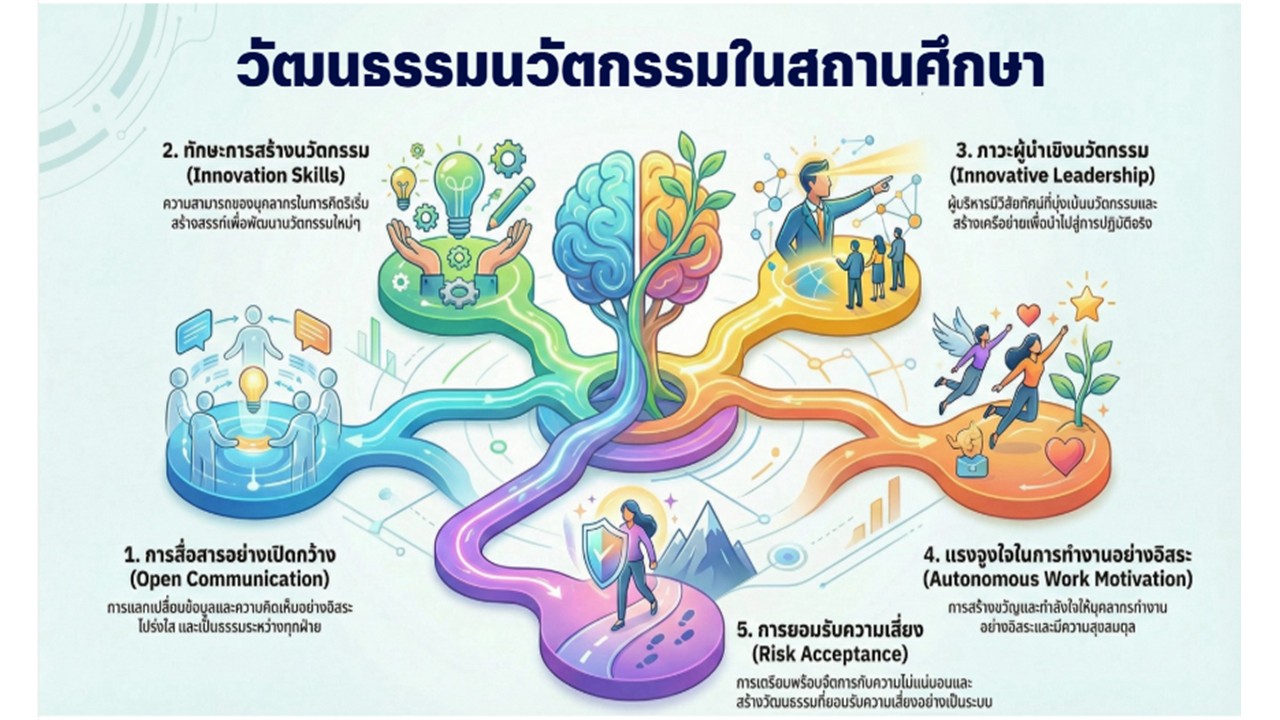
The purpose of this study was to investigate the current conditions, desirable conditions, and priority needs for developing an innovation culture in secondary schools under the Bueng Kan Secondary Educational Service Area Office. The population comprised 25 secondary schools, and the sample consisted of 278 participants, including 17 school administrators and 261 teachers. The sample size was determined using the Krejcie and Morgan table, and stratified random sampling based on school size was employed. The research instrument was a five-point Likert-scale questionnaire, with an overall reliability coefficient of 0.987. Data were analyzed using frequencies, percentages, means, standard deviations, and the Modified Priority Needs Index (PNIModified). The results indicated that the current state of innovation culture in schools was moderate overall, whereas the desirable condition was at the highest level. In terms of current condition, the highest mean score was observed for autonomous work motivation, while the lowest mean scores were observed for innovation skills and risk acceptance. Regarding the desirable condition, autonomous work motivation remained the highest-ranked dimension, whereas risk acceptance received the lowest mean score. The analysis of priority needs revealed that open communication was the most critical area requiring development (PNIModified = 0.312), followed by innovation skills (PNIModified = 0.311). The dimension with the lowest priority need was risk acceptance (PNIModified = 0.301).
Keywords: Innovation, Innovation culture, Innovation Culture Development Model
Article Details

This work is licensed under a Creative Commons Attribution-NonCommercial-NoDerivatives 4.0 International License.
References
กฤตภาส เจียรพินิจพงศ์. (2564). การออกแบบโมเดลการขับเคลื่อนนวัตกรรมในองค์กร.วารสารการบริหารและพัฒนา, 45–58.
ลลิตา สิริพัชรนันท์, เพ็ญศรี ฉิรินัง, อุดมวิทย์ ไชยสกุลเกียรติ, & วรเดช จันทรศร. (2566). การจูงใจพนักงานใน องค์การสำหรับการจัดการสมัยใหม่. Journal of Administrative and Management Innovation, 127-136.
สำนักงานเลขาธิการสภาการศึกษา. (2565). รายงานแนวโน้มการศึกษาไทยในอนาคต. พริกหวานกราฟฟิค.
สุชาติ ไตรภพสกุล & ชาคริต พิชญางกูร. (2567). การส่งเสริมวัฒนธรรมนวัตกรรมในสถานศึกษาด้วยการพัฒนาสมรรถนะครู. วารสารวิจัยการศึกษา, 88–102.
สุทธิพงษ์ ศรีวิชัย. (2565). ภาวะผู้นำการเปลี่ยนแปลงของผู้บริหารสถานศึกษากับการส่งเสริมวัฒนธรรม
สุวิมล ว่องวาณิช. (2564). การวิจัยและสถิติสำหรับการวิจัยทางสังคมศาสตร์ (พิมพ์ครั้งที่ 12). กรุงเทพฯ: โรงพิมพ์แห่งจุฬาลงกรณ์มหาวิทยาลัย.
หทัยทิพย์ อูปธรรม. (2567). แนวทางการพัฒนาวัฒนธรรมนวัตกรรมของสถานศึกษา สังกัดสำนักงานเขตพื้นที่ การศึกษามัธยมศึกษาเชียงใหม่ (วิทยานิพนธ์ปริญญาโท, มหาวิทยาลัยเชียงใหม่).
Amabile, T. M. (1996). Creativity in context. Westview Press.
Amabile, T. M., & Khaire, M. (2008). Creativity and the role of the leader. Harvard Business
Deal, T. E., & Kennedy, A. A. (2000). Corporate cultures: The rites and rituals of corporate life. Addison Wesley.
Fullan, M. (2011). Whole system reform for innovative teaching and learning. In Microsoft-ITL
Gumusluoglu,L.,& Ilsev, A. (2009). Transformational leadership, creativity, and organizational innovation. Journal of Business Research, 62(4), 461-473.
Hargreaves, A., & Fink, D. (2005). Sustainable leadership. The Essentials of School Leadership, 173-189.
Martins,E.C.,& Terblanche, F. (2003). Building organisational culture that stimulates creativity and innovation. European Journal of Innovation Management, 64–74.
Pisano, G. P. (2015). You need an innovation strategy. Harvard Business Review, 44–54.
Review, 100–109.
Rogers, E. M. (2003). Diffusion of innovations (5th ed.). Free Press.
Schein, E. H. (2010). Organizational culture and leadership (4th ed.). Jossey-Bass.
Schein, E. H. (2010). Organizational culture and leadership (4th ed.). Jossey-Bass.
