
An Analysis of Current Conditions, Desired Conditions, and Priority Needs of Sustainable Innovative Organizations of Schools
Article Sidebar
Main Article Content
Abstract
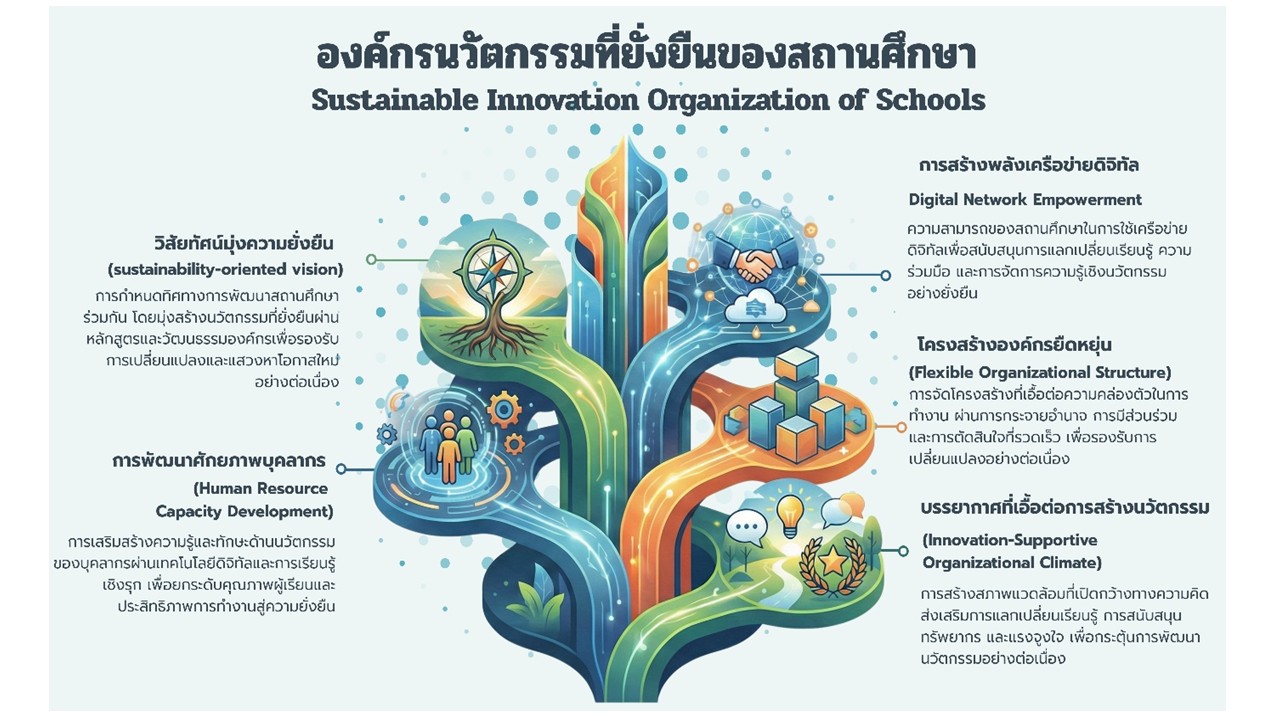
This research aims to investigate the current and desirable states, as well as the priority needs, of sustainable, innovative organizations in schools. The sample comprised 278 school administrators and teachers affiliated with the Bueng Kan Secondary Educational Service Area Office, determined using Krejcie and Morgan's table and stratified random sampling. The research instrument is a five-point Likert-scale questionnaire with a high reliability coefficient of 0.978. The data were analyzed using descriptive statistics and qualitative content analysis. The results indicated that the current level of sustainable innovative organizational development was moderate overall, whereas the desirable level was rated as very high. The needs assessment revealed that sustainability-oriented vision was the most critical development priority, with the highest Modified Priority Needs Index (PNIModified = 0.3918) Drawing on the empirical findings, a sustainable innovative organization framework was formulated, comprising five core dimensions: (1) sustainability-oriented vision, (2) digital network empowerment, (3) human resource capacity development, (4) flexible organizational structure, and (5) an innovation-supportive organizational climate.
Keywords: Innovation, Organizational Development, Sustainable Innovative Organization
Article Details

This work is licensed under a Creative Commons Attribution-NonCommercial-NoDerivatives 4.0 International License.
References
ขวัญชนนก แสงท่านั่ง. (2563). รูปแบบการพัฒนาสถานศึกษาสู่องค์กรแห่งนวัตกรรมสำหรับสถานศึกษา
ขั้นพื้นฐาน. วารสารสังคมศาสตร์และมานุษยวิทยาเชิงพุทธ, 5(7), 154–168.
ภาณุเดช แสนบุญเมือง. (2565). แนวทางการพัฒนาสู่องค์กรนวัตกรรมยุคเทคโนโลยีพลิกผันของสถานศึกษา
สังกัดสำนักงานเขตพื้นที่การศึกษาประถมศึกษาหนองคาย เขต 1. Interdisciplinary Academic and Research Journal, 5(1), มกราคม–กุมภาพันธ์ 2568.
พรทิพย์ โอษฐิเวช. (2566). แนวทางการเสริมสร้างการเป็นองค์กรนวัตกรรมของสถานศึกษาสังกัดสำนักงาน
เขตพื้นที่การศึกษามัธยมศึกษาอุบลราชธานี. การศึกษาค้นคว้าอิสระตามหลักสูตรปริญญาศึกษาศาสตรมหาบัณฑิต แขนงวิชาบริหารการศึกษา สาขาวิชาศึกษาศาสตร์ มหาวิทยาลัยสุโขทัยธรรมาธิราช.
วิโรจน์ สารรัตนะ. (2563). ภาวะผู้นำทางการศึกษา: ทฤษฎีและปฏิบัติ. กรุงเทพฯ: ทิพย์วิสุทธิ์.
สุชาติ ธาดาธำรงเวช.(2564).ผลของการใช้ปัญญาประดิษฐ์ (AI) ในการปรับเหมาะการเรียนการสอนต่อ
ผลสัมฤทธิ์ทางการเรียน. วารสารศึกษาศาสตร์, 32(2), 67–82.
สุวิมล ว่องวาณิช. (2558). การวิจัยประเมินความต้องการจำเป็น. กรุงเทพฯ: สำนักพิมพ์แห่งจุฬาลงกรณ์
มหาวิทยาลัย.
สำนักงานเขตพื้นที่การศึกษามัธยมศึกษาบึงกาฬ. (2566). แผนพัฒนาการศึกษา พ.ศ. 2566–2570: นโยบาย
เพื่อพัฒนาการจัดการศึกษาขั้นพื้นฐานที่สอดคล้องกับยุทธศาสตร์ชาติระยะ 20 ปี.
สำนักงานเลขาธิการสภาการศึกษา. (2560). แผนการศึกษาแห่งชาติ พ.ศ. 2560–2579. กรุงเทพมหานคร:
สำนักงานเลขาธิการสภาการศึกษา.
สำนักงานเลขาธิการสภาการศึกษา. (2567). การพัฒนานวัตกรรมกระบวนการ การนำนโยบายสู่การปฏิบัติ.
กรุงเทพฯ: สำนักงานเลขาธิการสภาการศึกษา.
Holder, B. J., & Matter, G. (2008). The innovative organization. Retrieved December 11, 2009.
Lawson, B., & Samson, D. (2001). Developing innovation capability in organisations: A dynamic
capabilities approach. International Journal of Innovation Management, 5(3),
–400.
OECD. (2018). Innovating education and educating for innovation: The power of digital
technologies and skills. OECD Publishing.
OECD. (2019). Education at a glance 2019: OECD indicators. OECD Publishing.
Tidd, J., Bessant, J., & Pavitt, K. (2001). Managing innovation (2nd ed.). Chichester: Wiley and Sons.
UNESCO. (2015). Education 2030: Incheon declaration and framework for action for the
implementation of Sustainable Development Goal 4. UNESCO.
UNESCO. (2017). Education for sustainable development goals: Learning objectives. UNESCO.
