
Confirmatory Factor Analysis of the Happy Workplace Model in Schools
Article Sidebar
Main Article Content
Abstract
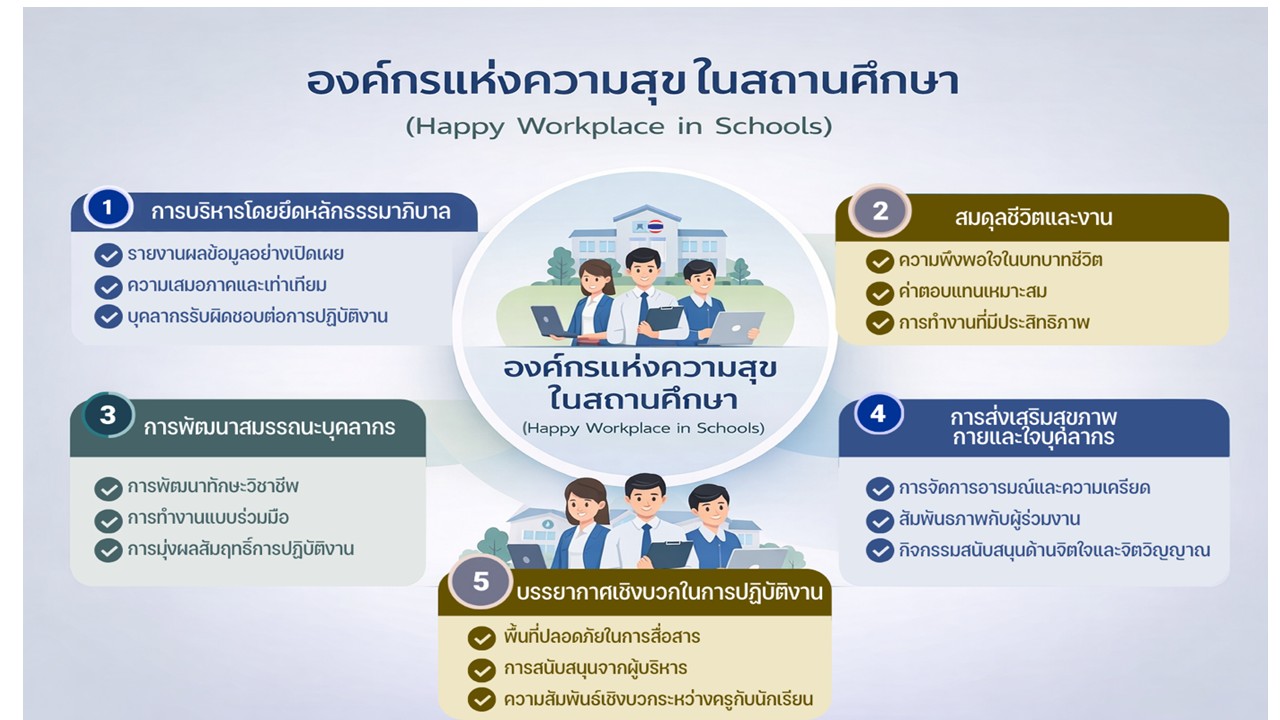
This study aimed 1) to investigate the components and indicators of the happy workplace in schools under the Nong Khai Primary Educational Service Area Office 2, and
2) to examine the goodness-of-fit of the indicator model of the happy workplace in schools under the Nong Khai Primary Educational Service Area Office 2 with empirical data.
The sample consisted of 300 school administrators and personnel, selected through a multistage sampling procedure. The research instrument was a 5-point Likert-scale questionnaire that was validated for content validity using the Index of Item–Objective Congruence (IOC) by 3 experts and demonstrated a high level of reliability, with an overall coefficient of 0.979. Data were analyzed using confirmatory factor analysis (CFA) in Mplus 7.0. The findings indicated that the happy organization in schools comprised five components with a total of 15 indicators: 1) governance-based administration (3 indicators), 2) work–life balance (3 indicators), 3) personnel competency development (3 indicators), 4) promotion of physical and mental health of personnel (3 indicators), and 5) a positive working atmosphere (3 indicators). In addition, the results of the model fit assessment revealed that the researcher's indicator model of a happy organization in schools was consistent and well aligned with the empirical data.
Keywords: Confirmatory Factor Analysis, Happy Workplace, Educational Administration, Organizational Happiness
Article Details

This work is licensed under a Creative Commons Attribution-NonCommercial-NoDerivatives 4.0 International License.
References
กระทรวงศึกษาธิการ. (2546). พระราชบัญญัติการศึกษาแห่งชาติ พุทธศักราช 2542 แก้ไขเพิ่มเติม
(ฉบับที่ 2) พุทธศักราช 2545. กรุงเทพมหานคร: คุรุสภา.
_______. (2566). รมว.ศธ.แถลงนโยบายการศึกษา “เรียนดี มีความสุข”. สืบค้นจาก https://
moe360.blog/2023/09/14/minister-ed-statement-ed-policy/
ขวัญเนตร สุขประดิษฐ์และกิตติ เหลาสุภาพ. (2565). บรรยากาศองค์การที่ส่งผลต่อคุณภาพชีวิต
การทำงานของนักวิชาการสาธารณสุขในโรงพยาบาลส่งเสริมสุขภาพตำบล จังหวัด
อุบลราชธานี. วารสารวิจัยและพัฒนาระบบสุขภาพ, 15(3), 1-13. https://he02.tci-
thaijo.org/index.php/RDHSJ/article/view/258148.
ณัฐพงษ์ น้อยโคตรและบุญชม ศรีสะอาด. (2565). ปัจจัยส่งเสริมความสุขในองค์กรการศึกษา.
วารสารการบริหารการศึกษาและการพัฒนา, 8(3), 77-95.
ธนิต สินศุภสว่าง. (2566). การพัฒนาสมรรถนะบุคลากรองค์กรปกครองส่วนท้องถิ่น. วารสาร
บัณฑิตศึกษาวิชาการ, 1(2), 25-32. https://so18.tci-thaijo.org/index.php/A_GJ/
article/view/165/103.
ธิดารัตน์ อินทรเสนี. (2565). บรรยากาศองค์การกับพฤติกรรมการเป็นสมาชิกที่ดีขององค์การของครู
โรงเรียนมัธยมศึกษา จังหวัดตรังและจังหวัดกระบี่. วารสารวิชาการวิทยาลัยการศึกษา,
(2), 45-56.
วรัญญา ดุษดี, พวงเพ็ชร์ วัชรอยู่, และอภิญญา หิรัญวงษ์. (2560). ผลกระทบของความผาสุกของ
พนักงาน ความสมดุลระหว่างชีวิตกับการทำงาน และวัฒนธรรมองค์การที่มีต่อความผูกพัน
ของพนักงานต่อองค์การของธุรกิจตัวแทนจำหน่ายรถยนต์. วารสารบริหารธุรกิจเทคโนโลยี
มหานคร, 14(1), 178-191.
ศราวุฒิ อินดาและวันทนา อมตาริกุล. (2565). แนวทางการพัฒนาสู่องค์กรแห่งความสุขของ
สถานศึกษาสังกัดสำนักงานเขตพื้นที่การศึกษาประถมศึกษาจังหวัดหนองคาย. วารสาร
ปัญญาปณิธาน, 7(1), 83-96.
สำนักงานกองทุนสนับสนุนการสร้างเสริมสุขภาพ (สสส.). (2559). ผนึกกำลังสร้าง ‘โรงเรียนแห่ง
ความสุข’ แดนอีสานล่าง. สืบค้นจาก https://www.thaihealth.or.th/ผนึกกำลังสร้าง-
โรงเรีย/
_______. (2566). สุขภาวะแบบองค์รวมในองค์กรยุคใหม่ สร้างได้ ด้วย Happy Workplace.
สืบค้นจาก https://www.thaihealth.or.th/สุขภาวะแบบองค์รวมในองค/
_______. (2567). คู่มือสร้างเสริมองค์กรสุขภาวะ. สำนักสนับสนุนสุขภาวะองค์กร (สำนัก 8).
สืบค้นจาก https://happy8workplace.thaihealth.or.th/books-videos/books/254
สำนักงานเขตพื้นที่การศึกษาประถมศึกษาหนองคาย เขต 2. (2568). แผนปฏิบัติการประจำปี
งบประมาณ พ.ศ. 2568. หนองคาย: สำนักงานเขตพื้นที่การศึกษาประถมศึกษาหนองคาย
เขต 2.
สำนักงานสภาพัฒนาการเศรษฐกิจและสังคมแห่งชาติ. (2561). ยุทธศาสตร์ชาติ 20 ปี (พ.ศ. 2561-
. สำนักนายกรัฐมนตรี.
สิริวดี ชูเชิด. (2565). การพัฒนาสมรรถนะบุคลากรในการปฏิบัติงานให้มีประสิทธิภาพ. วารสารวไลย
อลงกรณ์ปริทัศน์ (มนุษยศาสตร์และสังคมศาสตร์), 12(1), 223-238.
สุภชา นิตยนันท์. (2565). ความสมดุลในชีวิตและการทํางานของพนักงาน บริษัท เอเวอร์กรีน
คอนเทนเนอร์เทอร์มินัล (ประเทศไทย) จำกัด. มหาวิทยาลัยรามคําแหง. สืบค้นจาก
https://mmm.ru.ac.th/mmm/is/sat18/6314060023.pdf.
องค์การการศึกษา วิทยาศาสตร์ และวัฒนธรรมแห่งสหประชาชาติ (ยูเนสโก). (2563). โรงเรียนแห่ง
ความสุข!: กรอบแนวคิดเพื่อความเป็นอยู่ที่ดีของผู้เรียนในภูมิภาคเอเชียและแปซิฟิก
(ฉบับย่อ). สำนักงานยูเนสโก กรุงเทพฯ. สืบค้นจาก https://unesdoc.unesco.org/ark:/
/pf0000374061
อธิคุณ สินธนาปัญญาและคณะ. (2557). การบริหารความสุขในสถานศึกษา. วารสารสุทธิปริทัศน์, 28(88), 15-32.
อุมาพร สีสุริยาและวานิช ประเสริฐพร. (2565). ความสัมพันธ์ระหว่างบรรยากาศองค์การกับการเป็น
ชุมชนการเรียนรู้ทางวิชาชีพในโรงเรียนขยายโอกาสทางการศึกษา สังกัดสำนักงานเขตพื้นที่
การศึกษาประถมศึกษาขอนแก่น เขต 2. วารสารวิจัยและพัฒนาระบบสุขภาพ, 7(2), 323-
https://so02.tci-thaijo.org/index.php/JRKSA/article/view/252626
Chupanich, P., Aotprapai, P., Seesophon, S., & Laoraksawong, P. (2024). Factors
associated with stress among healthcare personnel after COVID-19 in northeast
Thailand: A cross-sectional study. Clinical Practice & Epidemiology in Mental
Health, 20(1), Article e17450179327231. https://clinical-practice-and-epidemiology-in-
mental-health.com/VOLUME/20/ELOCATOR/e17450179327231/FULLTEXT/.
Keeves, J. P. (1997). Educational research, methodology, and measurement:
An international handbook (2nd ed.). Oxford: Pergamon.
Suavansri, P., Pichayayothin, N., Espinosa, P. R., Areekit, P., Nilchantuk, C., Jones, T. S.,
… Heaney, C. A. (2022). Well-being in Thailand: A culturally driven grounded
inquiry exploration of a complex construct. Applied Research in Quality of
Life, 17, 3327-3347. https://doi.org/10.1007/s11482-022-10067-7.
United Nations Development Programme (UNDP). 2021. Governance for sustainable
development: Principles and practices. New York, NY: UNDP.
https://www.undp.org/publications/governance-sustainable-development.
United Nations. (2025). The Sustainable Development Goals Report 2025. United
Nations Department of Economic and Social Affairs. Retrieved from
https://unstats.un.org/sdgs/report/2025/The-Sustainable-Development-Goals-Report-
University of Oxford. (2023). Happiness and productivity: New evidence from
British Telecom employees. Retrieved from https://wellbeing.hmc.ox.ac.uk/
news/productivity-management-science
Vale, A. P., Ribeiro, L. M., & Alves, J. M. (2025). Happiness in school organizations: the
role of leadership (a scoping review). Frontiers in Education, 10, 1541533. https://doi
.org/10.3389/feduc.2025.1541533.
