
Confirmatory Factor Analysis of Digital Learning Culture
Article Sidebar
Main Article Content
Abstract
This study aimed to 1) investigate the components and indicators of digital learning culture for schools under the Secondary Educational Service Area Office Nong Khai, and
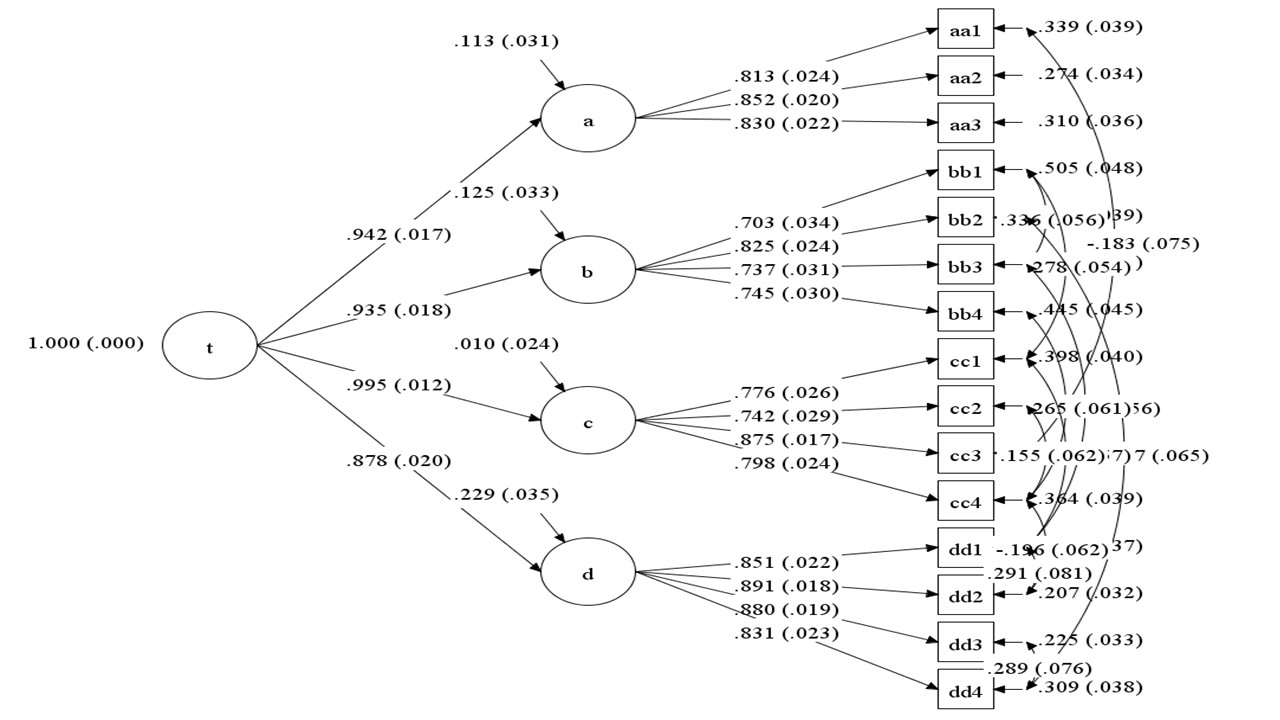
2) Examine the congruence of the digital learning culture component model and its indicators with empirical data. The research sample consisted of 285 participants, including school administrators and teachers, selected through a multistage sampling procedure. The research instrument was a 5-point Likert scale questionnaire, which was validated for Content Validity (IOC) by three experts and yielded a total reliability coefficient of 0.972. Data analysis was performed using Confirmatory Factor Analysis (CFA) in Mplus 7.0. The results indicated that the digital learning culture comprises 4 components and 15 indicators, namely:
1) Values of Collaborative Work in Online Communities (3 indicators), 2) Digital Competence (4 indicators), 3) Digital Learning Environment (4 indicators), and 4) Digital Leadership
(4 indicators). Furthermore, the analysis showed that the digital learning culture component model fit the empirical data well.
Keywords: Confirmatory Factor Analysis, Learning Culture, Digital Learning Culture
Article Details

This work is licensed under a Creative Commons Attribution-NonCommercial-NoDerivatives 4.0 International License.
References
กระทรวงดิจิทัลเพื่อเศรษฐกิจและสังคม. (2562). รายงานประจำปี 2562 กระทรวงดิจิทัลเพื่อเศรษฐกิจและ สังคม. กรุงเทพฯ: สำนักงานปลัดกระทรวงดิจิทัลเพื่อ
เศรษฐกิจและสังคม.
กระทรวงศึกษาธิการ. (2563). นโยบายและจุดเน้นกระทรวงศึกษาธิการ ปีงบประมาณ 2563. ค้นเมื่อ 5 กันยายน 2568, จาก
https://www2.chaiyaphum3.go.th/main/files/obec/moe_point63.pdf
กิตติภูมิ นามวงค์. (2565). ภาวะผู้นำดิจิทัลของผู้บริหารสถานศึกษาที่ส่งผลต่อการเป็นโรงเรียนนวัตกรรม. วารสารการบริหารและนวัตกรรมการศึกษา.
ก่อศักดิ์ อาชวากร. (2567). Cultivating a Digital-First Culture เนื้อแท้ของวัฒนธรรมที่ให้ความสำคัญกับเทคโนโลยีดิจิทัลเป็นอันดับแรก. ค้นเมื่อ 18 สิงหาคม
, จาก https://irev.co.th/th/articles/292179-cultivating-a-digital-first-culture
ถนอมพร เลาหจรัสแสง. (2561). นวัตกรรมเทคโลยีสารสนเทศเพื่อการศึกษาในยุคการเรียนรู้ 4.0 เชียงใหม่ : ตองสาม ดีไซน์.
นัฐพัชร สมงาม พนิดา นิลอรุณ และ ชลภัสสรณ์ สิทธิวรงค์ชัย. (2568). การพัฒนาสมรรถนะดิจิทัลและประสิทธิภาพการทำงาน. วารสารสังคมศาสตร์ปัญญาพัฒน์.
(3), 503-518.
ประมุข ชูสอน. (2560). การพัฒนาตัวบ่งชี้สมรรถนะภาวะผู้นำของคณบดีคณะครุศาสตร์/ศึกษาศาสตร์. วิทยานิพนธ์ปริญญาปรัชญาดุษฎีบัณฑิต สาขาวิชาการบริหาร
การศึกษา บัณฑิตวิทยาลัย มหาวิทยาลัยขอนแก่น.
รติยากร คชา และดาวรุวรรณ ถวิลการ. (2565). รูปแบบการพัฒนาวัฒนธรรมการเรียนรู้เชิงดิจิทัลในโรงเรียนประถมศึกษา สังกัดสำนักงานเขตพื้นที่การศึกษาประถม
ศึกษาชัยภูมิเขต 3. ขอนแก่น: คณะศึกษาศาสตร์ มหาวิทยาลัยขอนแก่น.
วรากรณ์ สามโกเศศ. (2564). การศึกษาไทยกับความท้าทายในยุคโควิด-19. กรุงเทพฯ: มติชน.
ศศิมา สุขสว่าง. (2563). The new normal กับการปรับตัวสำหรับการเปลี่ยนแปลงในยุค Digital Transformation. ค้นเมื่อวันที่ 5 กันยายน 2568, จาก
https://www.sasimasuk.com/17203943/the-new-normal.
สริษา คำหนัก สถิรพร เชาวน์ชัย และกฤธยากาญจน์ โตพิทักษ์. (2567). ความสัมพันธ์ระหว่างภาวะผู้นำดิจิทัลกับการส่งเสริมการใช้เทคโนโลยีในการจัดการเรียนรู้
ของผู้บริหารสถานศึกษาในโรงเรียน สังกัดสำนักงานเขตพื้นที่การศึกษาประถมศึกษาตาก เขต 1. วารสารมณีเชษฐาราม. 7(2), 143-157.
สำนักงานเขตพื้นที่การศึกษามัธยมศึกษาหนองคาย. (2568). แผนการบริหารและพัฒนาทรัพยากรบุคคล ประจำปีงบประมาณ พ.ศ. 2568. หนองคาย: สำนักงานเขต
พื้นที่การศึกษามัธยมศึกษาหนองคาย.
___________________________________. (2568). แผนยุทธศาสตร์หรือแผนพัฒนา สำนักงานเขตพื้นที่การศึกษาหนองคาย. ค้นเมื่อ วันที่ 17 กันยายน 2568,
สำนักงานเลขาธิการสภาการศึกษา. (2560). แผนการศึกษาแห่งชาติ พ.ศ. 2560-2579. กรุงเทพฯ: สำนักงานเลขาธิการสภาการศึกษา.
Amna Bibi & Muhammad Akram. (2022). Effect of Organizational Learning Culture on School Effectiveness. Global Educational Studies
Review, 7(4): 27-39.
Dirk Ifenthaler, Sandra Hofhues, Marc Egloffstein, & Christian Helbig. (2021). Digital Transformation of Learning Organizations. Cham,
Switzerland; Springer Nature.
Eko Nurhaji Purnomo. (2024). Transformation of Digital-Based School Culture: implications of change management on Virtual Learning
Environment integration. COGENT EDUCATION. 11(1), 1-17.
Guven, G., & Gulbahar, Y. (2020). Building a digital learning culture by rethinking pedagogies for the 21st century. Retrieved from
Pedagogies_for_the_21st_Century
Lauren Landry. (2019). 8 Essential Leadership Communication Skills. Retrieved January 10, 2026, from
https://online.hbs.edu/blog/post/leadership-communication.
Mishra, P. & Koehler, M. J. (2006). Technological pedagogical content knowledge: A framework for teacher Knowledge. The Teachers
College Record, 108(6), 1017-1054.
OECD. (2020). TALIS 2018 Results (Volume II): Teachers and School Leaders as Valued Professionals. Paris: OECD Publishing.
Robert A. Coleman. (2024). What Is a Digital Culture and Why is it Important? Retrieved September 4, 2025, from
https://www.td.org/content/atd-blog/learning-culture-structure-strategy- and-practices
Sohan Swain. (2025). What is Digital Culture? Retrieved September 6, 2025, from https://www.simpplr.com/glossary/digital-culture/
Ward, G. (2020). How To Build A Digital Learning Culture In Your Organization. Retrieved September 1, 2025, from
https://elearningindustry.com/build-digitallearning-culture-organization
