
Factors of Collaborative Networks Affecting the Sustainability of the Cooperative Movement in Thailand
Article Sidebar
Main Article Content
Abstract
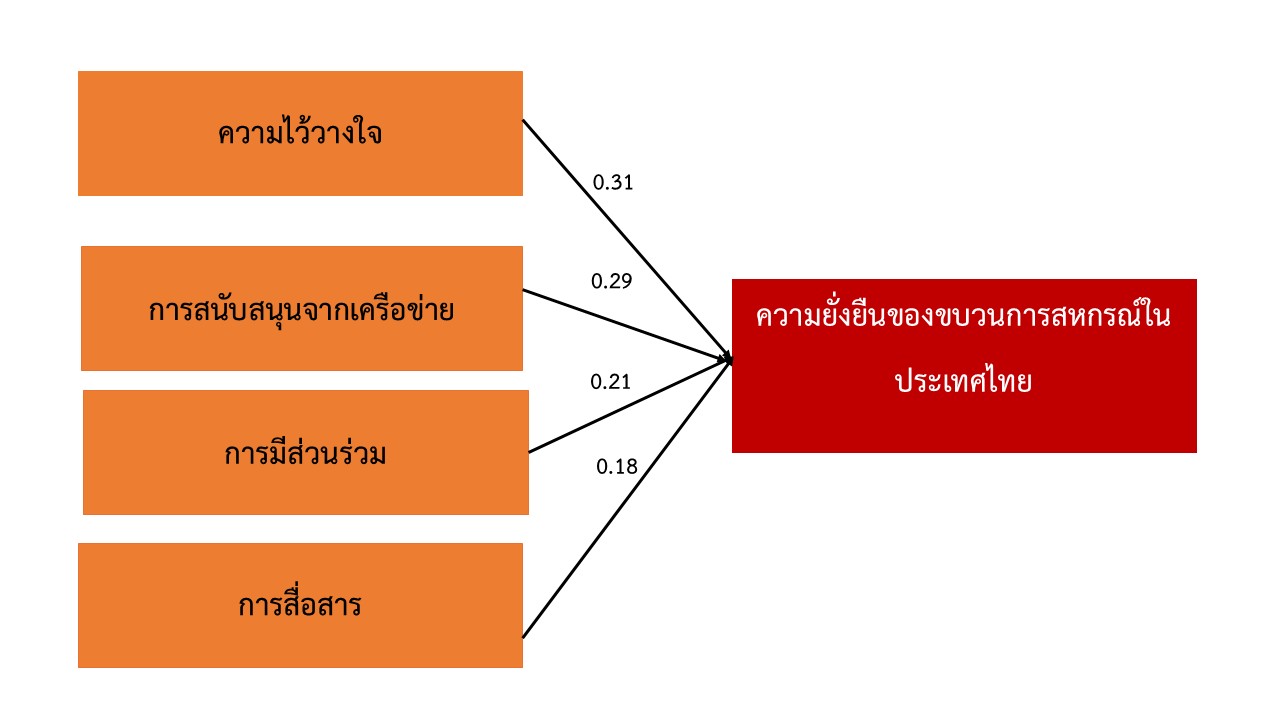
This research aimed to (1) study the level of cooperation networks of the cooperative movement in Thailand and (2) analyze the influence of cooperation network factors on the sustainability of the cooperative movement in Thailand. The research was quantitative, with a sample of 400 cooperative committees and management in Thailand. The instrument used was a 5-level Likert scale questionnaire with a reliability coefficient of 0.963. The statistical methods used to analyze the data included percentages, means, standard deviations, Pearson correlation coefficients, and stepwise multiple regression analysis. The research results showed that (1) the overall cooperation network factor was at a high level, with network support having the highest average score, followed by trust, communication, and participation, respectively; (2) the overall sustainability of the cooperative movement in Thailand was at a high level, with the social aspect having the highest average score, followed by the economic aspect and the management aspect; and (3) the cooperation network factor could collectively predict the sustainability of the cooperative movement in Thailand with statistical significance at the .01 level, explaining 61% of the variance. The most influential variable was trust, followed by network support, participation, and communication, respectively. The research results indicate that cooperation networks are an important mechanism for strengthening the sustainability of the Thai cooperative movement, especially by building trust and support among network partners, thereby increasing the operational potential and stability of cooperatives in the long term.
Keywords: Collaboration Networks, Sustainability, Cooperatives, Social Capital
Article Details

This work is licensed under a Creative Commons Attribution-NonCommercial-NoDerivatives 4.0 International License.
References
กรมส่งเสริมสหกรณ์. (2566). รายงานผลการดำเนินงานสหกรณ์ประจำปี. chrome-extension://efaidnbmnnnibpcajpcglclefindmkaj/https://cpd.go.th/images2/2024/CPD_Annual_Report/CPD_Annual_Report_2566_Edit.pdf
จุมพล อุดมภาคสกุล. (2554). แนวทางการพัฒนาการเชื่อมโยงเครือข่ายธุรกิจของสหกรณ์และกลุ่มเกษตรกร ในจังหวัดแพร่. นนทบุรี: มหาวิทยาลัยสุโขทัยธรรมาธิราช.
ญดาพัชร สุพรรณชาติ. (2565). ปัจจัยที่มีผลต่อการมีส่วนร่วมในการดำเนินธุรกิจสหกรณ์: กรณีศึกษาสหกรณ์ ออมทรัพย์กรมการพัฒนาชุมชน จำกัด. กรุงเทพฯ: คณะรัฐศาสตร์ มหาวิทยาลัยธรรมศาสตร์.
นัจรินทร์ อัมพรมหา. (2566). แนวทางการพัฒนาประสิทธิภาพการดำเนินงานของสหกรณ์เครดิตยูเนี่ยนไทย ฮอนด้า จำกัด กรุงเทพมหานคร. นนทบุรี: มหาวิทยาลัยสุโขทัยธรรมาธิราช.
พรรณราย ละตา. (2563). ความยั่งยืนในการดำเนินงานของสหกรณ์การเลี้ยงปศุสัตว์ กรป.กลาง โพนยางคำ จำกัด. วารสารเกษตรพระจอมเกล้า, 38(1), 82–92.
วิฑูร สิมะประเสริฐ. (2568). บทบาทของสถาบันการเงินชุมชนในการเสริมสร้างความมั่นคงทางเศรษฐกิจระดับ ฐานราก. วารสารสังคมศาสตร์และวัฒนธรรม, 9(4), 267–281.
วิฑูรย์ วิทโยภาส. (2564). หลักการสหกรณ์ต่อวิถีประชาธิปไตย. วารสารวิชาการไทยวิจัยและการจัดการ, 2(1), 122–131.
สมภพ จูโล่ห์. (2567). การพัฒนาด้านสังคมเพื่อการพัฒนาที่ยั่งยืนขององค์กร. Journal of Management and Development Ubon Ratchathani Rajabhat University, 11(1), 258–295.
เอนก ถนอมทรัพย์. (2549). การศึกษาบทบาทของสหกรณ์เครดิตยูเนี่ยนในการสร้างความเข้มแข็งเศรษฐกิจ ชุมชน (กรณีศึกษาสหกรณ์เครดิตยูเนี่ยนชุมชนคลองจั่น จำกัด). เอกสารรายงานวิชาการส่วนบุคคล หลักสูตรประกาศนียบัตรชั้นสูงการบริหารงานภาครัฐและกฎหมายมหาชน รุ่นที่ 5 สถาบัน พระปกเกล้า.
Ansell, C., & Gash, A. (2008). Collaborative governance in theory and practice. Journal of Public Administration Research and Theory, 18, 543–571. https://doi.org/10.1093/jopart/mum032
Bryson, J. M., Crosby, B. C., & Bloomberg, L. (2014). Public value governance: Moving beyond traditional public administration and the new public management. Public Administration Review, 74(4), 445–456. https://doi.org/10.1111/puar.12238
Bryson, J. M., Crosby, B. C., & Stone, M. M. (2015). Designing and implementing cross-sector collaborations: Needed and challenging. Public Administration Review, 75(5), 647–663. https://doi.org/10.1111/puar.12432
Mikiewicz, P. (2021). Social capital and education – An attempt to synthesize conceptualization arising from various theoretical origins. Cogent Education, 8(1). https://doi.org/10.1080/2331186X.2021.1907956
Organisation for Economic Co-operation and Development. (2020). OECD economic outlook 2020. OECD Publishing.
Provan, K. G., & Kenis, P. (2008). Forms of network management: Structure, management, and effectiveness. Journal of Public Administration Research and Theory, 18, 229–252. https://doi.org/10.1093/jopart/mum015
Putnam, R. D. (2000). Bowling alone: The collapse and revival of American community. Simon & Schuster.
