
Cho Prae: Beliefs of people in the Year of the Tiger and the legend of coming to pay homage to Phra That Cho Hae
Article Sidebar
Main Article Content
Abstract
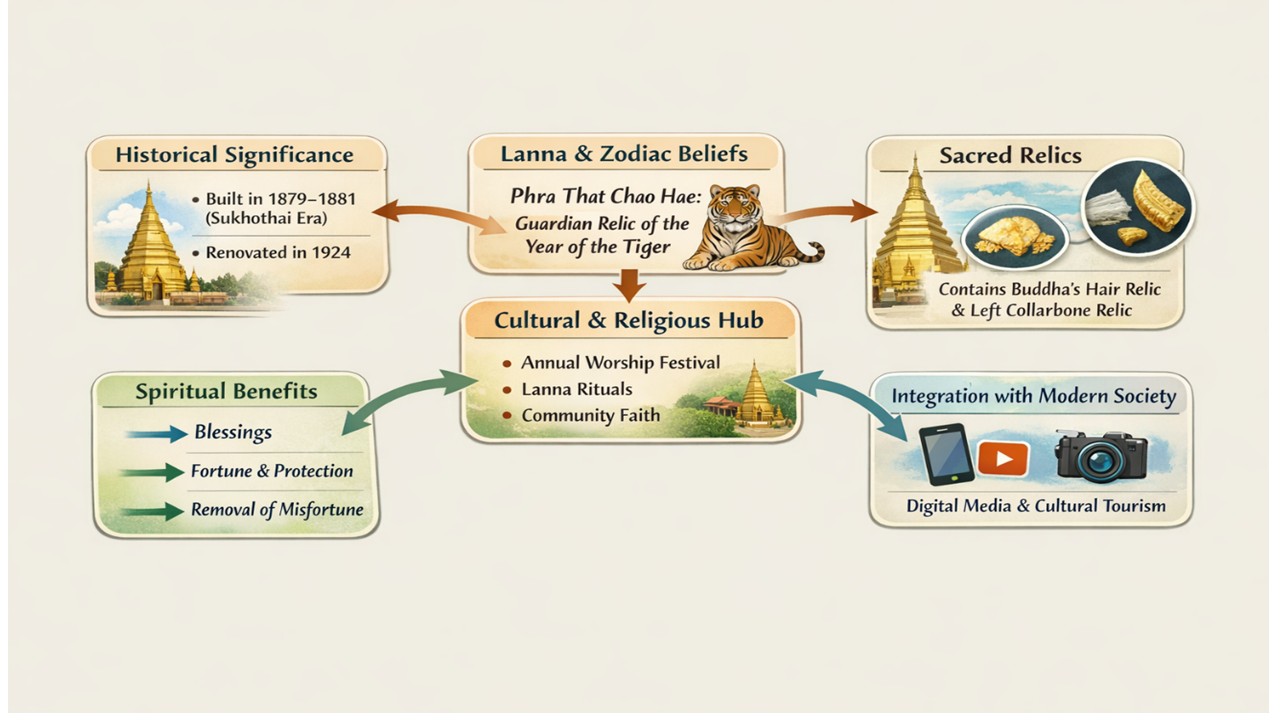
This research aimed to: 1) study the historical background of Phra That Cho Hae, and 2) examine the beliefs of people born in the Year of the Tiger in relation to the legend of paying homage to the pagoda. The study employed purposive sampling. The key informants consisted of monks, the abbot of Wat Phra That Cho Hae, local scholars, historians of Phrae, community elders, and local sages. The practitioner group included individuals born in the Year of the Tiger who traveled to worship the pagoda, participants in annual rituals, and organizers or those involved in the ceremonies. The general group comprised tourists, local residents not born in the Year of the Tiger, and young people in the area. This study adopted a qualitative cultural research approach. Data were collected through surveys, interviews, observations, focus group discussions, and workshops, and were analyzed using content analysis. The findings revealed that: 1) Phra That Cho Hae was an important sacred site of Phrae Province with a long historical background closely associated with Lanna Buddhism. Local legends mentioned the enshrinement of the Buddha’s relics and the construction of the pagoda, reflecting Lanna artistic styles and the faith of past communities. 2) Phra That Cho Hae was regarded as the pagoda of the Year of the Tiger. Individuals born in the Year of the Tiger traditionally traveled to pay homage in order to gain auspiciousness, enhance their destiny, and achieve prosperity in life. This belief had been transmitted through legends, oral traditions, and annual rituals. As a result, Phra That Cho Hae remained a spiritual center for both local residents and Buddhists from other areas. In conclusion, Phra That Cho Hae was not only valuable in terms of history and architecture but also functioned as a center of belief and cultural identity, reflecting the relationship between religion, zodiac beliefs, and the way of life of people in Lanna society continuously up to the present time.
Keywords: Phra That Cho Hae (Pagoda); Year of the Tiger; Belief
Article Details

This work is licensed under a Creative Commons Attribution-NonCommercial-NoDerivatives 4.0 International License.
References
ในตะวัน กำหอม. (2559). การวิจัยทางสังคมศาสตร์และวัฒนธรรมศาสตร์. โรงพิมพ์ทีคอมมหาสารคาม.วิทยาลัยทองสุข.
ในตะวัน กำหอม. (2559). ผ้าหมี่ : การอนุรักษ์และพัฒนาเพื่อส่งเสริมวิถี วัฒนธรรมชุมชน ตำบลขวาวอำเภอเสลภูมิ จังหวัดร้อยเอ็ดความหลากหลายทางวัฒนธรรม. คณะวัฒนธรรมศาสตร์ มหาวิทยาลัยมหาสารคาม ฉบับที่ 26 ปีที่ 12 เดือน พฤษภาคม-สิงหาคม
กรมศิลปากร. (2539). ศิลปะล้านนา. กรุงเทพฯ: กรมศิลปากร.
กรมศิลปากร. (2545). พระราชบัญญัติโบราณสถาน โบราณวัตถุ ศิลปวัตถุ และพิพิธภัณฑสถานแห่งชาติ. กรุงเทพฯ: กรมศิลปากร.
ฉัตรทิพย์ นาถสุภา. (2543). วัฒนธรรมกับการเปลี่ยนแปลงทางสังคม. กรุงเทพฯ: สำนักพิมพ์จุฬาลงกรณ์มหาวิทยาลัย.
ดำรงราชานุภาพ, สมเด็จฯ กรมพระยา. (2513). พงศาวดารสุโขทัย. กรุงเทพฯ: คลังวิทยา.
ทรงคุณ จันทจร. (2553). การวิจัยเชิงคุณภาพทางวัฒนธรรมชั้นสูง. มหาสารคาม : สถานบันวิจัยศิลปและวัฒนธรรมอีสาน,
ภาณุรังษี เดือนโฮ้ง (2566) ช่อแฮศรีเมือง : ทุนทางวัฒนธรรมกับแนวทางการพัฒนาเศรษฐกิจ สร้างสรรค์ในพื้นที่ชุมชน ตำบลช่อแฮ อำเภอเมือง จังหวัดแพร่,คณะมนุษยศาสตร์และสังคมศาสตร์ มหาวิทยาลัยราชภัฏอุตรดิตถ์.
วัดพระธาตุช่อแฮ พระอารามหลวง. (ม.ป.ป.). ประวัติพระธาตุช่อแฮ. แพร่: วัดพระธาตุช่อแฮ พระอารามหลวง
ศรีศักร วัลลิโภดม. (2544). ล้านนา: พัฒนาการทางประวัติศาสตร์และวัฒนธรรม. กรุงเทพฯ: เมืองโบราณ.
สรัสวดี อ๋องสกุล. (2554). ประวัติศาสตร์ล้านนา. กรุงเทพฯ: อมรินทร์.
สุจิตต์ วงษ์เทศ. (2551). ตำนานพระธาตุในล้านนา. กรุงเทพฯ: มติชน.
Berger, P. L. (1967). The Sacred Canopy. New York: Anchor Books.
Berger, P. L. (1999). The Desecularization of the World. Washington, D.C.: Ethics and Public Policy Center.
Eliade, M. (1959). The Sacred and the Profane. New York: Harcourt.
Penth, H. (2004). A Brief History of Lan Na. Chiang Mai: Silkworm Books.
