
Muay Thai: Soft Power for Development in Economic and Social
Article Sidebar
Main Article Content
Abstract
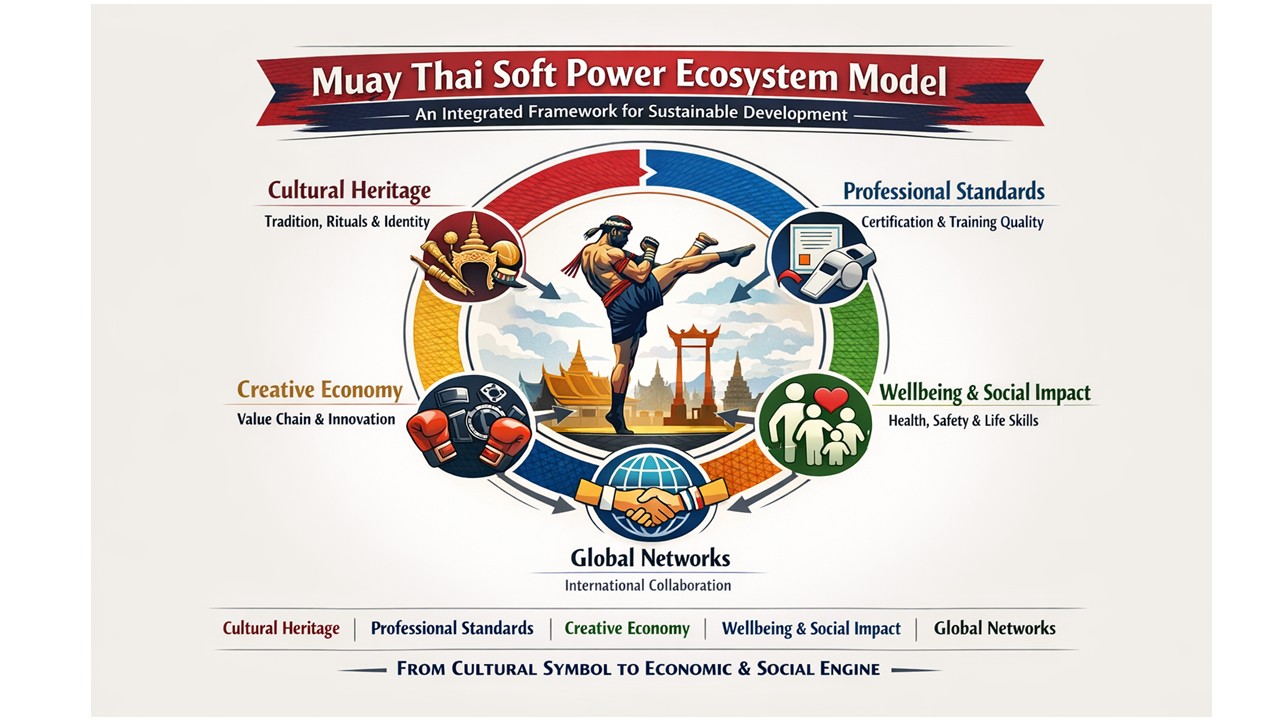
This research aims to 1) examine perspectives, opinions, and needs regarding the use of Muay Thai as a soft power tool for economic and social development; and 2) provide guidelines and policy recommendations for utilizing the influence of Muay Thai as a sustainable economic and social soft power tool. This research employs a qualitative research method. The population and informants consisted of: 1) boxing camp heads, 2) boxing camp managers, 3) boxing event managers, 4) Thai professional Muay Thai boxers, 5) foreign professional Muay Thai boxers, 6) representatives from the Ministry of Culture, and 7) representatives from the Ministry of Tourism and Sports. A purposive sampling method was used. The research instrument was an interview questionnaire. Data were analyzed using interpretive and content analysis. The research findings revealed that 1) the concept of soft power refers to cultural influence that creates attraction without coercion. Muay Thai is considered a significant soft power asset for Thailand, recognized as a martial art, cultural heritage, and creative economy asset. Development should integrate strategies from the government, private sector, and community, preserving traditional identity while leveraging it commercially, establishing standards, and utilizing digital platforms to drive the economy, tourism, and national image sustainably through domestic and international collaboration networks. 2) Promoting Muay Thai as sustainable soft power requires an integrated approach encompassing camp standards, competitions, management, welfare, and marketing. A national strategy with clear indicators is needed, along with the establishment of a database and support fund. The quality of life and post-competition careers of Muay Thai fighters should be improved, while traditional rituals are preserved. International cooperation should be expanded, and tourism and digital marketing should be promoted. This requires systematic collaboration across all sectors for sustainability.
Keywords: Muay Thai, Soft Power, Development Benefits, Economy and Society
Article Details

This work is licensed under a Creative Commons Attribution-NonCommercial-NoDerivatives 4.0 International License.
References
กรมส่งเสริมวัฒนธรรม. (2555). เกณฑ์การคัดเลือกมรดกภูมิปัญญาทางวัฒนธรรมของชาติ. กรุงเทพฯ: กรมส่งเสริมวัฒนธรรม กระทรวงวัฒนธรรม.
การกีฬาแห่งประเทศไทย. (2567). แผนกลยุทธ์ซอฟต์พาวเวอร์แห่งชาติ เพื่อประโยชน์ด้านเศรษฐกิจ สังคม และความมั่นคงแห่งชาติด้านกีฬามวยไทย. คณะอนุกรรมาธิการพิจารณาศึกษาแผนกลยุทธ์ซอฟต์พาวเวอร์ ด้านกีฬา ศิลปะการต่อสู้ การท่องเที่ยว. สำนักงานเลขาธิการวุฒิสภา.
เขมนิจ มาลาเว. (2567). ซอฟต์พาวเวอร์ไทย:ความเข้าใจ อุปสรรค และโอกาสการพัฒนาในเวทีโลก. วารสารวิทยาการจัดการ มหาวิทยาลัยราชภัฏธนบุรี, 6(1), 141-158.
ณดา จันทร์สม. (2567). ขับเคลื่อนเศรษฐกิจสร้างสรรค์เป็นซอฟท์พาวเวอร์ เพื่อการพัฒนาที่ยั่งยืน. สืบค้น 1 ตุลาคม 2567, จาก https://nida.ac.th/economy-into-soft-power-for-sustainable-development/
ธัญลักษณ์ หงส์โต, ธีระวัฒน์ จันทึก และพิทักษ์ ศิริวงศ์. (2566). แนวทางการพัฒนาเกณฑ์การประเมินการจัดการคุณภาพมาตรฐานของค่ายมวยไทย. วารสารการเมือง การบริหาร และกฎหมาย, 12(3), 315-333.
ธีวินท์ สุพุทธิกุล. (2567). Soft power ที่คุณฝันถึงและข้อคำนึงบางประการ. สืบค้นจาก https://www.the101.world/soft-power-misconceptions/
นปภัสร์ ชูสุวรรณ. (2560). ปัจจัยด้านการตลาดที่มีอิทธิพลต่อความต้องการเดินทางท่องเที่ยวเพื่อมาชมมวยไทยของนักท่องเที่ยวต่างชาติ. วิทยานิพนธ์ (ศศ.ม.) สาขาวิชาการจัดการอุตสาหกรรมการบริการและการท่องเที่ยว บัณฑิตวิทยาลัย มหาวิทยาลัยกรุงเทพ.
นพรัตน์ พบลาภ และสุดเฉลิม ศัสตราพฤกษ์. (2567). นโยบายซอฟต์พาวเวอร์: การบริหารเศรษฐกิจสร้างสรรค์เพื่อการพัฒนาศักยภาพอุตสาหกรรมการท่องเที่ยวเชิงวัฒนธรรมของชุมชนบ้านคลองแค จังหวัดสมุทรสาคร. วารสารมนุษยศาสตร์และสังคมศาสตร์มหาวิทยาลัยธนบุรี, 18(2), 139-154.
สำนักงานส่งเสริมวัฒนธรรมสร้างสรรค์. (2566). ซอฟต์พาวเวอร์ของประเทศไทย: แนวทางการขับเคลื่อน 5F (Fighting, Fashion, Food, Film, Festival). กระทรวงวัฒนธรรม.
สุภาพิชญ์ ถิระวัฒน์. (2565). Soft Power อำนาจละมุน ร้อยเรื่องเมืองไทย. สืบค้น 10 กันยายน 2567, จาก https://library.parliament.go.th/th/radioscript/rr2565-may7
สุรเชษฐ์ ชัยวงศ์ และต่อศักดิ์ แก้วจรัสวิไล. (2566). มวยไทย: อำนาจอ่อนที่ทรงอิทธิพล. วารสารกองทุนพัฒนาสื่อปลอดภัยและสร้างสรรค์, 2(1), 1-13.
โสพิชา เถกิงเกียรติ และชยาพล ชมชัยยา. (2566). ช่องทางการรับรู้ของคนไทยต่อการจัดแสดง Soft Power ของรัฐบาล ในการประชุม APEC 2022. วารสารกองทุนพัฒนาสื่อปลอดภัยและสร้างสรรค์, 2(1), 15-42.
Joseph S. Nye, Jr. (2005). The future of Power (United State: Public Affairs, pp. 94-95.
Joseph S. Nye. (2004). Soft Power the Mean to Success in World Politics. United State: Public Affairs.
Ministry of Education. (2008). Basic education core curriculum B.E. 2551 (A.D. 2008). Bangkok: Agricultural Cooperative Federation of Thailand Limited.
OECD. (2021). Education at a glance 2021: OECD indicators. OECD Publishing. https://doi.org/10.1787/b35a14e5-en.
