
Organizing Educational Game Activities to Promote the Use of the Five Senses among Preschool Children: A Case Study of the Child Development Center, Nararatchakwai Subdistrict Administrative Organization, Mueang District, Nakhon Phanom Province
Article Sidebar
Main Article Content
Abstract
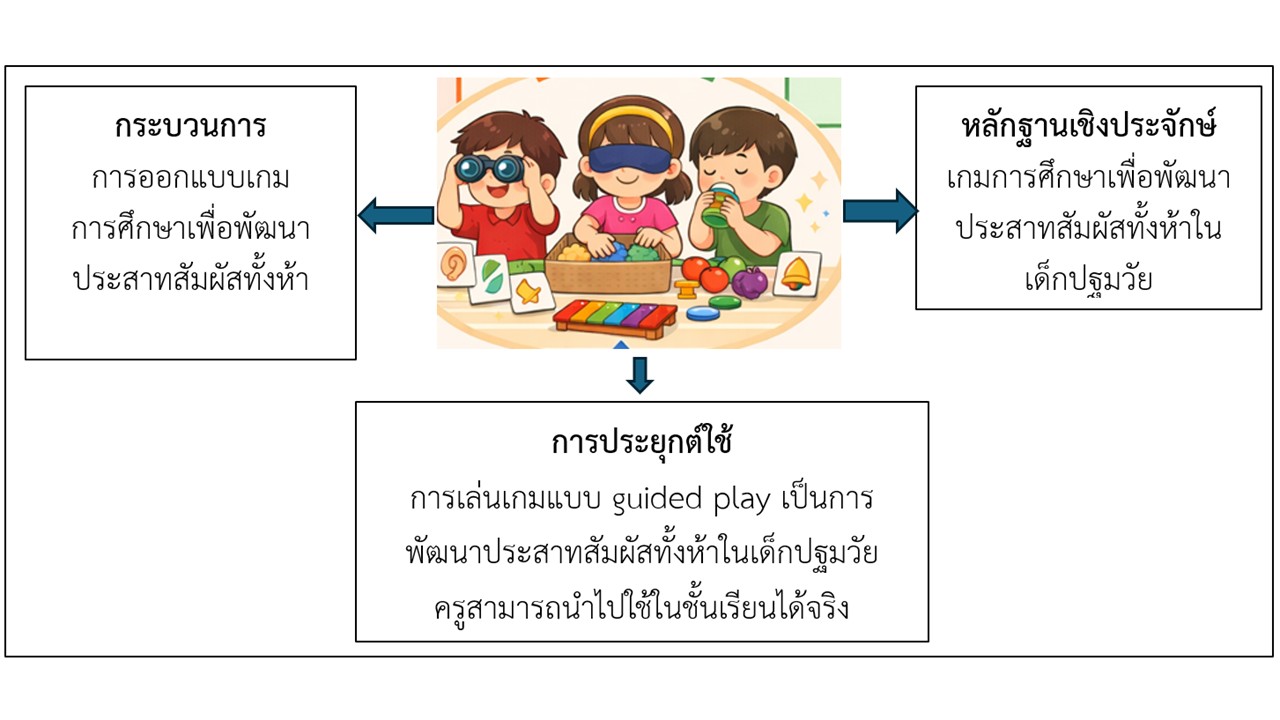
Educational games are learning activities that stimulate preschool children’s use of the five senses in an enjoyable, developmentally appropriate manner, thereby naturally promoting holistic development. This study aimed to: (1) examine preschool children’s use of the five senses after participating in educational game-based activities; and (2) compare preschool children’s use of the five senses before and after participating in the educational game-based activities. The target group consisted of 21 preschool children selected through purposive sampling. The research instruments included experience-based learning plans and a five-senses assessment form. Data were analyzed using percentage, mean, standard deviation, and hypothesis testing with the Wilcoxon Signed-Rank Test. The findings showed that: (1) after participating in the educational game-based activities, preschool children demonstrated the use of all five senses, with a post-activity mean score of 3.00, equivalent to 100%; and (2) preschool children who participated in the educational game-based activities showed significantly higher use of the five senses after the intervention than before the intervention, at the .05 level of statistical significance.
Keywords: Educational Games, Five Senses, Early Childhood Children, Child Development Center
Article Details

This work is licensed under a Creative Commons Attribution-NonCommercial-NoDerivatives 4.0 International License.
References
กระทรวงศึกษาธิการ. (2560). หลักสูตรการศึกษาปฐมวัย พุทธศักราช 2560. สำนักงานคณะกรรมการ
การศึกษาขั้นพื้นฐาน (สพฐ.).
กษมา แสงวิฑูรย์ & กรุณา ลิ้มประเสริฐ. (2566). ศึกษาชุดกิจกรรมเกมการศึกษาเพื่อพัฒนาทักษะพื้นฐานด้าน
สติปัญญาของเด็กปฐมวัยตามแนวคิดของมอนเตสซอรี่. วารสารศึกษาศาสตร์ มมร, 11(1), 220–233.
https://so04.tci-thaijo.org/index.php/edj/article/view/260202
ชนะชัย คงมั่น. (2564). ศึกษาสภาพการดำเนินงานของครู/ผู้ดูแลเด็กในการดูแลและจัดประสบการณ์การ
เรียนรู้และการเล่นเพื่อพัฒนาเด็กปฐมวัยตามมาตรฐานสถานพัฒนาเด็กปฐมวัยแห่งชาติของศูนย์พัฒนาเด็กเล็กสังกัดองค์กรปกครองส่วนท้องถิ่น จังหวัดพิษณุโลก. [วิทยานิพนธ์มหาบัณฑิต, มหาวิทยาลัยราชภัฏพิบูลสงคราม].
ทัศพร พรหมประเสริฐ, จินตนา ยูนิพันธุ์, สุภาวดี ชุ่มจิตต์ และวิรัลพัชร กิตติธะระพันธุ์. (2565). การบำบัด
ด้วยการเล่นและการบูรณาการประสาทรับความรู้สึกต่อปัญหาพฤติกรรม ของเด็กออทิสติกวัยก่อนเรียนที่มีอาการรุนแรง. วารสารการปฏิบัติการพยาบาลและการผดุงครรภ์ไทย, 9(2), 97–110. https://he02.tci-thaijo.org/index.php/apnj/article/view/258529
ยุพารัตน์ กงจีน & ทัศนะ ศรีปัตตา. (2565). สภาพและแนวทางการดำเนินงานของครูที่ให้การดูแลการจัด
ประสบการณ์เรียนรู้และการเล่นเพื่อพัฒนาเด็กปฐมวัยตามมาตรฐานสถานพัฒนาเด็กปฐมวัยแห่งชาติของศูนย์พัฒนาเด็กเล็กสังกัดองค์กรปกครองส่วนท้องถิ่น อำเภอหล่มสัก จังหวัดเพชรบูรณ์. Journal of Roi Kaensarn Academi, 7(9), 33–56. https://so02.tci-thaijo.org/index.php/JRKSA/article/view/255736
วัชรินทร์ แสงสัมฤทธิ์ผล, ทับทิม ศรีวิไลม ปทุมรัตน์ สามารถ, ธวัชชัย ทองบ่อ, เศวต เซี่ยงลี่
และกันนิกา เพิ่มพูนพัฒนา. (2566). การพัฒนารูปแบบการเลนเพื่อสงเสริมพัฒนาการ
ของเด็กกอนวัยเรียนไทย : บริบทครัวเรือนและสถานพัฒนาเด็กปฐมวัย. วารสารการสงเสริมสุขภาพ
และอนามัยสิ่งแวดลอม. 46(2), 53-68. https://thaidj.org/index.php/tjha/issue/view/1037
สุพัตรา เลขาวิจิตร. (2563). การจัดประสบการณ์การเรียนรู้โดยใช้เกมการศึกษาและเพลง
เพื่อพัฒนาความพร้อมทางคณิตศาสตร์ของเด็กปฐมวัยชั้นอนุบาลปีที่ 2. วารสารเทคโนโลยีและสื่อสารการศึกษา คณะศึกษาศาสตร์ มหาวิทยาลัยมหาสารคาม. 3(8), 9-22, https://so02.tci-thaijo.org/index.php/etcedumsujournal/article/view/244458/165715
สำนักงานเลขาธิการสภาการศึกษา. (2564). รายงานผลการติดตามการดำเนินงานตามมาตรฐานสถานพัฒนา
เด็กปฐมวัยแห่งชาติประจำปีงบประมาณ พ.ศ. 2564. ปฐมวัยไทยแลนด์ (ONEC).
อุบล ผลจันทน์, สุนทรี ดุลมา และไพรินทร์ บุหลัน. (2567). การจัดกิจกรรมเกมการศึกษาแบบสัมพันธ์เนื้อหา
เพื่อพัฒนาทักษะพื้นฐานทางคณิตศาสตร์ สำหรับเด็กปฐมวัย อายุ 3-4 ปี. วารสารครุศาสตร์ปัญญา,4(6), 337–384. https://so06.tci-thaijo.org/index.php/IEJ/article/view/289376
Bandura, A. (1986). Social foundations of thought and action: A social cognitive theory.
Prentice-Hall.
Chang, I.-C., & Yen, C.-E. (2023). Application of somatosensory computer game for nutrition
education in preschool children. Computers, 12(1), 20. https://doi.org/10.3390/computers12010020
Csikszentmihalyi, M. (1990). Flow: The psychology of optimal experience. Harper & Row.
Fisher, K. R., Hirsh-Pasek, K., Newcombe, N., & Golinkoff, R. M. (2013). Taking shape:
Supporting preschoolers’ acquisition of geometric knowledge through guided play. Child Development, 84(6), 1872–1878. doi: 10.1111/cdev.12091
Garris, R., Ahlers, R., & Driskell, J. E. (2002). Games, motivation, and learning: A research and
practice model. Simulation & Gaming, 33(4), 441–467.
https://doi.org/10.1177/1046878102238607
Jaruchainiwata, P., Khayankij, S., Hemchayart, W., & Tamrongath, U. (2024). Promoting young
children’s creative thinking, social skills, and attention using guided play and loose parts. Kasetsart Journal of Social Sciences, 45(1), 121–128. https://doi.org/10.34044/j.kjss.2024.45.1.13
Mayer, R. E. (2009). Multimedia learning (2nd ed.). Cambridge University Press.
_________. (2019). Computer games in education. Annual Review of Psychology, 70(1), 531–
https://doi.org/10.1146/annurev-psych-010418-102744
Montessori, M. (1967). The Montessori method (A. E. George, Trans.). Schocken Books.
Mualli, C., Rofiki, M., Listrianti, F., Vinori, M. J., & Muhaiminah, M. (2022). Concentration of
children’s learning in motor-sensory play management development framework. Jurnal Obsesi: Jurnal Pendidikan Anak Usia Dini, 6(5), 3807–3816. https://doi.org/10.31004/obsesi.v6i5.2140
National Association for the Education of Young Children. (2020). Developmentally
appropriate practice (DAP) position statement.
Piaget, J. (1952). The origins of intelligence in children (M. Cook, Trans.). International
Universities Press.
Prendiville, J., et al. (2023). Understanding barriers of eating unfamiliar fruits and vegetables in
children using ‘Sensory Play’: A narrative review. International Journal of Food Science & Technology, 58(8), 4075–4087. https://doi.org/10.1111/ijfs.16521
Shonkoff, J. P., & Phillips, D. A. (Eds.). (2000). From neurons to neighborhoods: The science of
early childhood development. National Academies Press.
UNICEF Thailand. (2018). Learning through play (Report).
Vygotsky, L. S. (1978). Mind in society: The development of higher psychological processes.
Harvard University Press.
World Bank. (2018, May 23). Nurturing Care Framework for Early Childhood Development
launched at the 71st World Health Assembly (Press release).
