
Administrators' Role for Development of Teacher Learning Management in 21st Century under Krabi Primary Educational Service Area Office
Article Sidebar
Main Article Content
Abstract
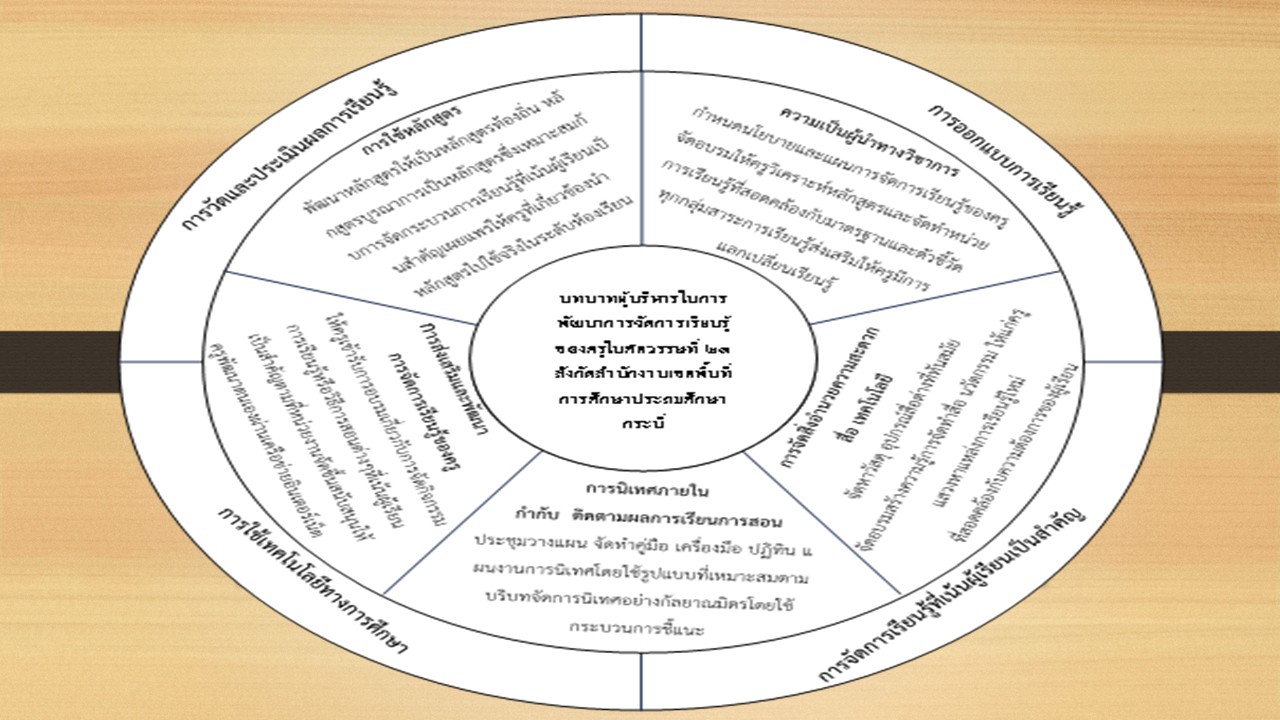
This research aimed to (1) study the learning management conditions of teachers in the 21st century under the Krabi Primary Educational Service Area Office, (2) investigate the role of administrators in developing teachers' learning management in the 21st century under the same office, and (3) present the role of administrators in developing teachers' learning management in the 21st century under the Krabi Primary Educational Service Area Office using a mixed-methods research approach. Data were collected using a questionnaire from a sample of 327 teachers in the Krabi Primary Educational Service Area Office. The statistics used included frequency, percentage, mean, standard deviation, and interviews with 5 key informants. Qualitative data were analyzed using descriptive analysis methods. The research findings revealed that (1) the learning management conditions of teachers in the 21st century under the Krabi Primary Educational Service Area Office, in terms of overall learning design and specific areas, were at a high level. Analysis of specific areas showed that the highest average was in measurement and evaluation, followed by student-centered learning management, learning design, and educational technology. (2) The development of the administrator's role comprised aspects of academic leadership, the provision of facilities, media, technology, internal supervision, monitoring teaching and learning outcomes, promoting and developing teachers, and curriculum utilization, which are factors that positively impact the development of teachers' learning management in the 21st century. (3) The presentation of the administrator's role in developing teachers' learning management in the 21st century under the Krabi Primary Educational Service Area Office indicated that all experts agreed on its appropriateness, feasibility, and potential benefits for practical implementation.
Article Details

This work is licensed under a Creative Commons Attribution-NonCommercial-NoDerivatives 4.0 International License.
References
กระทรวงศึกษาธิการ. (2553). หลักสูตรแกนกลางการศึกษาขั้นพื้นฐาน พุทธศักราช 2551. พิมพ์ครั้งที่ 3. กรุงเทพมหานคร: โรงพิมพ์ชุมนุมสหกรณ์การเกษตรแห่งประเทศไทย จำกัด.
จิราภา เพียรเจริญ. (2556). บทบาทผู้บริหารในการส่งเสริมการจัดการเรียนรู้ของครู ตามหลักสูตรสถานศึกษาขั้นพื้นฐานในโรงเรียนมัธยมศึกษา จังหวัดปทุมธานี. วิทยานิพนธ์ศึกษาศาสตรมหาบัณฑิต. กรุงเทพมหานคร: มหาวิทยาลัยธุรกิจบัณฑิตย์.
เฉลิมชัย หาญกล้า. (2559). การบริหารการศึกษา หลักการ แนวคิด ทฤษฎีสู่การปฏิบัติ. กรุงเทพมหานคร: แดเน็กซ์ อินเตอร์คอร์ปปอเรชั่น.
ทรงพล เจริญคำ. (2563). หลักการและทฤษฎีการบริหารการศึกษา. กรุงเทพมหานคร: โอ เอสพริ้นติ้งเฮ้าส์.
นพพงษ์ บุญจิตราดุล. (2557). หลักการและทฤษฎีการบริหารการศึกษา. นนทบุรี: ตีรณสาร.
พระราชบัญญัติการศึกษาแห่งชาติ พ.ศ. 2542. (2542). ราชกิจจานุเบกษา. เล่มที่ 116 ตอนที่ 74ก.
พิมพ์พร จารุจิตร์. (2559). ภาวะผู้นำกับการบริหารสถานศึกษาในศตวรรษที่ 21. เอกสารประกอบการเรียนการสอน คณะครุศาสตร์ มหาวิทยาลัยราชภัฏอุดรธานี.
สำนักบริหารงานการมัธยมศึกษาตอนปลาย. (2558). แนวทางการจัดทักษะการเรียนรู้ในศตวรรษที่ 21 ที่เน้นสมรรถนะทางสาขาวิชาชีพ. กรุงเทพมหานคร: ชุมนุมสหกรณ์การเกษตรแห่งประเทศไทย.
