
Developing a School Management Model that Promotes Teachers' Digital Technology Competencies to Foster Student Excellence in Science and Technology at Chulabhorn Royal Academy Science School, Lopburi
Article Sidebar
Main Article Content
Abstract
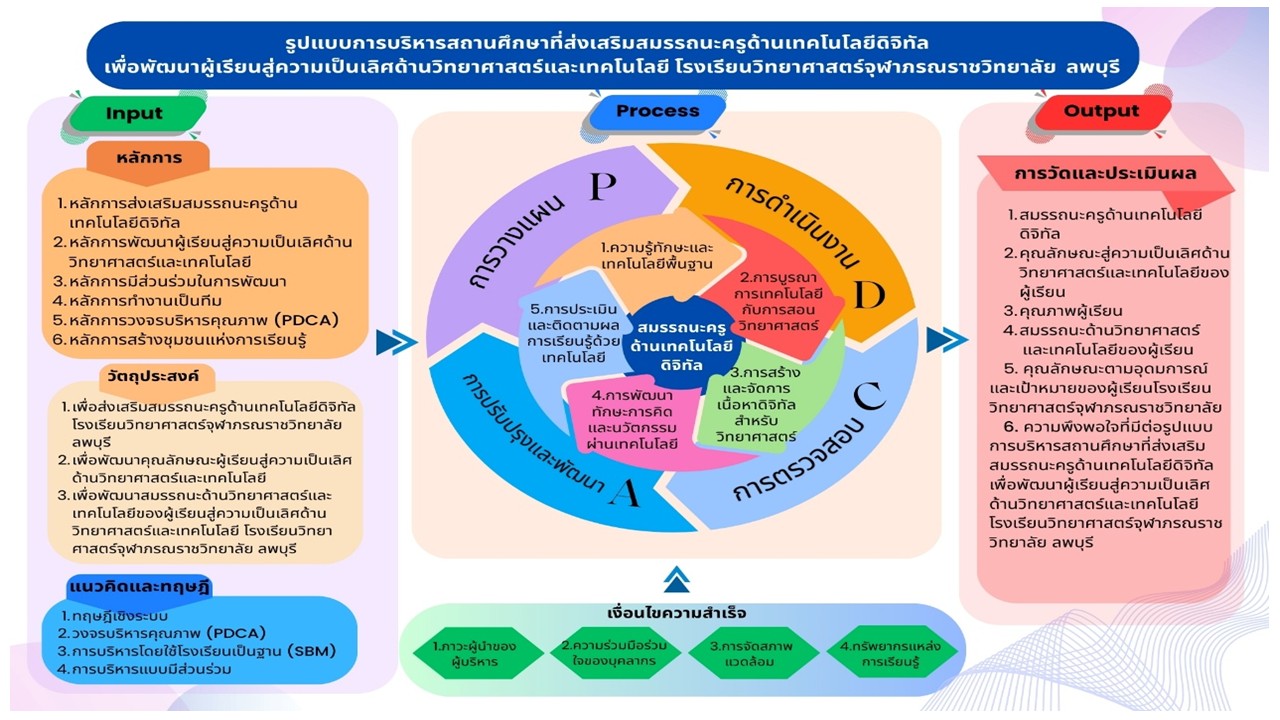
This research aims to develop a school management model that enhances teachers' digital technology competencies to improve students' excellence in science and technology at Chulabhorn Royal Academy, Lopburi. The study is divided into four phases: 1. Phase 1 involves studying the components, current conditions, necessary needs, characteristics of excellence in science and technology of students, and management strategies that promote teachers' competencies in digital technology to develop students toward excellence in science and technology. 2. Phase 2 consists of creating and testing a model and a manual for using the management model that enhances teachers' competencies in digital technology for developing students' excellence in science and technology. 3. Phase 3 assesses the results of using the model and the manual for the school management model that promotes teachers' competencies in digital technology to develop students toward excellence in science and technology. 4. Phase 4 focuses on evaluating and certifying the model and the manual for the school management model that enhances teachers' competencies in digital technology to develop students toward excellence in science and technology. The research findings reveal that: 1. The model comprises six components: principles, objectives, concepts and theories, content, assessment and evaluation, and success conditions. Experts have commented that it is appropriate. 2. The overall digital technology competency of teachers is at a very high level. The characteristics of excellence in students' science and technology show that the learning areas with the highest average academic achievement are also at a very high level. Over the years, students of Chulabhorn Royal Academy, Lopburi, have received 4 national awards and 8 international awards. Additionally, the satisfaction levels of deputy school directors and teachers with the model and manual for using the management model, which enhances teachers' digital technology competencies, are very high. 3. The evaluation results certifying the model and the manual for the school management model that promotes teachers' competencies in digital technology to develop students toward excellence in science and technology at Chulabhorn Royal Academy, Lopburi, are overall at a very high level. The aspects with the highest evaluation scores are appropriateness, usefulness, and feasibility; all aspects meet the evaluation criteria.
Keywords: School Management, Teacher Competence, Digital Technology, Excellence, Science and Technology
Article Details

This work is licensed under a Creative Commons Attribution-NonCommercial-NoDerivatives 4.0 International License.
References
กณิชชา ศิริศักดิ์. (2563). การพัฒนาสมรรถนะครูด้านเทคโนโลยีดิจิทัลเพื่อการจัดการเรียนรู้ในศตวรรษที่ 21. วารสารศึกษาศาสตร์ มหาวิทยาลัยศรีนครินทรวิโรฒ, 21(2), 1-15.
จิณณวัตร ปะโคทัง. (2561). ข้อเสนอการจัดการศึกษาในยุคดิจิทัล. วารสารการศึกษา, 29(2), 45-58.
ฐิตินาฏ ปังศรีวงศ์. (2567). ความต้องการจำเป็นและแนวทางการพัฒนาสมรรถนะดิจิทัลครู สังกัดสำนักงานเขตพื้นที่การศึกษามัธยมศึกษาสุโขทัย. วารสารการบริหารการศึกษา มหาวิทยาลัยศิลปากร, 14(1), 203-218.
ณัฐิกานต์ ปังศรีวงศ์. (2563). การพัฒนาทักษะด้านการใช้เทคโนโลยีสารสนเทศและการสื่อสารเพื่อการจัดการ เรียนรู้ในศตวรรษที่ 21 ของครูโรงเรียนตลาดหนองหวาย สังกัดสำนักงานเขตพื้นที่การศึกษา ประถมศึกษาสุราษฎร์ธานี เขต 2. วารสารวิชาการและวิจัย มหาวิทยาลัยราชภัฏสุราษฎร์ธานี, 12(2), 87-102.
พีระวัตร จันทกูล และฉลอง ชาตรูประชีวิน. (2560). รูปแบบการพัฒนาสมรรถนะครูในการใช้เทคโนโลยีสารสนเทศและการสื่อสารเพื่อการจัดการเรียนรู้ในศตวรรษที่ 21. วารสารศึกษาศาสตร์ มหาวิทยาลัย นเรศวร, 19(4), 225-240.
พงษ์พัชรินทร พุธวัฒนะ. (2566). การพัฒนาสมรรถนะดิจิทัลของครูในศตวรรษที่ 21: แนวทางและความท้าทาย. วารสารนวัตกรรมการศึกษาและการพัฒนาท้องถิ่น, 5(3), 145-160.
ทรรศนีย์ วงค์คำอนุชา, กอนพ่วง สถิรพร, เชาวน์ชัย และปกรณ์ ประจันบาน. (2567). รูปแบบการพัฒนาสมรรถนะครูของโครงการผลิตครูระบบปิด. วารสารมนุษยศาสตร์และสังคมศาสตร์ มหาวิทยาลัยราชภัฏสุรินทร์, 26(1), 256-273.
โรงเรียนวิทยาศาสตร์จุฬาภรณราชวิทยาลัย ลพบุรี. (2567). รายงานประจำปีการศึกษา 2567. โรงเรียนวิทยาศาสตร์จุฬาภรณราชวิทยาลัย ลพบุรี.
ศิริชัย กาญจนวาสี. (2557). ทฤษฎีการประเมิน (ระบุครั้งที่พิมพ์). สำนักพิมพ์แห่งจุฬาลงกรณ์มหาวิทยาลัย.
ศศิวิมล ม่วงกล่ำ. (2562). การวิเคราะห์องค์ประกอบความสามารถด้านเทคโนโลยีดิจิทัลของครู. วารสารวิชาการศึกษาศาสตร์, 20(1), 89-103.
สํานักงานเลขาธิการสภาการศึกษา. (2560). แผนการศึกษาแห่งชาติ พ.ศ. 2560 – 2579. กรุงเทพฯ:
สํานักงานเลขาธิการสภาการศึกษา.กรุงเทพฯ: บริษัทพริกหวาน กราฟฟิค จํากัด.
สถาบันส่งเสริมการสอนวิทยาศาสตร์และเทคโนโลยี. (2563). ผลการประเมิน PISA 2018: นักเรียนไทยวัย
ปี รู้และทำอะไรได้บ้าง. ออนไลน์. สืบค้นเมื่อวันที่ 2 มีนาคม 2563. แหล่งที่มา: https://pisathailand.ipst.ac.th/issue-2019-48/
สำนักงานคณะกรรมการดิจิทัลเพื่อเศรษฐกิจและสังคม. (2565). กรอบสมรรถนะดิจิทัลสำหรับครูไทย. กระทรวงดิจิทัลเพื่อเศรษฐกิจและสังคม.คู่มือการพัฒนาสมรรถนะดิจิทัล (Digital Competency) สำหรับครูและบุคลากรทางการศึกษา,กระทรวงศึกษาธิการ.
สิริณัฏฐ์ ลิมป์จำนงค์. (2566). องค์ประกอบสมรรถนะครูด้านเทคโนโลยีดิจิทัล. วารสารวิจัยทางการศึกษา, 17(1), 45-62.
สำนักงานคณะกรรมการการศึกษาขั้นพื้นฐาน. (2566). คู่มือการประเมินคุณภาพตามมาตรฐาน
การศึกษาขั้นพื้นฐานเพื่อการประกันคุณภาพภายในของสถานศึกษา. กรุงเทพฯ: โรงพิมพ์
สำนักงานพระพุทธศาสนาแห่งชาติ.
เสาวลักษณ์ จีนเมือง จิรศักดิ์ แซ่โค้ว และญาณิศา บุญจิตร์ (2567).การพัฒนาสมรรถนะครูด้านการใช้เทคโนโลยีสารสนเทศและการสื่อสารเพื่อส่งเสริมประสิทธิภาพการจัดการเรียนรู้ในศตวรรษที่ 21 ของ โรงเรียนขยายโอกาส สังกัดสำนักงานเขตพื้นที่การศึกษาประถมศึกษาสุราษฎร์ธานี เขต 3. วารสาร วิจัยวิชาการ, 7(5), 207–224. https://doi.org/10.14456/jra.2024.95
Anderson, L. W., & Krathwohl, D. R. (Eds.). (2001).A taxonomy for learning, teaching, and assessing: A revision of Bloom's taxonomy of educational objectives*. Longman.
Bloom, B. S., Engelhart, M. D., Furst, E. J., Hill, W. H., & Krathwohl, D. R. (1956). Taxonomy of educational objectives: The classification of educational goals, Handbook I: Cognitive domain. David McKay.
Boonchai, W. (2021).Digital competence framework for Thai science teachers: Development and validation. Journal of Educational Technology Development and Exchange, 14(2), 45-62.
Dweck, C. S. (2018). Mindset: The new psychology of success (Updated ed.). Ballantine Books.
Ertmer, P. A., & Ottenbreit-Leftwich, A. T. (2010). Teacher technology change: How knowledge, confidence, beliefs, and culture intersect. Journal of Research on Technology in Education, 42(3), 255-284.
Finn, S. E., & Tonsager, M. E. (1997). Information-gathering and therapeutic models of assessment: Complementary paradigms. Psychological Assessment, 9(4), 374–385. https://doi.org/10.1037/1040-3590.9.4.374
Shulman, L. S. (1986). Those who understand: Knowledge growth in teaching. Educational Researcher, 15(2), 4-14.
Smith, J. and Johnson, A. (2021) Factors Contributing to General Wellbeing: A Com-prehensive Review. Journal of Wellbeing Studies, 15, 45-62.
Koehler, M. J., & Mishra, P. (2009). What is technological pedagogical content knowledge. Contemporary Issues in Technology and Teacher Education, 9(1), 60-70.
National Science Foundation. (2020). Investing in science, engineering, and education for the nation's future. NSF Strategic Plan for FY 2018-2022. NSF.
National Research Council (2021). Developing assessments for the Next Generation Science Standards. The National Academies Press. https://doi.org/10.17226/18409
Voogt, J., & McKenney, S. (2017). TPACK in teacher education. Technology, Pedagogy and Education, 26(1), 69-83.
UNESCO. (2018). UNESCO ICT competency framework for teachers. UNESCO Publishing.
UNESCO. (2021). UNESCO strategy on technological innovation in education (2022-2025). UNESCO Publishing. https://unesdoc.unesco.org/ark:/48223/pf0000375776.
World Economic Forum. (2020). The future of jobs report 2020. World Economic Forum.
Redecker, C., & Punie, Y. (2017). European framework for the digital competence of educators. Publications Office of the European Union.
Mishra, P., & Koehler, M. J. (2006). Technological pedagogical content knowledge: A framework for teacher knowledge. Teachers College Record, 108(6), 1017-1054.
Partnership for 21st Century Learning. (2019). Framework for 21st century learning. Battelle for Kids.
