
Supervision and Review of the Exercise of Administrative Discretion under Administrative Law by Government Officials
Article Sidebar
Main Article Content
Abstract
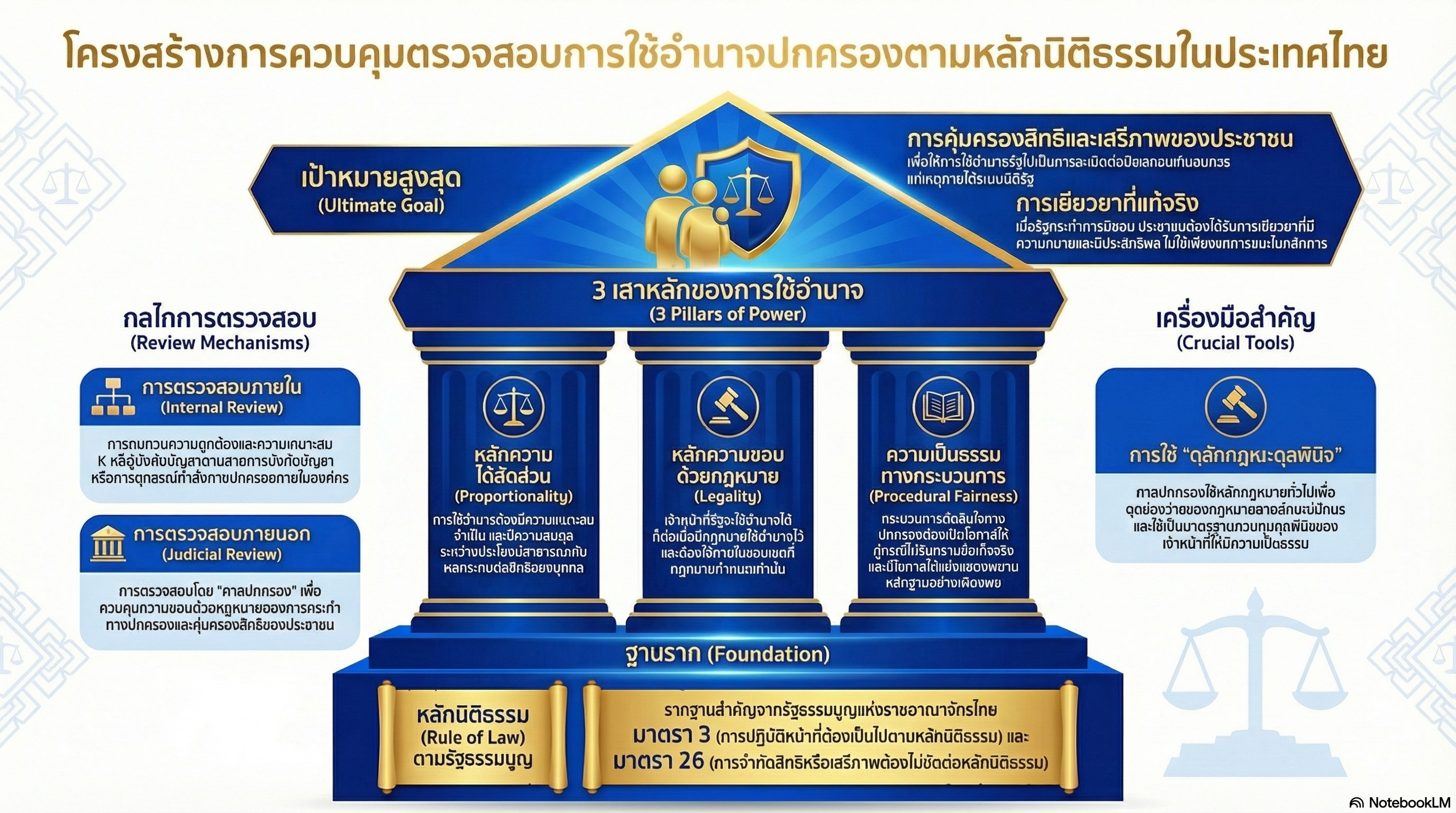
This academic article, entitled “The Principle of the Rule of Law in Administrative Law,” examines a fundamental principle governing the exercise of power by administrative authorities, which directly affects the rights of individuals. A key legal issue lies in the risk that administrative authorities may exercise discretionary power beyond legal boundaries, contrary to the principles of legality, proportionality, and procedural fairness, thereby affecting individual rights and leading to ineffective legal remedies. The objectives of this study are: (1) to explain the relationship between administrative law and the principle of the rule of law; (2) to examine legal standards used to review and control the exercise of administrative power by state officials; and (3) to assess mechanisms for reviewing administrative power within administrative organizations under Thai law, with comparative reference to foreign legal systems concerning administrative power and its control. Methodologically, this article employs doctrinal legal research, involving analysis of legal principles and comparative law. The study relies on constitutional provisions relating to the rule of law, the structure of administrative courts, court judgments and decisions reflecting legality and proportionality review, as well as academic works concerning the rule of law and proportionality. The findings indicate that both foreign legal systems and the Thai legal system recognize the authority of administrative officials to exercise public power affecting individuals. Such power must have a legal basis and be exercised in accordance with the rule of law to ensure legality and proper administrative action. The exercise of administrative power must comply with the principles of proportionality and fairness. However, in practice, the exercise of administrative power in Thailand has not always fully adhered to the objectives of administrative law and the rule of law. Therefore, it is necessary to strengthen administrative mechanisms that are clear, consistent, and fair, and to establish effective review systems to ensure that the rule of law is genuinely implemented in practice.
Keywords: Rule of Law, Exercise of Administrative Power, Administrative Discretion, Legality, Proportionality
Article Details

This work is licensed under a Creative Commons Attribution-NonCommercial-NoDerivatives 4.0 International License.
References
ชาญชัย แสวงศักดิ์ .(2567). คำอธิบายกฎหมายปกครอง พิมพ์ครั้งที่ 33 กรุงเทพฯ: สำนักพิมพ์วิญญูชน.
บรรเจิด สิงคะเนติ .(2568). หลักกฎหมายมหาชน หลักนิติธรรม/นิติรัฐ ในฐานะ”เกณฑ์”จำกัด อำนาจรัฐ. พิมพ์ครั้งที่ 4 กรุงเทพฯ : สำนักพิมพ์วิญญูชน.
บุญชู ณ ป้อมเพชร. (2558). เอกสารประกอบการสอนวิชากฎหมายปกครอง. คณะนิติศาสตร์ มหาวิทยาลัยเชียงใหม่.
วรเจตน์ ภาคีรัตน์. (2549). คำสั่งทางปกครองที่ไม่ชอบด้วยกฎหมาย. วารสารวิชาการศาลปกครอง, 6(1), 38-52.
วรพจน์ วิศรุตพิชญ์. (2540). ข้อความคิดและหลักการพื้นฐานในกฎหมายมหาชน. กรุงเทพฯ: สำนักพิมพ์นิติธรรม.
สมคิด เลิศไพฑูรย์. (2533). หลักแห่งความได้สัดส่วน (แปล). วารสารนิติศาสตร์. วารสารวิชาการศาลปกครอง. (2566, พ.ค.–ส.ค.). วารสารวิชาการศาลปกครอง, 23(2).
Arai-Takahashi, Y. (1999). Proportionality – a German approach. Amicus Curiae. Bingham, T. (n.d.). The Rule of Law.
Council of Europe. (2016). The Rule of Law Checklist. Venice Commission.
Dicey, A. V. (n.d.). (แนวคิดหลักนิติธรรมตามที่สรุปไว้ในข้อมูลตั้งต้น).
Reed, L. (2020). The Rule of Law and the Independence of the Judiciary (Speech).
Thio, L.-ann. (2010). Rule of law within ASEAN states: The Thai experience. Asian Journal of Comparative Law.
คำพิพากษา/แนววินิจฉัย
ศาลปกครองสูงสุด. คำวินิจฉัยศาลปกครองสูงสุดที่ อบ 272/2567 (ที่ประชุมใหญ่)
กฎหมาย/เอกสารทางการ
รัฐธรรมนูญแห่งราชอาณาจักรไทย พุทธศักราช 2560 (มาตรา 3, 26).
รัฐธรรมนูญแห่งราชอาณาจักรไทย พุทธศักราช 2540 (มาตรา 276).
พระราชบัญญัติจัดตั้งศาลปกครองและวิธีพิจารณาคดีปกครอง พ.ศ. 2542.
Constitutional Reform Act 2005 (UK), s. 1.
