
The Structural Equation Model of Global Mindset of School Administrators Affecting Quality Schools under The Udon Thani Primary Educational Service Area Office 4
Article Sidebar
Main Article Content
Abstract
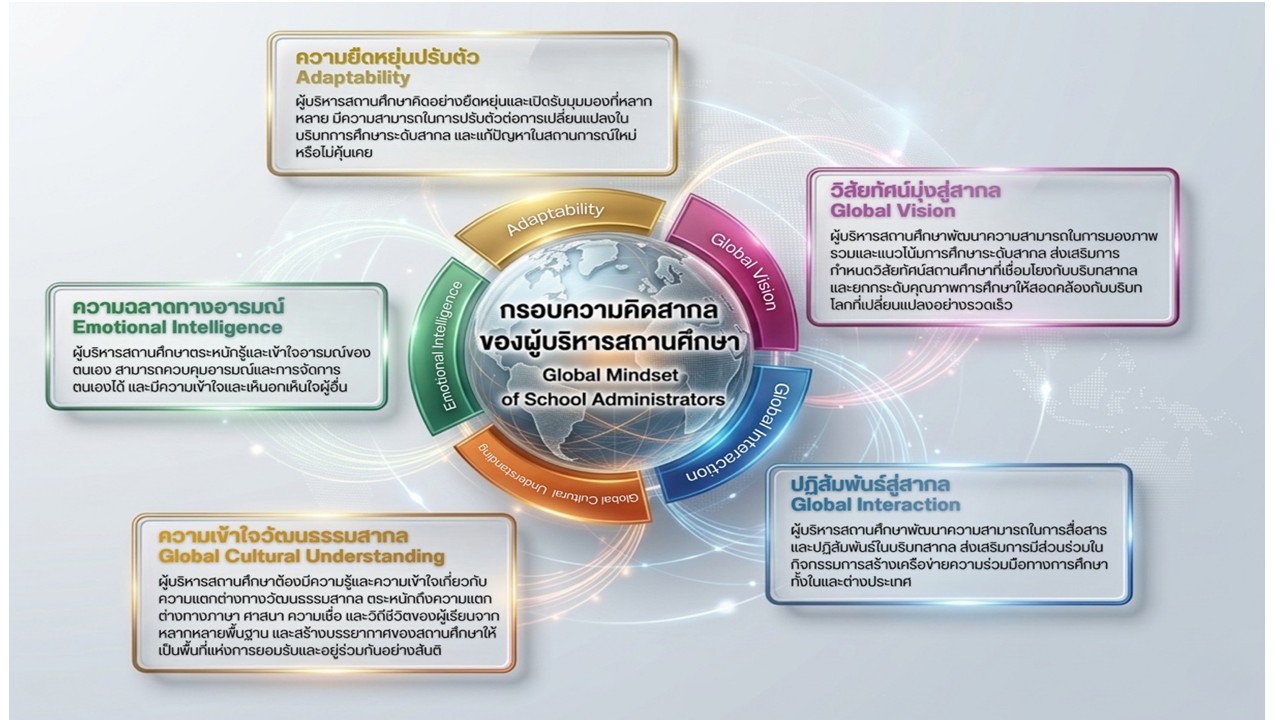
This research aimed to: (1) examine the goodness-of-fit of the structural equation model of the global mindset of school administrators affecting quality schools under the Udon Thani Primary Educational Service Area Office 4, as developed by the researcher, with empirical data; (2) investigate the influence of the global mindset of school administrators on quality schools under the Udon Thani Primary Educational Service Area Office 4 and (3) explore guidelines for developing the global mindset of school administrators affecting quality schools under the Udon Thani Primary Educational Service Area Office 4. A mixed-methods research design was employed, using a multi-phase interactive model. The structural equation model consisted of 10 parameters. Based on a parameter-to-sample size ratio of 1:20, the sample size was determined to be 200 participants, comprising school administrators and teachers. The research instrument was a five-point Likert scale questionnaire with a reliability coefficient of 0.820. Structural equation modeling was analyzed using the Mplus 7.0 program. The findings revealed that: (1) the structural equation model demonstrated a good fit with the empirical data (X2 = 33.137, df = 24, p-value = 0.101, X2/df = 1.380, CFI = 0.995, TLI = 0.993, RMSEA = 0.044, SRMR = 0.016); (2) the global mindset of school administrators had a positive direct and total effect on quality schools, with a coefficient of 0.951, statistically significant at the .01 level, explaining 90.50% of the variance (R² = 0.905); and (3) the guidelines for developing the global mindset of school administrators affecting quality schools under the Udon Thani Primary Educational Service Area Office 4 consisted of five key dimensions: (1) adaptability, (2) global vision, (3) global interaction, (4) global cultural understanding, and (5) emotional intelligence.
Keywords: Global Mindset, School Administrators, Quality Schools, Structural Equation Model
Article Details

This work is licensed under a Creative Commons Attribution-NonCommercial-NoDerivatives 4.0 International License.
References
กนกวรรณ ใจมั่น (2566). การบริหารกิจการบ้านเมืองแบบร่วมมือกับการนำนโยบายโครงการโรงเรียนคุณภาพไปสู่การปฏิบัติในพื้นที่: กรณีศึกษาสำนักงานเขตพื้นที่การศึกษาประถมศึกษาสุพรรณบุรี เขต 1. หลักสูตรรัฐศาสตรมหาบัณฑิต มหาวิทยาลัยธรรมศาสตร์.
กระทรวงศึกษาธิการ. (2567). หนังสือที่ระลึกคล้ายวันสถาปนากระทรวงศึกษาธิการ ครบรอบ 132 ปี “เรียนดี มีความสุข”. กรุงเทพฯ: พีจีที กรุ๊ป จำกัด.
จินดารัตน์ แย้มวงษ์. (2562). แนวคิดการพัฒนาภาวะผู้นําของผู้บริหารโรงเรียนมัธยมศึกษาตามแนวคิดการพัฒนานักเรียนให้มีภาวะผู้นําแบบโลกาภิวัฒน์. วารสารครุศาสตร์ จุฬาลงกรณ์มหาวิทยาลัย, 47(4), 108- 123.
ทนงศักดิ์ โพธิ์เกตุ. (2564). รูปแบบการบริหารเพื่อพัฒนาสู่โรงเรียนคุณภาพของโรงเรียนบ้านดอนแยง สำนักงานเขตพื้นที่การศึกษาประถมศึกษาเชียงราย เขต 4. วารสารสังคมศาสตร์และมานุษยวิทยาเชิงพุทธ, 6(1), 34-51.
ธนชิต วะปะแก้ว. (2566). รูปแบบการพัฒนากรอบความคิดสากล (Global Mindset) ของผู้บริหารและครู โรงเรียนมาตรฐานสากล สังกัดสำนักงานเขตพื้นที่การศึกษามัธยมศึกษาขอนแก่น. วิทยานิพนธ์ปริญญาศึกษาศาสตรมหาบัณฑิต สาขาวิชาการบริหารการศึกษา บัณฑิตวิทยาลัย มหาวิทยาลัยขอนแก่น.
ธนพล จูมแพง. (2566). ภาวะผู้นำการเปลี่ยนแปลงของผู้บริหารสถานศึกษาที่ส่งผลต่อการบริหารโรงเรียนคุณภาพ สังกัดสำนักงานเขตพื้นที่การศึกษาประถมศึกษาอุดรธานี. วิทยานิพนธ์ปริญญาครุศาสตรศาสตรมหาบัณฑิต การบริหารการศึกษา มหาวิทยาลัยราชภัฏอุดรธานี.
สำนักงานเขตพื้นที่การศึกษาประถมศึกษาอุดรธานี เขต 4. (2568). สำนักงานเขตพื้นที่แผนพัฒนาการศึกษาขั้นพื้นฐาน (2566-2570) ฉบับทบทวน ประจำปีงบประมาณ 2568. การศึกษาประถมศึกษาอุดรธานี เขต 4.
สำนักงานคณะกรรมการการศึกษาขั้นพื้นฐาน. (2567). โรงเรียนคุณภาพ “1 อำเภอ 1 โรงเรียนคุณภาพ”. ค้นเมื่อ 19 กรกฎาคม 2568, จาก https://eduinno.obec.go.th/schoolgrading/
สุนทรพจน์ ดำรงค์พานิช. (2563). โปรแกรม Mplus กับการวิเคราะห์ข้อมูลการวิจัยทางพฤติกรรมศาสตร์ และสังคมศาสตร์. กรุงเทพฯ: สำนักพิมพ์จุฬาลงกรณ์มหาวิทยาลัย.
สุภมาส อังศุโชติ. (2551). สถิติวิเคราะห์สำหรับการวิจัยทางสังคมศาสตร์และพฤติกรรมศาสตร์ เทคนิคการใช้โปรแกรม LISREL. กรุงเทพฯ บริษัท มิสชั่น มีเดีย จำกัด.
อุดมศักดิ์ สันสมบัติ และธารารัตน์ มาลัยเถาว์. (2567). การศึกษาการบริหารงานโรงเรียนคุณภาพประจำตำบล สังกัดสำนักงานเขตพื้นที่การศึกษาประถมศึกษาเชียงราย เขต 2. วารสารวิจัยสังคมและปริทัศน์, 47(1), 49-58.
Bathan Peter. (2021). Committing to Social Responsibility: A Grounded Theory of a Conducive Learning Environment. New Educational Review, 65(3), 178-189.
Creemers P.M. Bert and Kyriakides Leonidas. (2012). Improving Quality in Education: Dynamic approaches to school improvement. New York: Routledge.
Iddris Faisal. (2024). Entrepreneurship Education on International Entrepreneurship Intention: The Role of Entrepreneurship Alertness, proactive Personality, Innovative Behaviour And Global Mindset. Journal of Applied Research in Higher Education, 17(2), 640-662.
Javidan, Hough and Bullough. (2010). Conceptualizing and Measuring Global Mindset: Development of the Global Mindset Inventory. Glendale, AZ: Thunderbird School of Global Management.
Jie S. and Harms R. (2017). Cross-Cultural Competences and International Entrepreneurial Intention: A Study on Entrepreneurship Education. Retrieved July 11, 2025, from https://doi.org/10.1155/2017/9042132
Nasaj, M., Kumar, A., Kumari, P. and Alaya, A. (2025). The influence of proactive personality, cultural intelligence and global mindset on individual’s resilience behavior, Journal of Asia Business Studies, 19(2), 561-580.
Panina. (2021). Developments in Virtual Learning Environments and the Global Workplace: Developing Global Mindset Through Experiential Learning in Global Virtual Teams. Hershey PA, USA: IGI Global.
Rachmad, Yoesoep Edhie. (2022). Adaptive Leadership Theory. Albacete: Cuchillo Publicaciones Internacionales, Edición Especial 2022.
