
Vlog Production Combining Infographics and Artificial Intelligence Techniques to Promote Tourism in Koh Kret, Nonthaburi Province
Article Sidebar
Main Article Content
Abstract
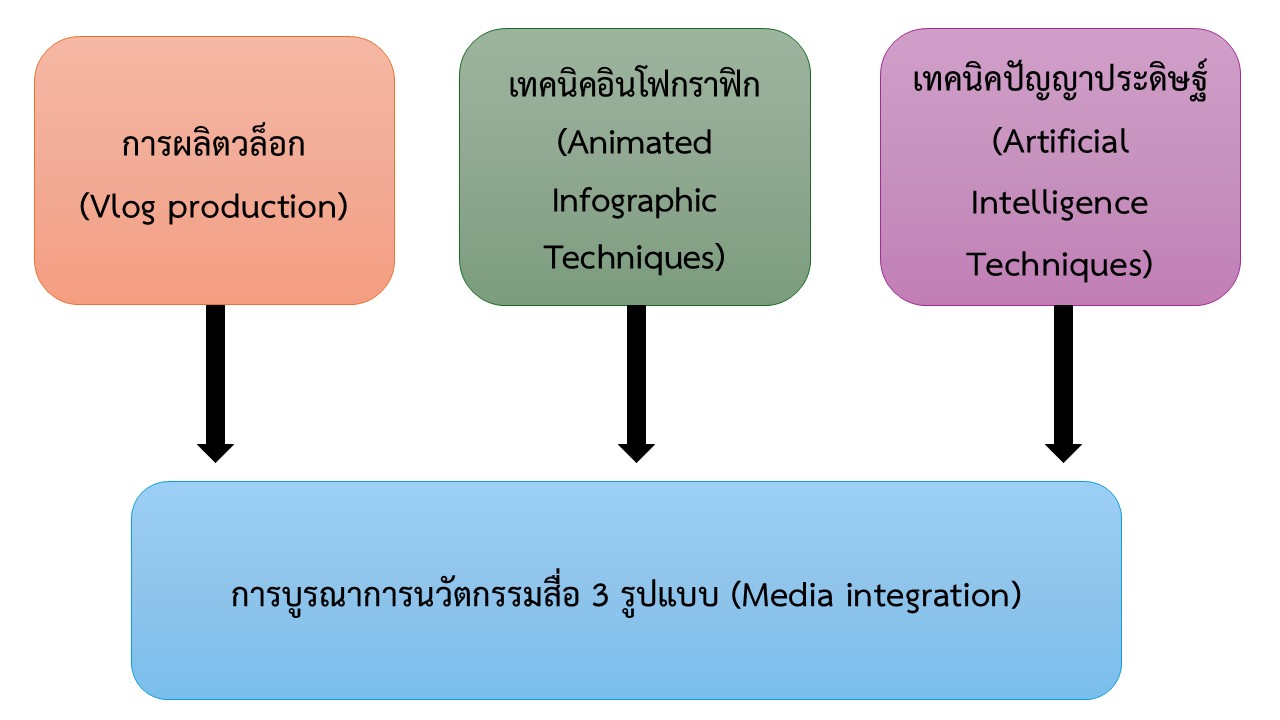
This research aimed to: 1) study the production of vlogs integrated with infographic techniques and artificial intelligence techniques to promote tourism on Koh Kret, Nonthaburi Province, and 2) examine the level of satisfaction of the target audience after viewing the produced media. The target group consisted of 50 individuals aged 18–25 who use Facebook as an online platform, selected through purposive sampling to evaluate satisfaction. In addition, in-depth interviews were conducted with four experts: (1) a vlog production expert, (2) an infographic expert, (3) a content expert, and (4) an artificial intelligence expert. The research instruments included questionnaires and in-depth interviews, and the data were analyzed using inferential statistics. The results revealed that: 1) the production of vlogs integrated with infographic and artificial intelligence techniques to promote tourism on Koh Kret, Nonthaburi Province, was of a high-quality level, and 2) the target audience’s satisfaction with the produced media was at a high level. Furthermore, experts indicated that the media were appropriate, creative, and effective in enhancing audience understanding. In conclusion, the produced media demonstrated high quality and were effective in enhancing the tourism image and stimulating tourism on Koh Kret.
Keywords: Vlog, Animated, Infographic Techniques, Tourism, Artificial Intelligence
Article Details

This work is licensed under a Creative Commons Attribution-NonCommercial-NoDerivatives 4.0 International License.
References
กรมพัฒนาฝีมือแรงงาน. (2566). รายงานสถานการณ์แรงงานประจำปี 2566. สืบค้นจาก
กิติศักดิ์ สิรหทัยวรกิจ. (2564). อิทธิพลของความผูกพันต่อองค์กรในฐานะตัวแปรคั่นกลางที่
เชื่อมโยงแรงจูงใจสู่ประสิทธิภาพในการปฏิบัติงานของพนักงานบริษัทพัฒนา
อสังหาริมทรัพย์แห่งหนึ่งในเขตกรุงเทพมหานคร. วารสารวิชาการมหาวิทยาลัยราชภัฏ
เพชรบุรี, 11(3), 55–69.
ณิชารีย์ หาญแสวงสิน, และ พรลภัส สุวรรณรัตน์. (2567). ปัจจัยที่มีผลต่อความพึงพอใจในการ
ปฏิบัติงานของพนักงานสำนักงานคณะกรรมการกำกับและส่งเสริมการประกอบธุรกิจ
ประกันภัย. วารสารสมาคมนักวิจัย, 29(2), 50–60.
นริศรา ฉัตรเจริญศิริ. (2562). ปัจจัยที่มีอิทธิพลต่อความผูกพันองค์กรของพนักงานที่ปฏิบัติงาน
ด้านโลจิสติกส์ในพื้นที่กรุงเทพมหานคร. สารนิพนธ์ปริญญาการจัดการมหาบัณฑิต,
วิทยาลัยการจัดการ มหาวิทยาลัยมหิดล.
พัชร์หทัย จารุทวีผลนุกูล, ธัญวฤณ วัทโล, และ วิลาสิณี สุดประเสริฐ. (2563). ปัจจัยที่ส่งผลต่อ
ความผูกพันต่อองค์การของพนักงาน บริษัท เอสเอสเค โลจิสติกส์ จำกัด. วารสารวิจัย
มหาวิทยาลัยรังสิต (ฉบับสังคมศาสตร์), 2(3), 45–56.
ลี่ เหมิง. (2565). การศึกษาปัจจัยแรงจูงใจ คุณภาพชีวิตทำงาน และภาวะผู้นำ ส่งผลต่อความ
ผูกพันของพนักงานระดับบริการธุรกิจ SME ในเขตกรุงเทพมหานคร. การค้นคว้าอิสระ
บริหารธุรกิจมหาบัณฑิต, มหาวิทยาลัยกรุงเทพ.
Belch, G. E., & Belch, M. A. (2005). Advertising and Promotion: An Integrated
Marketing Communications Perspective (6th ed.). New York, NY: McGraw-
Hill/Irwin.
Herzberg, F. (1959). The Motivation to Work. New York: Wiley.
Kotler, P. (2000). Marketing Management: The Millennium Edition (10th ed.). Upper
Saddle River, NJ: Prentice Hall.
Meyer, J. P., & Allen, N. J. (1991). A three-component conceptualization of
organizational commitment. Human Resource Management Review, 1(1), 61-89.
Robbins, S. P., & Judge, T. A. (2019). Organizational behavior (18th ed.). Pearson.
