
Development of Mathematical Problem-Solving Ability and Mathematics Learning Achievement on System of Linear Equations in Two Variables among Grade 9 Students Using the 7E Learning Cycle Instructional Model in Conjunction with the STAR Problem-Solving Str
Article Sidebar
Main Article Content
Abstract
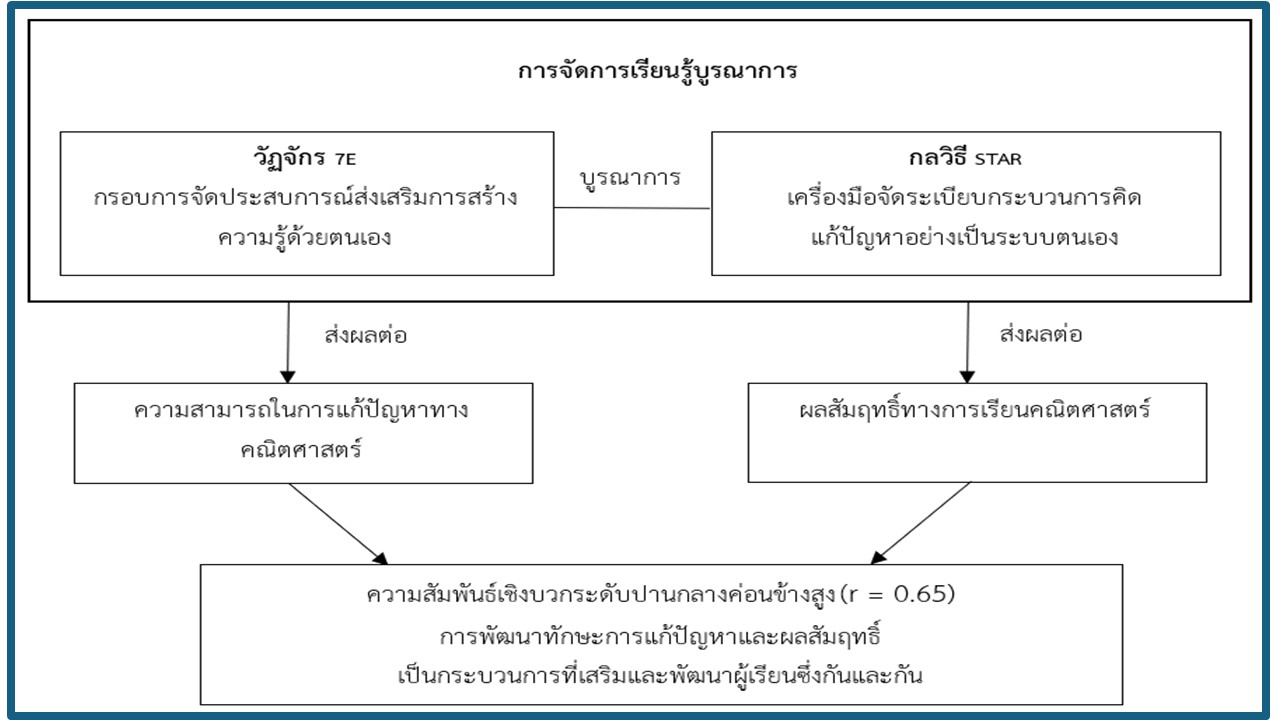
This research aimed to: 1) compare the mathematical problem-solving ability and learning achievement on linear equation systems with two variables word problems of Mathayom Suksa 3 Students before and after learning; 2) compare the mathematical problem-solving ability and learning achievement on linear equation systems with two variables word problems of Mathayom Suksa 3 Students after receiving instruction using the 7E learning cycle combined with STAR problem-solving strategy against the 70% criterion; and 3) investigate the relationship between mathematical problem-solving ability and mathematics learning achievement on linear equation systems with two variables word problems of Mathayom Suksa 3 Students after receiving instruction using the 7E learning cycle combined with STAR problem-solving strategy. The sample consisted of 90 Mathayom Suksa 3 Students from Wat Raikhingwittaya School, Nakhon Pathom Province, in the second semester of the 2025 academic year, selected through cluster random sampling. The research instruments included lesson plans, a 4-item subjective test measuring mathematical problem-solving ability, and a 20-item multiple-choice test with four options measuring mathematics learning achievement. Data were analyzed using dependent t-test, one-sample t-test, and Pearson's correlation coefficient. The research findings revealed that: 1) students' mathematical problem-solving ability and mathematics learning achievement after learning were significantly higher than before learning at the .05 level; 2) students' mathematical problem-solving ability and mathematics learning achievement after learning were significantly higher than the 70% criterion at the .05 level; and 3) mathematical problem-solving ability had a relatively high positive correlation with mathematics learning achievement. The findings demonstrate that the 7E learning cycle combined with STAR problem-solving strategy is a highly effective instructional innovation for developing problem-solving skills and mathematics learning achievement by promoting students' ability to analyze problems, plan solutions, and verify answers systematically, which are essential skills for 21st-century learning.
Keywords: 7E Learning Cycle, STAR Strategy, Mathematical Problem-Solving Ability
Article Details

This work is licensed under a Creative Commons Attribution-NonCommercial-NoDerivatives 4.0 International License.
References
กระทรวงศึกษาธิการ. (2551). หลักสูตรแกนกลางการศึกษาขั้นพื้นฐาน พุทธศักราช 2551. กรุงเทพมหานคร: โรงพิมพ์ชุมชนสหกรณ์การเกษตรแห่งประเทศไทย.
กระทรวงศึกษาธิการ. (2560). มาตรฐานการเรียนรู้และตัวชี้วัด กลุ่มสาระการเรียนรู้คณิตศาสตร์ วิทยาศาสตร์ และสาระภูมิศาสตร์ ในกลุ่มสาระการเรียนรู้สังคมศึกษา ศาสนา และวัฒนธรรม (ฉบับปรับปรุง พ.ศ. 2560) ตามหลักสูตรแกนกลางการศึกษาขั้นพื้นฐาน พุทธศักราช 2551. กรุงเทพ: โรงพิมพ์ชุมนุมสหกรณ์การเกษตรแห่งประเทศไทย.
กันต์กนิษฐ์ พลพิพัฒน์. (2560). การศึกษาผลสัมฤทธิ์ทางการเรียนและทักษะการแก้โจทย์ปัญหาคณิตศาสตร์นักเรียนโดยใช้กลวิธี STAR. วิทยานิพนธ์ปริญญาครุศาสตรมหาบัณทิต, มหาวิทยาลัยราชภัฏรำไพพรรณี.
ดารณี ชมโสม. (2563). การพัฒนากิจกรรมการเรียนรู้วิชาคณิตศาสตร์โดยใช้รูปแบบวัฏจักรการเรียนรู้ (7E) เรื่องทศนิยมและเศษส่วน สำหรับนักเรียนชั้นมัธยมศึกษาปีที่ 1. วิทยานิพนธ์ครุศาสตรมหาบัณฑิต, มหาวิทยาลัยราชภัฏสกลนคร.
เนตรชนก แสนทิพย์. (2556). การพัฒนากิจกรรมการเรียนรู้คณิตศาสตร์ ตามแนวคิดคอนสตรัคติวิซึม ร่วมกับกลวิธี STAR เรื่อง ระบบสมการเชิงเส้นชั้นมัธยมศึกษาปีที่ 3. ปริญญานิพนธ์มหาบัณฑิต, มหาวิทยาลัยราชภัฏสกลนคร.
ประจบ แสงสีบับ. (2556). ผลการจัดการเรียนรู้แบบร่วมมือโดยใช้กลวิธี STAR เรื่อง โจทย์ปัญหาสมการเชิงเส้นตัวแปรเดียวและการแปรผัน ที่มีต่อความสามารถในการแก้ปัญหาและทักษะการเชื่อมโยงทางคณิตศาสตร์ ของนักเรียนชั้นมัธยมศึกษาปีที่ 2. ปริญญานิพนธ์มหาบัณฑิต, มหาวิทยาลัยศรีนครินทรวิโรฒ.
สถาบันทดสอบทางการศึกษาแห่งชาติ. (2567). รายงานผลการวิเคราะห์ผลการทดสอบทางการศึกษาระดับชาติขั้นพื้นฐาน (O-NET) เพื่อพัฒนาการเรียนการสอน. จากhttps://www.niets.or.th/th/
สถาบันส่งเสริมการสอนวิทยาศาสตร์และเทคโนโลยี (สสวท.). (2555). วัดผลประเมินผลคณิตศาสตร์. กรุงเทพฯ: สถาบันส่งเสริมการสอนวิทยาศาสตร์และเทคโนโลยี.
สุสิริยา ธิรากุลนันท์ชัย (2562). ผลของการจัดกิจกรรมการเรียนรู้คณิตศาสตร์โดยใช้วงจรการเรียนรู้แบบ 7E ร่วมกับการใช้คําถามระดับสูงที่มีต่อความสามารถในการแก้ปัญหาทางคณิตศาสตร์ของนักเรียนมัธยมศึกษาปีที่ 1. วิทยานิพนธ์ปริญญามหาบัณฑิต, จุฬาลงกรณ์มหาวิทยาลัย.
อรษา เกมกาแมน. (2559). ผลการเรียนรู้วิชาคณิตศาสตร์ เรื่องโจทย์ปัญหาเศษส่วนของนักเรียนชั้นประถมศึกษาปีที่ 6 โดยการจัดการเรียนรู้แบบร่วมมือกันแบบแบ่งกลุ่มผลสัมฤทธิ์ (STAD) ผสานกลวิธี STAR. วิทยานิพนธ์ศึกษาศาสตรมหาบัณฑิต สาขาวิชาการวิจัยและการพัฒนาหลักสูตร คณะครุศาสตร์อุตสาหกรรมมหาวิทยาลัยเทคโนโลยีราชมงคลธัญบุรี.
แอนนา สุภาพญาติ. (2561). ผลการจัดการเรียนรู้ตามวัฏจักรการเรียนรู้ 7 ขั้น (7E) ที่มีต่อความสามารถใน การแก้ปัญหาทางคณิตศาสตร์ และผลสัมฤทธิ์ทางการเรียนวิชาคณิตศาสตร์ของนักเรียนชั้นมัธยมศึกษาปีที่ 2. วิทยานิพนธ์การศึกษามหาบัณฑิต, มหาวิทยาลัยบูรพา.
Ananiadou, K., & Claro, M. (2009). 21st Century Skills and Competences for New Millennium Learners in OECD Countries. OECD Education Working Papers, No. 41, OECD Publishing, Paris.
Eisenkraft, A. (2003). Expanding the 5E Model: A Proposed 7E Model Emphasizes Transferring Learning and the Important of Eliciting Prior Understanding. The Science Teacher, 70.
Maccini, P. (1998). Effects of an instructional strategy incorporating concrete problem representation on the introductory algebra performance of secondary students with learning disabilities. Unpublished doctoral dissertation, The Pennsylvania State University, University Park.
Polya, G. (1985). How to Solve It: A New Aspect of Mathematical Method (2nd ed.). Princeton University Press.
Yustikarinda, A. N., Widodo, S., & Katminingsih, Y. (2024). Mathematical Disposition and The Impact of Learning Cycle 7E on Problem-Solving Skills in Mathematics. International Journal of Humanities Education and Social Sciences, 4(1). https://doi.org/10.55227/ijhess.v4i1.1088
