
Enhancing Foreign Teachers’ Pedagogical Practices through Coaching-Oriented Supervision: A Case Study of the Intensive English Program at Khemasiri Memorial School
Article Sidebar
Main Article Content
Abstract
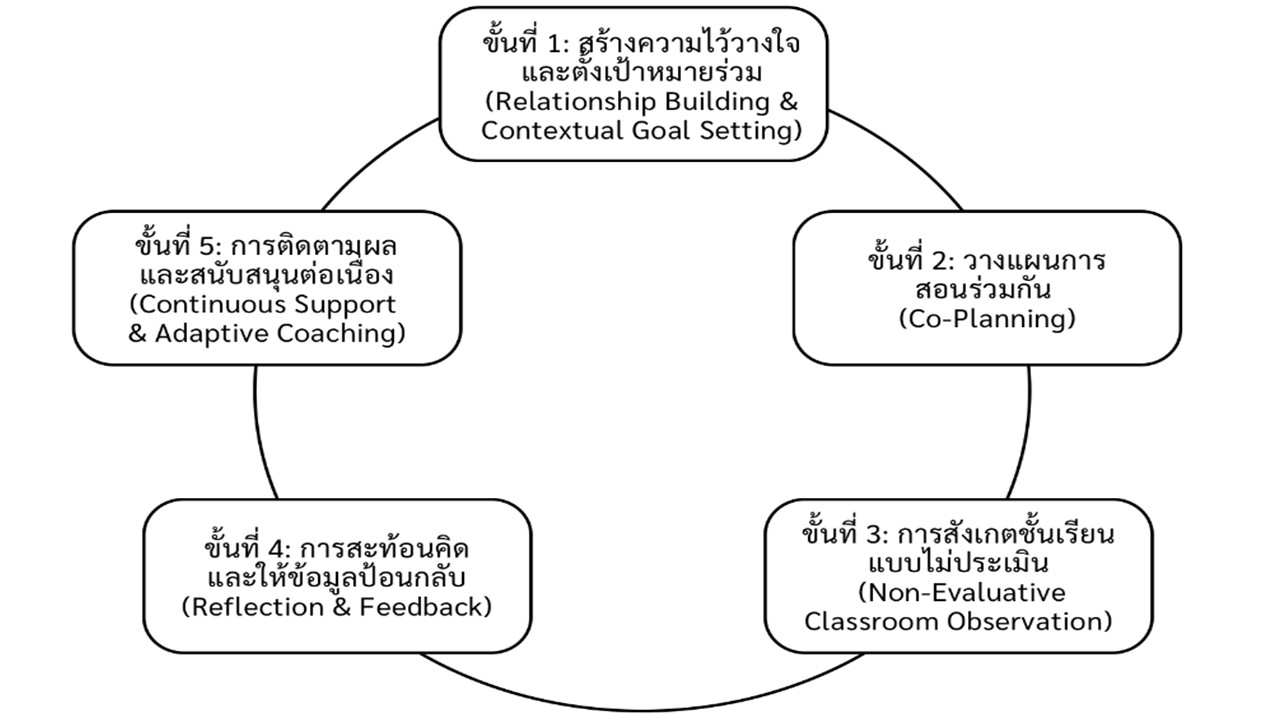
This study pursued two objectives: 1) to investigate the developmental process through which foreign teachers enhance their English‑language instructional capacity via a coaching‑oriented supervision system in the context of Khemasiri Memorial School, and 2) to formulate contextually grounded guidelines for strengthening foreign‑teacher development in Thai educational settings. The study employed a qualitative research methodology, collecting data through classroom observations, interviews, and empirical evidence. The target population consisted of seven foreign teachers. In addition, three key informants were interviewed regarding approaches to the professional development of foreign teachers, including one head of the foreign language learning area, together with two homeroom teachers from English-focused programs at both primary and secondary school levels. Data were collected through classroom observations, semi‑structured interviews, and triangulated evidence‑based artifacts. The analysis revealed a five‑stage coaching process comprising 1) Relationship Building and Contextual Goal Setting, 2) Co‑Planning, 3) Non‑Evaluative Classroom Observation, 4) Reflective Dialogue and Feedback, and 5) Continuous Support and Adaptive Coaching. This developmental sequence enabled foreign teachers to internalize the cultural characteristics of Thai learners and to interpret the competency‑based curriculum with greater pedagogical precision. The study further proposes a set of development guidelines tailored to Thai school contexts, including 1) in‑depth cultural orientation to Thai learners, 2) strengthened understanding of the competency‑based curriculum, 3) systematic use of evidence‑based data to inform instructional decisions, 4) the establishment of collaborative professional learning communities with Thai teachers, and 5) sustained, coaching‑driven supervisory support. These findings contribute to the growing body of research on culturally responsive teacher development and highlight the importance of adaptive coaching models in multilingual school environments.
Keywords: Foreign teacher development, Intensive English Program, Coaching-Oriented Supervision
Article Details

This work is licensed under a Creative Commons Attribution-NonCommercial-NoDerivatives 4.0 International License.
References
ทิพย์กนก เวียงคำ. (2568). การพัฒนาโมเดลประสบการณ์ด้านสิ่งแวดล้อมของพนักงานเพื่อผลการดำเนินงาน
ที่ยั่งยืนของธุรกิจโรงแรมในประเทศไทย (วิทยานิพนธ์ปริญญาดุษฎีบัณฑิต, มหาวิทยาลัยศิลปากร).
มาร์เก็ตเธีย. (2569). ครูฟิลิปปินส์ครอง 70% ของตลาดครูต่างชาติในไทย ด้วยต้นทุนค่าจ้างที่ถูกกว่าครู
เจ้าของภาษา 2–3 เท่า. https://marketeeronline.co/archives/449938
ไมเรนาเรน จอย บาซิลิโอ, และ อรนุช ปวงสุข. (2566). การวิเคราะห์ความรู้ความเข้าใจของครูชาวต่างชาติ
ด้านกลยุทธ์การสื่อสารในบริบทของการสอนภาษาอังกฤษเป็นภาษาต่างประเทศในประเทศไทย.
วารสารศิลปศาสตร์ มหาวิทยาลัยอุบลราชธานี, 19(1), 232–259.
วันวิสาข์ ไชยแสง, และ จุไรรัตน์ สุดรุ่ง. (2562). สภาพและปัญหาการปฏิบัติงานของครูต่างชาติในโรงเรียน
มัธยมศึกษา สังกัดสำนักงานคณะกรรมการการศึกษาขั้นพื้นฐานในเขตกรุงเทพมหานคร.
วารสารอิเล็กทรอนิกส์ทางการศึกษา, 14(2), 1–11.
สุภางค์ จันทวานิช. (2567). วิธีการวิจัยเชิงคุณภาพ (พิมพ์ครั้งที่ 27). สำนักพิมพ์จุฬาลงกรณ์มหาวิทยาลัย.
สุรพงษ์ กล่ำบุตร, ศิรวิทย์ ปฐมชัยวาลย์, นฤดล จันทรเพ็ชร์, มาเรียม นิลพันธุ์, และ ริวรรณ วณิชวัฒนวรชัย.
(2567). การพัฒนาหลักสูตรเสริมร่วมกับการโค้ชที่ส่งเสริมความสามารถในการใช้ภาษาไทยเพื่อการ
สื่อสารของครูโรงเรียนวัชรวิทยา. วารสารศึกษาศาสตร์ วิทยาลัยนครราชสีมา, 3(2), 57–73.
สำนักงานคณะกรรมการการศึกษาขั้นพื้นฐาน. (2557). แนวปฏิบัติตามประกาศกระทรวงศึกษาธิการเรื่อง
นโยบายการปฏิรูปการเรียนการสอนภาษาอังกฤษ.
https://academic.obec.go.th/download/obec_book_teacher/basic_education_core_cu
rriculum/051024_Nayobai_Kan_Patirup_Kan_Rian_Kan_Son_Phasa_Angkrit.pdf
สำนักงานบริหารพื้นที่นวัตกรรมการศึกษา สำนักงานคณะกรรมการการศึกษาขั้นพื้นฐาน. (2566).
ประเด็นสำคัญในภาพรวมการขับเคลื่อนพื้นที่นวัตกรรมการศึกษา.
https://drive.google.com/file/d/1f7H0uje6ORxOdXFzodifvXeTP9y7BqvU/view
Aguilar, E. (2013). The Art of Coaching: Effective Strategies for School Transformation. Jossey-Bass.
Cloward, E. (2025). Stoicism 101: From Marcus Aurelius and Epictetus to the Law of Reason
and Amor Fati, an Essential Primer on Stoic Philosophy. Adams Media.
Cummins, J. (2000). Language, Power, and Pedagogy: Bilingual Children in the Crossfire.
Multilingual Matters.
Darling-Hammond, L., Hyler, M. E., Gardner, M., & Espinoza, D. (2017). Effective Teacher
Professional Development. Learning Policy Institute.
Derrah, H. R., Doungphummes, N., Boonrugsa, T., & Ono, M. (2024). Navigating between
Cultures: Foreign Teachers within Thai and Japanese Schools. Globalisation, Societies
and Education. https://doi.org/10.1080/14767724.2024.2397802
Dokmai, P., Sakorn, W., & Nontapa, R. (2023). The Professional Learning Community for
Teachers’ Professional Development Training in Classroom Action Research for
Enhancing Students’ Science, Mathematics, and Technology Competencies in New
Normal. International Journal of Science Education and Teaching, 2(1), 38–50.
DuFour, R., & Eaker, R. (1998). Professional Learning Communities at Work: Best Practices for
Enhancing Student Achievement. National Educational Service.
Erawan, P., & Erawan, W. (2024). Effective Approaches to Teacher Professional Development
in Thailand: Case Study. Journal of Education and Learning, 13(2), 64–74.
Glickman, C. D., Gordon, S. P., & Ross-Gordon, J. M. (2010). Supervision and Instructional
Leadership: A Developmental Approach (8th ed.). Allyn and Bacon.
Halliday, M. A. K. (1994). An Introduction to Functional Grammar. Edward Arnold.
Hattie, J., & Timperley, H. (2007). The Power of Feedback. Review of Educational Research,
(1), 81–112.
Knight, J. (2007). Instructional Coaching: A Partnership Approach to Improving Instruction.
Corwin Press.
Krashen, S. (1982). Principles and Practice in Second Language Acquisition (1st ed.).
Pergamon Press.
Leithwood, K. (2001). School Leadership and Educational Accountability. International
Journal of Leadership in Education, 4(3), 217–235.
Marzano, R. J. (2003). What Works in Schools: Translating Research into Action. Association
for Supervision and Curriculum Development.
Montriphakdi, W. (2024). The Developing a Professional Learning Community Model to
Promote Proactive Learning Management at Roi Et School for the Deaf.
Interdisciplinary Academic and Research Journal, 4(6), 815–830.
Niemiec, M. R., & Casioppo, D. (2024). Coaching and Character Strengths: An Essential,
Inextricable Interconnection: Core Practices and New Science. Journal of Positive
Psychology Coaching, 1, 1–24.
Schön, D. A. (1983). The Reflective Practitioner: How Professionals Think in Action. Basic Books.
Sherin, M. G., & Van Es, E. A. (2008). Effects of Video Club Participation on Teachers'
Professional Vision. Journal of Teacher Education, 60(1), 20–37.
Tuazon, A., & Sumadsad, C. (2022). Observance of 21st-century skills teaching practices and
its impact on academic performance. Kasetsart Journal of Social Sciences, 43(4), 903–910.
Van Zyl, L. E., Roll, L. C., Stander, M. W., & Richter, S. (2020). Positive Psychological Coaching
Definitions and Models: A Systematic Literature Review. Frontiers in Psychology, 11,
Article 793.
Vlastos, G. (1994). Socratic studies. Cambridge University Press.
Wangkaewhiran, T., Meesuk, P., & Wongrugsa, A. (2020). The Teacher’s Professional
Development Process in the Professional Learning Community in Thailand and in
Foreign Countries. Journal of Economics and Management Strategy, 8(1), 181–199.
Werk, L., & Muschalla, B. (2024). Effects and Side Effects in a Short Work Coaching for
Participants With and Without Mental Illness. Behavioral Sciences, 14(6), Article 462.
Wiggins, G., & McTighe, J. (2005). Understanding by Design (2nd ed.). Association for Supervision and Curriculum Development.
