
Guidelines for Developing Digital Intelligence (DQ) of School Administrators Under Surin Primary Educational Service Area Office 1
Article Sidebar
Main Article Content
Abstract
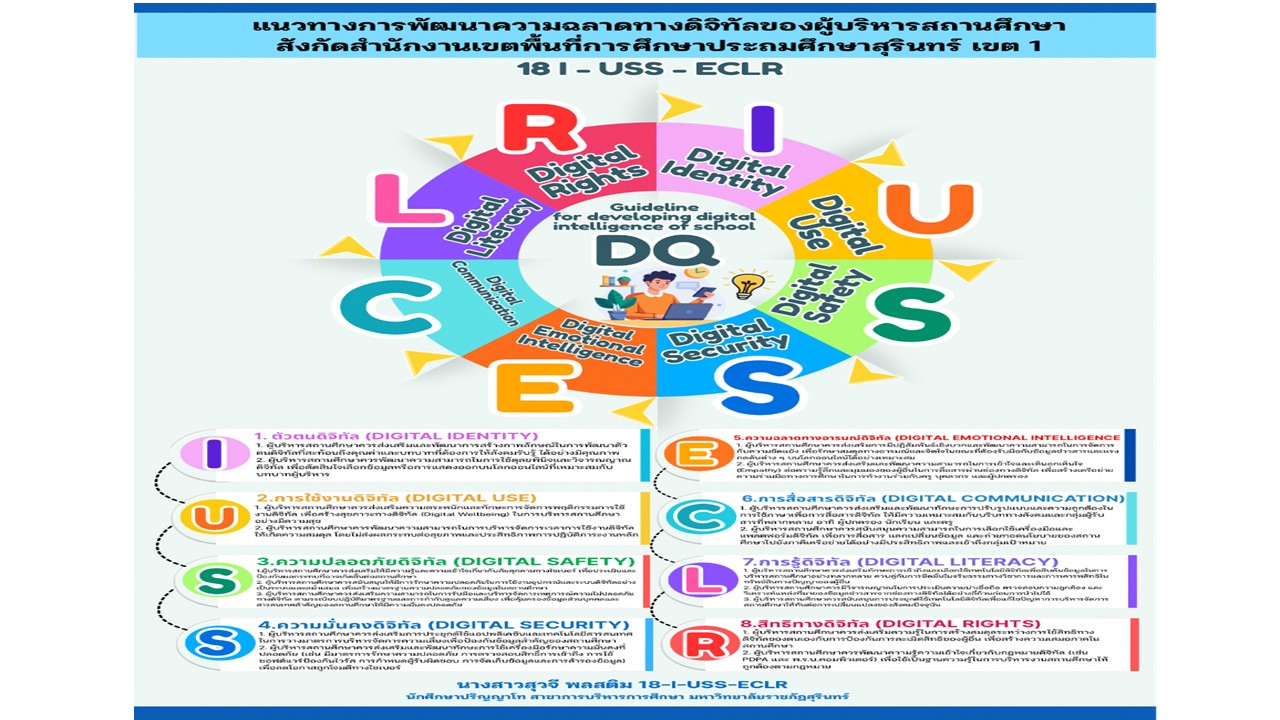
The purposes of this research were: 1) to investigate the current state, desirable state, and priority needs, 2) to establish development guidelines, and 3) to evaluate the appropriateness and feasibility of the guidelines for developing digital intelligence among school administrators under the Surin Primary Educational Service Area Office 1. This study employed a Mixed Methods Research approach, specifically an Exploratory Sequential Design. The research process involved collecting data from 165 school administrators using a questionnaire with a reliability coefficient of 0.97 to analyze the current and desirable states, as well as the Priority Needs Index (PNI). The quantitative results were subsequently synthesized with qualitative data obtained through a Focus Group Discussion with 11 experts to validate the development guidelines. Finally, the appropriateness and feasibility of these guidelines were evaluated by 15 experts. Statistical analysis included frequency distribution, percentage, mean, and standard deviation. The research findings revealed that: 1) The overall current state of digital intelligence development among school administrators was at a high level, while the desirable state was at the highest level. The three highest-ranking priority needs were digital communication, digital literacy, and digital security. 2) The guidelines for developing digital intelligence comprised 8 dimensions, encompassing a total of 18 strategic approaches. 3) The overall assessment of the appropriateness and feasibility of the proposed guidelines was at the highest level.
Keywords: Digital Intelligence (DQ), School Administrators, Development Guidelines
Article Details

This work is licensed under a Creative Commons Attribution-NonCommercial-NoDerivatives 4.0 International License.
