
Guidelines for Development Digital Leadership of School Administrators Under Surin Primary Educational Service Area Office 3
Article Sidebar
Main Article Content
Abstract
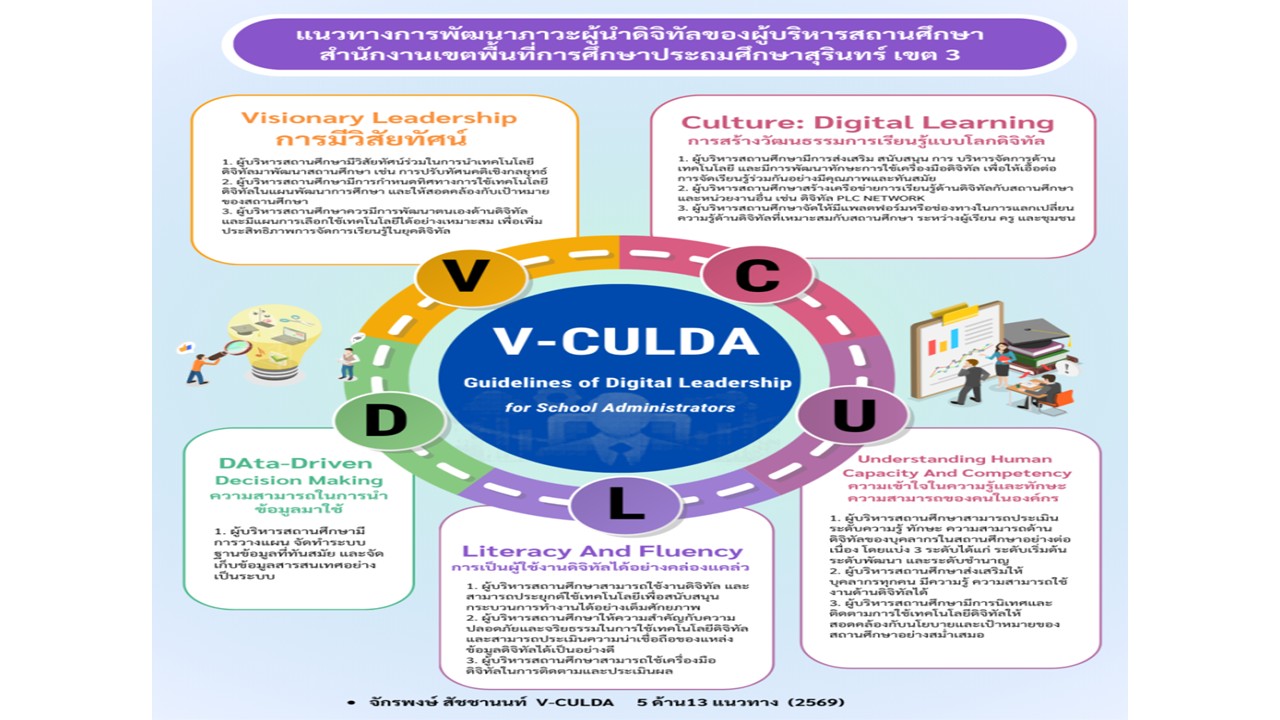
This research aimed to: 1) examine the current state and desirable conditions of digital leadership among school administrators; 2) study development guidelines; and 3) evaluate guidelines for developing digital leadership among school administrators under Surin Primary Educational Service Area Office 3. A mixed-methods research design was employed. The sample consisted of 146 schools with 292 informants in total. The research instrument was a rating scale questionnaire with a reliability coefficient of 0.95. Data were analyzed using frequency, percentage, mean, and standard deviation. A focus group discussion was conducted with 9 experts, and the guidelines were evaluated by 15 experts. The findings revealed that the current state and needs regarding digital leadership were at a high level overall, while the desirable conditions were rated at the highest level. The greatest needs, ranked in descending order, were visionary leadership, understanding of personnel competencies, building a digital learning culture, technology fluency, and data-driven decision making. The study yielded 5 main components and 13 sub-guidelines for development. The evaluation indicated that the guidelines were appropriate and, overall, at the highest level of feasibility.
Keywords: Digital Leadership, School Administrators, Development Guidelines
Article Details

This work is licensed under a Creative Commons Attribution-NonCommercial-NoDerivatives 4.0 International License.
References
จันทนา แสนสุข. (2559). ภาวะผู้นำดิจิทัลของผู้บริหารสถานศึกษา. สำนักพิมพ์แห่งจุฬาลงกรณ์มหาวิทยาลัย.
จิณณวัตร ปะโคทัง. (2561). ภาวะผู้นำทางการศึกษาและเทคโนโลยีดิจิทัล. มหาวิทยาลัยขอนแก่น.
ดาวรุวรรณ ถวิลการ. (2564). ภาวะผู้นำดิจิทัลของผู้บริหารสถานศึกษาในศตวรรษที่ 21. สำนักพิมพ์มหาวิทยาลัยศรีนครินทรวิโรฒ.
บุญชม ศรีสะอาด. (2560). การวิจัยเบื้องต้น (พิมพ์ครั้งที่ 10). สุวีริยาสาส์น.
วัฒนชัย ศิริกาญ. (2560). ภาวะผู้นำกับการพัฒนาองค์การนวัตกรรม. ซีเอ็ดยูเคชั่น.
วาสนา พลชาย. (2562). ภาวะผู้นำทางดิจิทัลของผู้บริหารสถานศึกษาตามทัศนะของข้าราชการครู สังกัดสำนักงานเขตพื้นที่การศึกษาประถมศึกษาหนองบัวลำภู เขต 1. วารสารการบริหารการศึกษา, ปีที่(ฉบับที่), หน้า. (ต้นฉบับไม่มีเลขปีที่/ฉบับที่/หน้า กรุณาเติมให้ครบ)
สุภวัช เชาว์เกษม. (ม.ป.ป.). วัฒนธรรมการเรียนรู้ในยุคดิจิทัล. มหาวิทยาลัยธรรมศาสตร์.
สุรีรัตน์ รอดพ้น. (2564). การจัดการระบบฐานข้อมูลในสถานศึกษาเพื่อการตัดสินใจเชิงบริหาร. วารสารวิชาการศึกษาศาสตร์, 22(1), 78–92.
สุวัฒน์ จุลสุวรรณ์. (2554). ภาวะผู้นำทางการบริหาร. โอเดียนสโตร์.
สำนักงานคณะกรรมการการศึกษาขั้นพื้นฐาน. (2555). แนวทางการพัฒนาการศึกษาขั้นพื้นฐานในศตวรรษที่ 21. กระทรวงศึกษาธิการ.
สำนักงานคณะกรรมการการศึกษาขั้นพื้นฐาน. (2563). พระบรมราโชบายด้านการศึกษาในหลวงรัชกาลที่ 10. กระทรวงศึกษาธิการ.
สำนักงานสภาพัฒนาการเศรษฐกิจและสังคมแห่งชาติ. (2561). แผนแม่บทภายใต้ยุทธศาสตร์ชาติ (พ.ศ. 2561–2580). สำนักงานสภาพัฒนาการเศรษฐกิจและสังคมแห่งชาติ.
สำนักงานเลขาธิการสภาการศึกษา. (2560). แผนการศึกษาแห่งชาติ พ.ศ. 2560–2579. กระทรวงศึกษาธิการ.
สำนักนโยบายและยุทธศาสตร์. (2563). แผนยุทธศาสตร์กระทรวงศึกษาธิการด้านเทคโนโลยีดิจิทัลเพื่อการศึกษา. กระทรวงศึกษาธิการ.
Bush, T., & Glover, D. (2005). School leadership development: Literature review. National College for School Leadership.
Certo, S. C., & Certo, S. T. (2006). Modern management (10th ed.). Pearson Prentice Hall.
Elliott, A. (2017). Leadership in a digital world. Sage Publications.
Karakose, T., Polat, H., & Papadakis, S. (2021). Examining teachers' perspectives on school principals' digital leadership roles and technology capabilities during the COVID-19 pandemic. Sustainability, 13(23), 13448. https://doi.org/10.3390/su132313448
Owens, M., Ravi, V., & Hunter, E. (2023). Digital inclusion as a lens for equitable parent engagement. TechTrends. https://doi.org/10.1007/s11528-023-00859-5
Senge, P. M. (1990). The fifth discipline: The art and practice of the learning organization. Doubleday.
Sheninger, E. (2014). Digital leadership: Changing paradigms for changing times. Corwin Press.
Zhong, L. (2017). Indicators of digital leadership in the context of K-12 education. Journal of Educational Technology Development and Exchange, 10(1), 27–40. https://doi.org/10.18785/jetde.1001.03
