
Priority Needs and Development Guidelines for Mindful Leadership among Secondary School Administrators
Article Sidebar
Main Article Content
Abstract
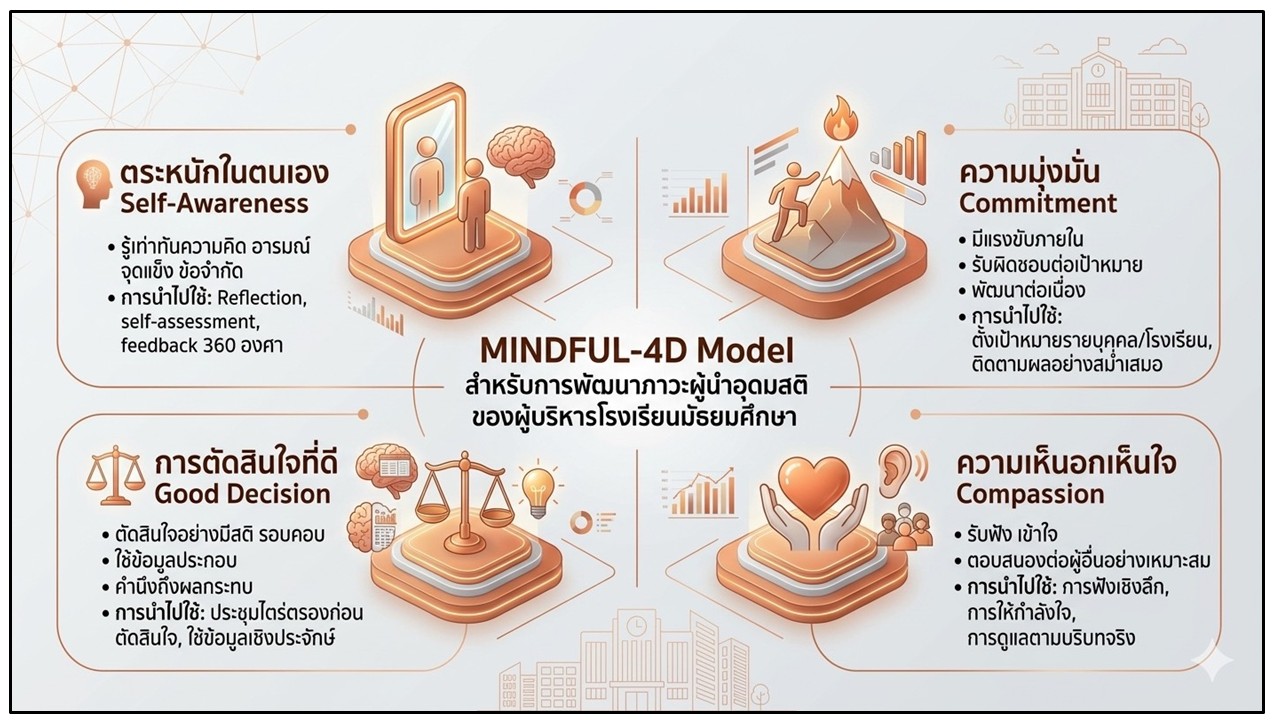
This research aimed to : 1) assess the needs for developing mindful leadership among secondary school administrators, and 2) propose guidelines for developing mindful leadership among secondary school administrators. The study employed an Explanatory Sequential Mixed Methods Design. The sample consisted of 214 secondary school principals in the Northern Region under the Office of the Basic Education Commission. The sample size was determined using the Krejcie and Morgan table, and participants were selected through multistage sampling. The research instrument was a three-part questionnaire with content validity ranging from .80 to 1.00 and an overall reliability coefficient of .98. Data were analyzed using frequency, percentage, mean, standard deviation, and the Modified Priority Needs Index (PNI modified). The development guidelines were derived from content analysis of open-ended responses in Part 3 of the questionnaire. The findings revealed that, overall, there was an urgent need for development (PNI modified = 0.30). The priority needs, ranked from highest to lowest, were good decision-making, empathy, self-awareness, and commitment. The synthesized development guidelines consisted of four main approaches: developing mindful and systematic open-minded decision-making, fostering compassionate and proactive empathetic leadership, enhancing deep self-awareness, and strengthening commitment and intrinsic motivation.
Keywords: Priority Needs, Development Guidelines, Mindful Leadership, Secondary School Administrators
Article Details

This work is licensed under a Creative Commons Attribution-NonCommercial-NoDerivatives 4.0 International License.
References
กระทรวงศึกษาธิการ. (2565). แผนพัฒนาการศึกษาแห่งชาติ 2566–2570. กระทรวงศึกษาธิการ.
วิโรจน์ สารรัตนะ. (2565). ภาวะผู้นำ: ทฤษฎีและนานาทัศนะร่วมสมัยปัจจุบัน (พิมพ์ครั้งที่ 3). ทิพย์วิสุทธิ.
Burmansah, B., Sutawan, K., Putra, R., & Ramadhan, R. (2022). Mindful leadership in educational settings: A review of conceptual development and implications. Journal of Positive School Psychology, 6(8), 1–10.
Bush, T. (2008). Leadership and management development in education. SAGE Publications.
Creswell, J. W., & Creswell, J. D. (2022). Research design: Qualitative, quantitative, and mixed methods approaches (6th ed.). SAGE Publications.
Day, D. V. (2001). Leadership development: A review in context. The Leadership Quarterly, 11(4), 581–613.
Day, D. V., & Gregory, J. L. (2017). Mindfulness as a prerequisite to effective leadership: Exploring the constructs that foster productive use of feedback for professional learning. Interchange, 48(4), 363–375.
Hargreaves, A. (2005). Sustainable leadership. Jossey-Bass.
Hsieh, C. C. (2018). Developing meaningful schools: An exploration of mindful leadership by principals. Educational Research Monthly, 292, 69–86.
Kabat-Zinn, J. (2003). Mindfulness-based interventions in context: Past, present, and future. Clinical Psychology: Science and Practice, 10(2), 144–156.
Liu, L. (2020). Examining the usefulness of mindfulness practices in managing school leader stress during COVID-19 pandemic. Journal of School Administration Research and Development, 5(S1), 15–20.
Mahfouz, J. (2018). Mindfulness training for school administrators: Effects on well-being and leadership. Journal of Educational Administration, 56(6), 602–619.
Tabancalı, E., & Öngel, G. (2020). Examining the relationship between school mindfulness and organizational trust. International Education Studies, 13(6), 14–25.
Wells, C. M. (2015). Conceptualizing mindful leadership in schools. Educational Administration Quarterly, 51(1), 1–38.
Williams, R. (2016). The 7 habits of mindful leaders. Ray Williams Associates.
