
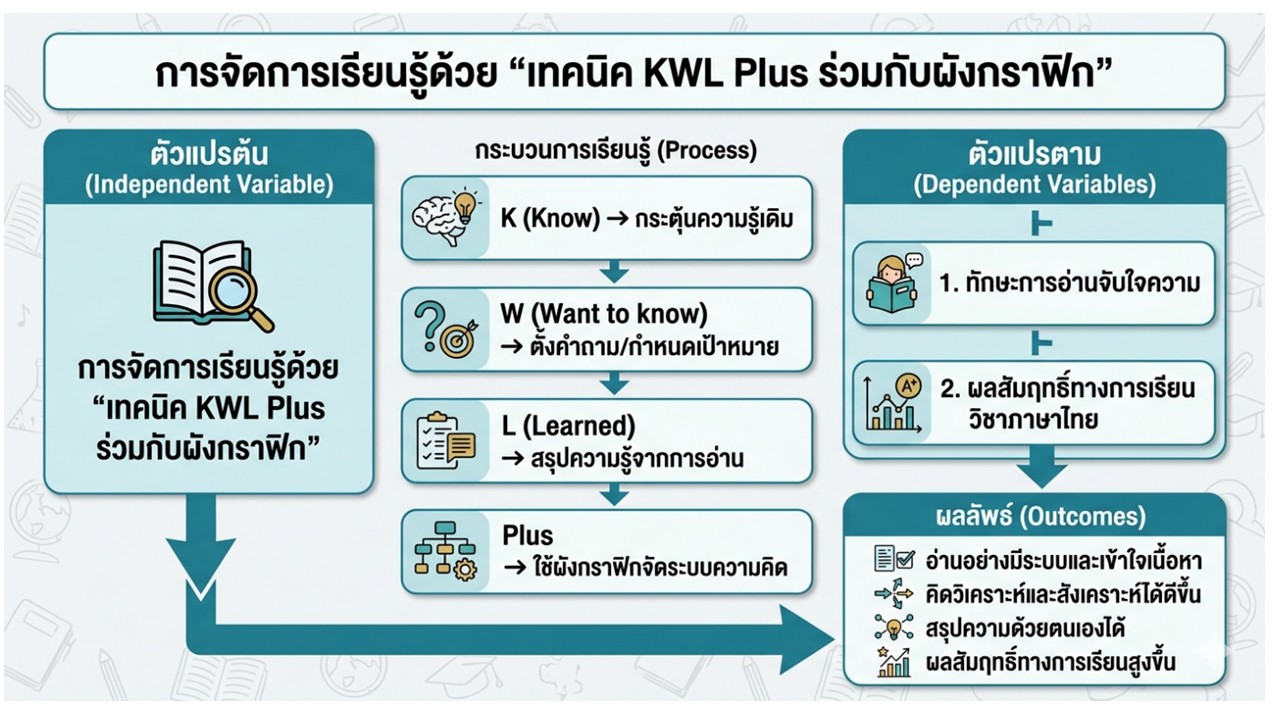
Development of Thai Reading Comprehension Skills and Learning Achievement Using Learning Management with KWL Plus Technique associated with Graphic Organizers for Prathomsuksa 5 Students
Article Sidebar
Main Article Content
Abstract
The objectives of this study were 1) to develop students' Thai reading comprehension skills to achieve a minimum average score of 70%, with at least 70% of students meeting the criterion; 2) to compare students' learning achievement after instruction using the KWL Plus technique associated with graphic organizers against a 70% criterion; and 3) to examine students' satisfaction with the instruction. This was the one-group posttest-only design. The target group consisted of 16 fifth-grade students selected through purposive sampling. The research instruments included lesson plans based on the KWL Plus technique with graphic organizers, a reading comprehension test, a learning achievement test, and a satisfaction questionnaire. Data were analyzed using percentages, means, standard deviations, and a t-test.
The results indicated that: 1) Students improved their Thai reading comprehension skills, with an average score of 20.62 out of 25 (82.50%), and all students (100%) met the 70% criterion; 2) The students' post-test mean score was 24.62 out of 25, which was significantly higher than the 70% criterion at the .05 level; and 3) Students reported a high level of satisfaction with the instructional method.
Keywords: KWL Plus Technique, Graphic Organizer, Reading Comprehension Skills, Learning Achievement
Article Details

This work is licensed under a Creative Commons Attribution-NonCommercial-NoDerivatives 4.0 International License.
References
ทิศนา แขมมณี. (2557). ศาสตร์การสอน:องค์ความรู้เพื่อการจัดกระบวนการเรียนรู้ที่มีประสิทธิภาพ. (พิมพ์ครั้งที่ 18). สำนักพิมพ์จุฬาลงกรณ์มหาวิทยาลัย
บุญชม ศรีสะอาด. (2553). การวิจัยเบื้องต้น (พิมพ์ครั้งที่ 9). สุวีริยาสาส์น.
ภัทรนันท์ ศรอินทร์. (2560). การศึกษาความสามารถด้านการอ่านและการเขียนภาษาไทยของนักเรียนชั้นประถมศึกษาปีที่ 1 โดยการจัดการเรียนรู้แบบ KWL-Plus. [วิทยานิพนธ์ปริญญามหาบัณฑิต ไม่ได้ตีพิมพ์]. มหาวิทยาลัยฟาร์อีสเทอร์น.
มหาวิทยาลัยจุฬาลงกรณราชวิทยาลัย (2551). ภาษากับการสื่อสาร Language and Communication. นวสาส์นการพิมพ์.
มาลินี สุทธิเวช. (2563). การพัฒนาผลสัมฤทธิ์การอ่านสรุปความ โดยใช้การจัดการเรียนรู้ด้วยเทคนิค KWL Plus สำหรับนักเรียนชั้นมัธยมศึกษาปีที่ 3. วารสารวิชาการทางการศึกษา, 21(1), 55-59.
วันวิดา กิจเจา. (2557). การศึกษาผลสัมฤทธิ์การอ่านจับใจความสำคัญของนักเรียนชั้นมัธยมศึกษาปีที่ 1 ที่จัดการเรียนรู้โดยการเรียนแบบร่วมมือเทคนิค STAD ร่วมกับเทคนิค KWL Plus. [วิทยานิพนธ์ปริญญามหาบัณฑิต ไม่ได้ตีพิมพ์]. มหาวิทยาลัยศิลปากร.
สมฤดี ทาแดง. (2564). การจัดการเรียนรู้การอ่านจับใจความด้วยเทคนิค KWL Plus ร่วมกับแผนผังความคิดของนักเรียนระดับชั้นมัธยมศึกษาปีที่ 2. [วิทยานิพนธ์ปริญญามหาบัณฑิต ไม่ได้ตีพิมพ์]. มหาวิทยาลัยราชภัฏมหาสารคาม.
สิริยากร กระออมแก้ว. (2566). การพัฒนาความสามารถการอ่านจับใจความ ของนักเรียนชั้นประถมศึกษาปีที่ 5 โดยใช้การจัดการเรียนรู้เทคนิค KWL Plus ร่วมกับเทคนิคการตั้งคำถาม 5W1H. [การค้นคว้าแบบอิสระปริญญามหาบัณฑิต]. มหาวิทยาลัยนเรศวร.
สุวิทย์ มูลคำ และ อรทัย มูลคํา. (2551). วิธีจัดการเรียนรู้เพื่อพัฒนากระบวนการคิด. ดวงกมลสมัย.
ศลิตา อรุณเดช, คชา ปราณีตพลกรัง, และ กิตติพัฒน์ ทาวงศ์ษา. (2565). การพัฒนาความสามารถการอ่านจับใจความของนักเรียนชั้นมัธยมศึกษาปีที่ 3 โดยการจัดการเรียนรู้ด้วยวิธีสอนแบบ KWL. วารสารศึกษาศาสตร์มหาวิทยาลัยขอนแก่น, 45(1), 101–116.
อรทัย จันใด. (2553). ปัจจัยที่มีอิทธิพลต่อผลสัมฤทธิ์ทางการเรียนภาษาอังกฤษ นักเรียนชั้นประถมศึกษาปีที่ 6 สังกัดสำนักงานเขตพื้นที่การศึกษาสกลนคร. [วิทยานิพนธ์ปริญญามหาบัณฑิต ไม่ได้ตีพิมพ์]. มหาวิทยาลัยมหาสารคาม.
อภิญญา ทองสีสัน และ นีรนาท จุลเนียม. (2568). การพัฒนาความสามารถด้านการอ่านจับใจความด้วยการจัดการเรียนรู้เทคนิค KWL-Plus ของนักเรียนชั้นประถมศึกษาปีที่ 6. วารสารสหศาสตร์การพัฒนาสังคม, 3(4), 926-947.
Carr, E., & Ogle, D. (1987). KWL Plus: A strategy for comprehension and summarization. Journal of Reading, 30(8), 636-631.
OECD. (2019). PISA 2018 results (Volume I): What students know and can do. OECD Publishing.
RAND Reading Study Group. (2002). Reading for Understanding: Toward an R&D Program in Reading Comprehension.
