
Needs Assessment of Digital-Era Academic Administration for Secondary Schools in Northern Thailand
Article Sidebar
Main Article Content
Abstract
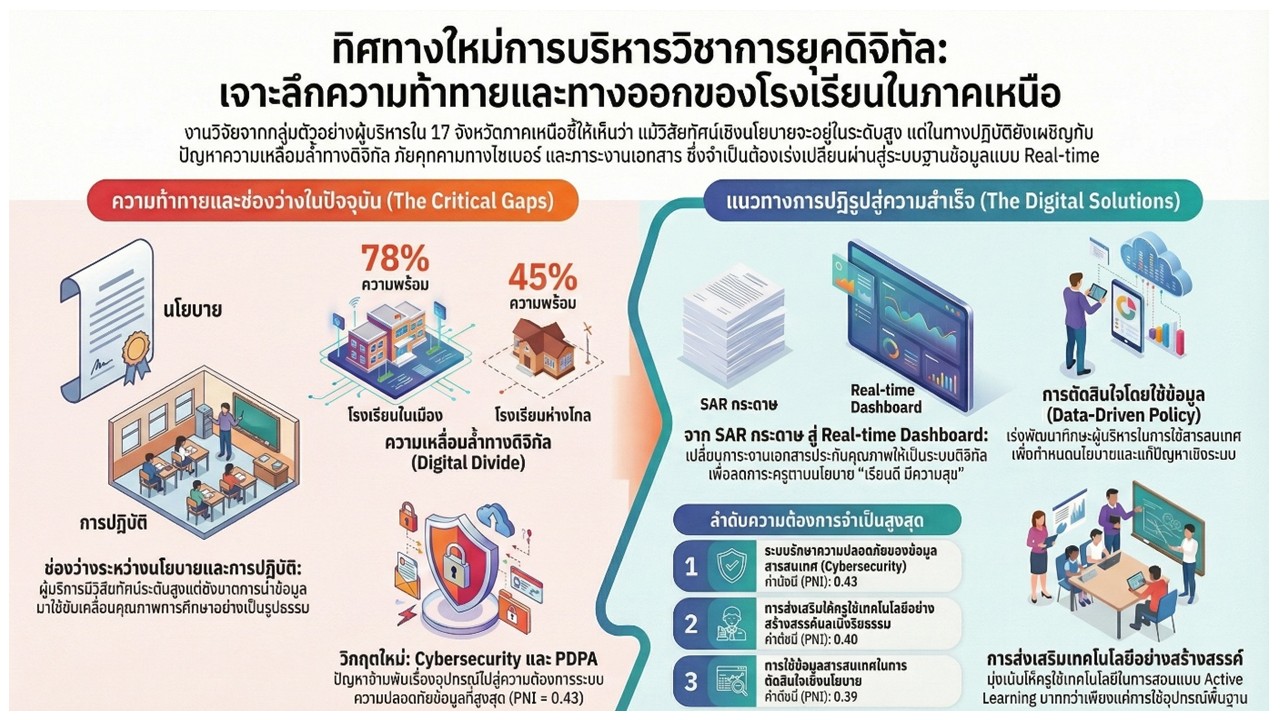
This research aimed to study the current and desired states and to assess the priority needs of digital-era academic administration for secondary schools in Northern Thailand. The study employed a quantitative survey research design. Data were collected from 210 school administrators, selected by stratified random sampling proportional to the administrator population and school size, from a population of 459 administrators across 17 northern provinces. The research instrument was a five-point rating-scale questionnaire covering five domains of academic administration. Data were analyzed using mean, standard deviation, and the Modified Priority Needs Index (PNImodified). The findings revealed that the current state of digital-era academic administration was at a high level, whereas the desired state was at the highest level. The component with the highest priority need was digital technology integration and data-driven decision making, followed by strategic management and quality assurance, twenty-first-century learner competency development, participation and collaborative networks, and competency-based instruction and assessment, respectively. The most critical needs concerned the information security system, the promotion of creative and ethical use of technology by teachers, and the use of information for policy decision making. These findings indicate that structural problems in information technology constitute the most significant barrier to digital-era academic administration.
Keywords: Needs Assessment, Digital Academic Administration, Secondary Schools, Northern Thailand, PNI Modified
Article Details

This work is licensed under a Creative Commons Attribution-NonCommercial-NoDerivatives 4.0 International License.
References
กระทรวงศึกษาธิการ. (2550). กฎกระทรวงกำหนดหลักเกณฑ์และวิธีการกระจายอำนาจการบริหารและการ
จัดการศึกษา พ.ศ. 2550. กรุงเทพฯ: กระทรวงศึกษาธิการ.
นงลักษณ์ วิรัชชัย และสุวิมล ว่องวานิช. (2562). การประเมินความต้องการจำเป็น. กรุงเทพฯ: สำนักพิมพ์แห่ง
จุฬาลงกรณ์มหาวิทยาลัย.
บุญชม ศรีสะอาด. (2553). การวิจัยเบื้องต้น (พิมพ์ครั้งที่ 9). กรุงเทพฯ: สุวีริยาสาส์น.
พฤทธิ์ ศิริบรรณพิทักษ์. (2552). การบริหารจัดการเชิงกลยุทธ์ทางการศึกษา. กรุงเทพฯ: คณะครุศาสตร์
จุฬาลงกรณ์มหาวิทยาลัย.
ยุทธศาสตร์ชาติ พ.ศ. 2561-2580. (2561). ราชกิจจานุเบกษา เล่ม 135 ตอนที่ 82 ก.
วรรณี แกมเกตุ. (2555). วิธีวิทยาการวิจัยทางพฤติกรรมศาสตร์ (พิมพ์ครั้งที่ 3). กรุงเทพฯ: สำนักพิมพ์แห่ง
จุฬาลงกรณ์มหาวิทยาลัย.
วิทยา นาควัชระ และคณะ. (2565). การพัฒนาโครงสร้างพื้นฐานดิจิทัลในภาคเหนือของประเทศไทย. วารสาร
เทคโนโลยีสารสนเทศ, 18(2), 123-125.
สมชาย จึงเสถียรทรัพย์. (2566). ความหลากหลายทางภูมิศาสตร์และสังคมของโรงเรียนมัธยมศึกษาเขต
ภาคเหนือ. วารสารการศึกษาไทย, 20(3), 45-47.
สำนักงานเลขาธิการสภาการศึกษา. (2560). แผนการศึกษาแห่งชาติ พ.ศ. 2560-2579. กรุงเทพฯ:
กระทรวงศึกษาธิการ.
สำนักงานส่งเสริมเศรษฐกิจดิจิทัล. (2565). รายงานสถานภาพเทคโนโลยีดิจิทัลในสถานศึกษา. กรุงเทพฯ:
DEPA.
อธิวัฒน์ พันธ์รัตน์. (2562). การบริหารงานวิชาการของผู้บริหารสถานศึกษา. วารสารบริหารการศึกษา, 15(1),
-12.
Baglama, B., et al. (2022). The role of school administrators in promoting digital technology in
education. Educational Technology Research, 45(3), 112-128.
Bates, A. W. (2019). Teaching in a digital age: Guidelines for designing teaching and learning
(2nd ed.). Tony Bates Associates.
Bryson, J. M. (2018). Strategic planning for public and nonprofit organizations (5th ed.). Jossey-
Bass.
Creswell, J. W. (2022). Research design: Qualitative, quantitative, and mixed methods
approaches (6th ed.). Sage.
David, F. R. (2017). Strategic management: Concepts and cases (16th ed.). Pearson.
Epstein, J. L. (2011). School, family, and community partnerships (2nd ed.). Westview Press.
Harasim, L. (2017). Learning theory and online technologies (2nd ed.). Routledge.
Hoy, W. K., & Miskel, C. G. (2007). Educational administration: Theory, research, and practice (8th ed.). McGraw-Hill.
Krejcie, R. V., & Morgan, D. W. (1970). Determining sample size for research activities. Educational
and Psychological Measurement, 30(3), 607-610.
Pattanasak, P., & Thanakit, S. (2023). Comparative analysis of educational contexts in urban
and rural northern Thai schools. Journal of Educational Administration, 61(1), 78-82.
Scott, C., & Guan, S. (2023). Digital divide in educational institutions. International Journal of
Education Technology, 15(2), 45-62.
Siemens, G. (2013). Learning analytics: The emergence of a discipline. American Behavioral
Scientist, 57(10), 1380-1400.
Siriwan, S., & Phongphit, S. (2024). Multicultural education and 21st century skills. Asian
Education Review, 12(2), 156-159.
UNESCO. (2020). Education in a post-COVID world: Nine ideas for public action. UNESCO
Publishing.
World Bank. (2023). Digital education in developing countries. World Bank Group.
