
Integrated Leadership of School Administrators under Loei Primary Educational Service Area Office 3
Article Sidebar
Main Article Content
Abstract
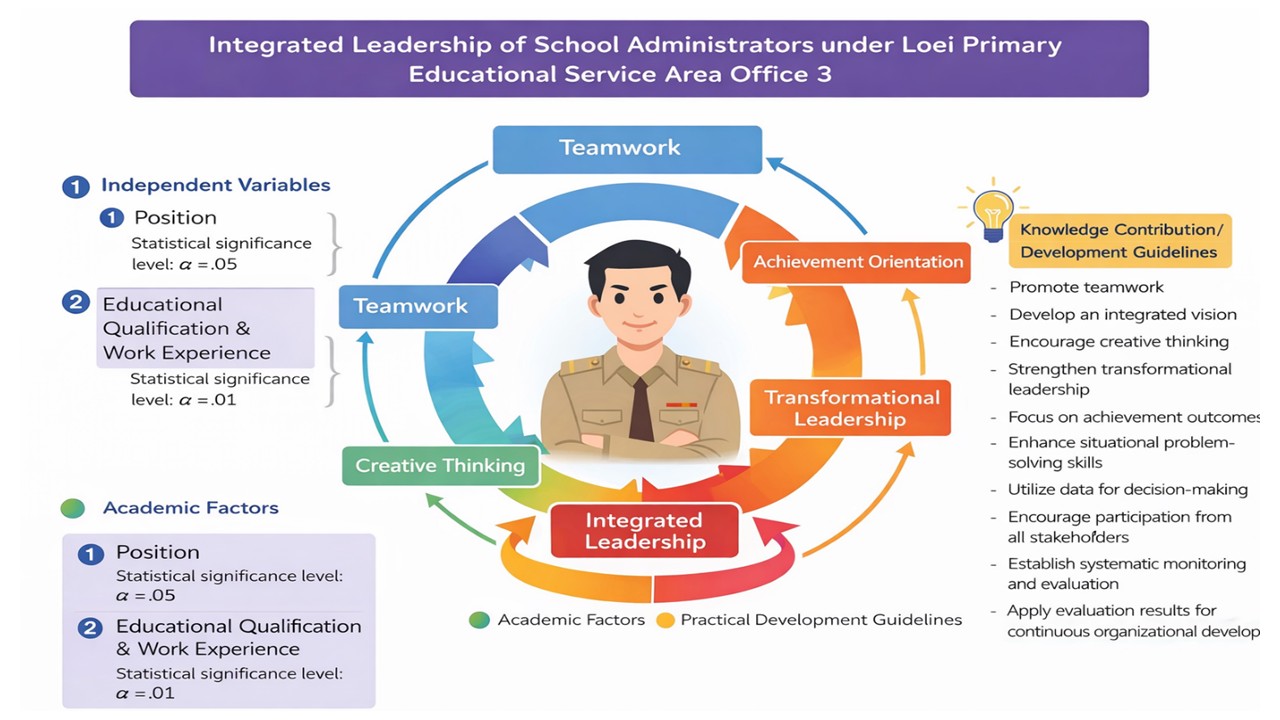
This study aimed to: 1) examine the level of integrated leadership of school administrators under the Loei Primary Educational Service Area Office 3; 2) compare the integrated leadership of school administrators classified by position, educational qualification, and work experience; and 3) propose guidelines for developing integrated leadership of school administrators. The sample consisted of 241 participants, determined using Krejcie and Morgan’s table. The research instrument was a questionnaire. The statistics used for data analysis included frequency, percentage, mean, standard deviation, t-test, and One-way ANOVA. Pairwise comparisons were conducted using Scheffe’s method, and content analysis was also employed. The research findings revealed that 1) The overall level of integrated leadership of school administrators was at a high level. When considering each aspect, it was found that teamwork had the highest mean, followed by achievement orientation, transformational leadership, situational problem-solving, and creativity. The aspect with the lowest mean was integrated vision. 2)The comparison of integrated leadership of school administrators, classified by position, showed a statistically significant difference at the .05 level. When classified by educational qualification and work experience, there were statistically significant differences at the .01 level.3)The guidelines for developing integrated leadership of school administrators emphasized enhancing teamwork, establishing an integrated vision, promoting creativity, fostering transformational leadership, focusing on achievement orientation, and improving situational problem-solving. These should be implemented through participatory approaches, systematic monitoring and evaluation, and the continuous use of evaluation results for organizational development.
Keywords: Integrated Leadership, School Administrators, Loei Primary Educational Service Area Office 3
Article Details

This work is licensed under a Creative Commons Attribution-NonCommercial-NoDerivatives 4.0 International License.
References
กระทรวงศึกษาธิการ. (2562). นโยบายและแผนการศึกษาชาติ. กรุงเทพมหานคร: กระทรวงศึกษาธิการ.
กัลยา ตากูล. (2550). การศึกษาการจัดการเรียนการสอนและสภาพแวดล้อมเพื่อส่งเสริมทักษะการคิดและกระบวนการคิดแก้ปัญหาอนาคตของนักเรียนระดับชั้นมัธยมศึกษาปีที่ 3: กรณีศึกษาโรงเรียนวชิราวุธวิทยา (วิทยานิพนธ์ปริญญามหาบัณฑิต). จุฬาลงกรณ์มหาวิทยาลัย.
คณะกรรมการการอุดมศึกษา. (2558). เกณฑ์คุณภาพการศึกษาเพื่อการดำเนินการที่เป็นเลิศ (EdPEx). กรุงเทพมหานคร: สำนักงานคณะกรรมการการอุดมศึกษา.
จตุรพล แสนศิลา. (2564). แนวทางการพัฒนาสมรรถนะด้านการมุ่งผลสัมฤทธิ์ของผู้บริหารสถานศึกษาในยุคดิจิทัล สังกัดสำนักงานเขตพื้นที่การศึกษาประถมศึกษามหาสารคาม เขต 3 (วิทยานิพนธ์มหาบัณฑิต). มหาวิทยาลัยมหาสารคาม.
จิตรา ทรัพย์โฉม. (2556). ความสัมพันธ์ระหว่างภาวะผู้นำการเปลี่ยนแปลงของผู้บริหารโรงเรียนกับประสิทธิผลการบริหารโรงเรียน สังกัดสำนักงานเขตพื้นที่การศึกษาประถมศึกษาสกลนคร เขต 2 (วิทยานิพนธ์มหาบัณฑิต). มหาวิทยาลัยราชภัฏสกลนคร.
ชัยยนต์ เพาพาน. (2559). ภาวะผู้นำทางการศึกษาในศตวรรษที่ 21. วารสารบริหารการศึกษา มหาวิทยาลัยขอนแก่น, คณะศึกษาศาสตร์ มหาวิทยาลัยขอนแก่น.
ธีระ รุญเจริญ. (2563). ภาวะผู้นำกับการพัฒนาคุณภาพการศึกษา. กรุงเทพมหานคร: ข้าวฟ่าง.
บุญชม ศรีสะอาด. (2560). การวิจัยเบื้องต้น (พิมพ์ครั้งที่ 10). กรุงเทพมหานคร: สุวีริยาสาส์น.
ปทุมพร เปียถนอม. (2554). รูปแบบการพัฒนาภาวะผู้นำเชิงบูรณาการสำหรับผู้บริหารสถาบันอุดมศึกษาเอกชน (วิทยานิพนธ์ดุษฎีบัณฑิต). จุฬาลงกรณ์มหาวิทยาลัย.
ปนัดดา ศิลปชัย, & ทนงศักดิ์ คุ้มไข่น้ำ. (2567). แนวทางการพัฒนาภาวะผู้นำเชิงบูรณาการของผู้บริหารสถานศึกษา สังกัดสำนักงานเขตพื้นที่การศึกษาประถมศึกษาหนองคาย เขต 1. วารสารมหาวิทยาลัยราชภัฏหนองคาย, 11(1), 78–92.
พิมลพรรณ เพชรสมบัติ. (2560). การทำงานเป็นทีมในองค์กร. คณะครุศาสตร์อุตสาหกรรม มหาวิทยาลัยเทคโนโลยีราชมงคลธัญบุรี.
วราภรณ์ สุบรรณ์. (2557). ภาวะผู้นำการเปลี่ยนแปลงของผู้บริหารที่ส่งผลต่อพฤติกรรมการสอนของครูในสถานศึกษา สังกัดสำนักงานเขตพื้นที่การศึกษาประถมศึกษาสกลนคร เขต 1 (วิทยานิพนธ์มหาบัณฑิต). มหาวิทยาลัยราชภัฏสกลนคร.
วิรัช บุญส่ง. (2561). การทำงานเป็นทีมของผู้บริหารสถานศึกษา สังกัดสำนักงานเขตพื้นที่การศึกษาประถมศึกษาปทุมธานี (วิทยานิพนธ์มหาบัณฑิต). มหาวิทยาลัยเทคโนโลยีราชมงคลธัญบุรี.
วิโรจน์ สารรัตนะ. (2562). ภาวะผู้นำทางการศึกษา: ทฤษฎีและแนวปฏิบัติ. มหาวิทยาลัยขอนแก่น.
วิไลวรรณ ศรีมันตะสิริภัทร. (2560). พฤติกรรมการตัดสินใจของผู้บริหารและครูที่ส่งผลต่อการทำงานเป็นทีมในสถานศึกษา. วารสารวิจัยรำไพพรรณี, 11(3), 148–156.
ศักดา แจ่มแจ้ง. (2560). รูปแบบการพัฒนาภาวะผู้นำเชิงบูรณาการสำหรับผู้บริหารสถานศึกษาขั้นพื้นฐานระดับปฐมวัย. วารสารวิชาการมหาวิทยาลัยราชภัฏพระนคร, 8(2), 93–113.
ศักดา พรมกุล. (2563). โมเดลสมการโครงสร้างภาวะผู้นำเชิงบูรณาการที่ส่งผลต่อคุณภาพโรงเรียนมัธยมศึกษา (วิทยานิพนธ์ดุษฎีบัณฑิต). มหาวิทยาลัยขอนแก่น.
สำนักงานเขตพื้นที่การศึกษาประถมศึกษาเลย เขต 3. (2568). รายงานผลการดำเนินงานประจำปี. เลย: สำนักงานฯ.
สำนักงานปลัดกระทรวงศึกษาธิการ. (2559). แผนการศึกษาแห่งชาติ. กรุงเทพมหานคร: กระทรวงศึกษาธิการ.
หงส์ฟ้า คำสำโรง. (2565). ภาวะผู้นำเชิงบูรณาการของผู้บริหารสถานศึกษา (วิทยานิพนธ์มหาบัณฑิต). มหาวิทยาลัยขอนแก่น.
อดิศร พูนสวัสดิ์. (2565). ภาวะผู้นำเชิงบูรณาการของผู้บริหารสถานศึกษาที่ส่งผลต่อการจัดการเรียนรู้ในศตวรรษที่ 21 (วิทยานิพนธ์มหาบัณฑิต). มหาวิทยาลัยมหามกุฏราชวิทยาลัย.
อนุสรา พิพิทธภัณฑ์. (2563). รูปแบบการพัฒนาภาวะผู้นำเชิงบูรณาการของครู (วิทยานิพนธ์ดุษฎีบัณฑิต). มหาวิทยาลัยราชภัฏสกลนคร.
อภิญญา บุตรอุดม. (2568). ภาวะผู้นำเชิงบูรณาการของผู้บริหารสถานศึกษา. วารสารมณีเชษฐาราม, 8(5), 323–336.
Amabile, T. M. (1996). Creativity in context. Westview Press.
Amabile, T. M., & Pratt, M. G. (2016). The dynamic componential model of creativity. Research in Organizational Behavior, 36, 157–183.
Armenakis, A. A., & Harris, S. G. (2009). Reflections: Our journey in organizational change research. Journal of Change Management, 9(2), 127–142.
Bass, B. M., & Avolio, B. J. (1994). Improving organizational effectiveness through transformational leadership. Sage.
Burke, W. W. (2011). Organization change: Theory and practice. Sage.
Canadian International Development Agency. (2001). Results-based management guide. CIDA.
Crosby, B. C., & Kiedrowski, K. (2007). Leadership for public value. Jossey-Bass.
Fullan, M. (2001). Leading in a culture of change. Jossey-Bass.
Good, C. V. (1973). Dictionary of education. McGraw-Hill.
Hallinger, P. (2011). Leadership for learning. Journal of Educational Administration, 49(2).
Hersey, P., & Blanchard, K. H. (1988). Management of organizational behavior. Prentice Hall.
Johnson, D. W., & Morrow, K. A. (1981). Communication in organizations. Harper & Row.
Katzenbach, J. R., & Smith, D. K. (1993). The wisdom of teams. Harvard Business School Press.
Kotter, J. P. (1996). Leading change. Harvard Business School Press.
Locke, E. A., & Latham, G. P. (2002). Building a useful theory of goal setting. American Psychologist, 57(9), 705–717.
Luecke, R. (2004). Creating teams with an edge. Harvard Business School Press.
Morgan, C. T. (1978). Introduction to psychology. McGraw-Hill.
Moynihan, D. P., & Ingraham, P. W. (2004). Integrative leadership in the public sector. Public Administration Review, 64(4), 419–429.
Sahney, S., Banwet, D. K., & Karunes, S. (2008). An integrated framework of quality in education. Quality Assurance in Education, 16(1), 57–74.
Souillard, D. H., & Kerr, D. R. (1990). Problem solving. HarperCollins.
Wallach, M. A., & Kogan, N. (1965). Modes of thinking in young children. Holt.
Winston, B. E., & Patterson, K. (2006). An integrative definition of leadership. International Journal of Leadership Studies, 1(2), 6–66.
Woodcock, M. (1989). Team development manual. Gower.
Yukl, G. (2010). Leadership in organizations (7th ed.). Pearson.
Yukl, G. (2013). Leadership in organizations (8th ed.). Pearson.
