
Guidelines for Creating a Happy Workplace to Enhance Teachers’ Work Motivation in Schools under the Chonburi Provincial Administrative Organization
Article Sidebar
Main Article Content
Abstract
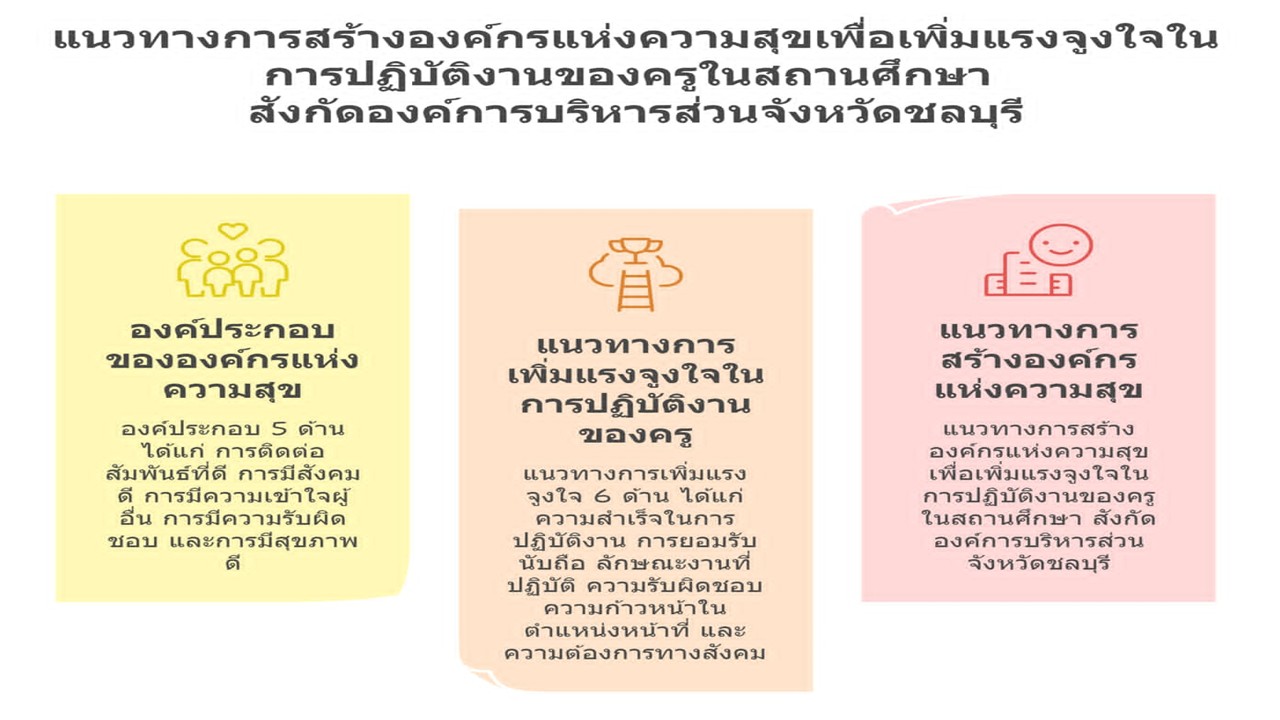
This research was conducted with three principal objectives: (1) to investigate the current state and the desirable state of cultivating a happy workplace aimed at enhancing teachers' work motivation in schools; (2) to assess the priority needs pertaining to the cultivation of a happy workplace aimed at enhancing teachers' work motivation in schools; and (3) to propose guidelines for cultivating a happy workplace aimed at enhancing teachers' work motivation in schools. The study employed a quantitative research design. The sample comprised 260 participants, consisting of 28 school administrators and 232 teachers. The research instruments consisted of a questionnaire together with an evaluation form designed to assess the appropriateness and feasibility of the proposed guidelines, both of which were constructed as five-point rating scales. The statistical techniques employed in the analysis included frequency, percentage, arithmetic mean, standard deviation, and the Modified Priority Needs Index (PNImodified). The findings were as follows. (1) With respect to the cultivation of a happy workplace in schools, the current state was, overall, at a high level, whereas the desirable state was, overall, at the highest level. In a similar vein, the current state concerning the enhancement of teachers' work motivation was rated at a high level across all dimensions, while the desirable state was, overall, at the highest level. (2) The assessment of priority needs for cultivating a happy workplace yielded an overall PNImodified value of 0.153. When disaggregated by dimension and ranked in descending order of priority, the results were: Good Health, Responsibility, Sound Interpersonal Relations, Conducive Social Environment, and Empathetic Understanding of Others, respectively. As regards the priority needs for enhancing teachers' work motivation, the overall PNImodified value was 0.088, with the constituent dimensions ranked in descending order of priority as follows: Recognition, Nature of Work, Responsibility, Achievement, Social Needs, and Advancement in Position, respectively. (3) The proposed guidelines for cultivating a happy workplace in schools were formulated to comprise one principal guideline, namely, Good Health, supported by three subsidiary guidelines. In parallel, the guidelines for enhancing teachers' work motivation were formulated to comprise four principal guidelines, namely, Recognition, Nature of Work, Responsibility, and Achievement, supported by twelve subsidiary guidelines.
Keywords: Guidelines, Happy Workplace, Teachers' Work Motivation
Article Details

This work is licensed under a Creative Commons Attribution-NonCommercial-NoDerivatives 4.0 International License.
References
กัญญ์สิริ กันทา, และ ณัฐวุฒิ สัพโส. (2568). การศึกษาแรงจูงใจในการปฏิบัติงานของครูผู้สอนในสถานศึกษา สังกัดสำนักงานเขตพื้นที่การศึกษาประถมศึกษาเชียงราย เขต 2. Journal of Sustainable Wisdom and Networking, 3(4), 48–66.
กอปรลาภ อภัยภักดิ์. (2563). บรรยากาศองค์กรแห่งความสุข: คนเบิกบาน งานสำเร็จ. วารสารมจรมนุษยศาสตร์ปริทรรศน์, 6(1), 315-331.
จอมพงศ์ มงคลวนิช. (2556). การบริหารองค์การและบุคลากรทางการศึกษา. (พิมพ์ครั้งที่ 2). กรุงเทพฯ: โรงพิมพ์วี.
จีระ หงส์ลดารมภ์. (2555). เอกสารประกอบการสัมมนา 8K’s + 5 K’s ทุนมนุษย์คนไทยในการรองรับประชาคมอาเซียน. กรุงเทพฯ: มหาวิทยาลัยธรรมศาสตร์.
ฐิติมา เวชพงศ์. (2566). การเสริมสร้างแรงจูงใจในการทำงานของครูโรงเรียนขนาดเล็ก อำเภอเมือง จังหวัดสมุทรสงคราม. วารสารศิลปศาสตร์ มหาวิทยาลัยธรรมศาสตร์, 23(2), 141–161.
ณัฐพงษ์ น้อยโคตร (2565). แนวทางการพัฒนาสถานศึกษาสู่องค์กรแห่งความสุข สังกัดสำนักงานเขตพื้นที่การศึกษาประถมศึกษามหาสารคาม เขต 2. วารสารพุทธปรัชญาวิวัฒน์. 6(1), 91-103.
ธนวุฒิ แก้วนุช, อุทัย บุญประเสริฐ และพิมลพรรณ เพชรสมบัติ. (2563). รูปแบบการพัฒนาสถานศึกษาขั้นพื้นฐานสู่การ เป็นองค์กรแห่งความสุข. (วิทยานิพนธ์ ศึกษาศาสตรดุษฎีบัณฑิต สาขาวิชาการจัดการศึกษา). คณะครุศาสตร์, มหาวิทยาลัยธุรกิจบัณฑิตย์.
ธร สุนทรายุทธ. (2553). ทฤษฎีองค์กรและพฤติกรรม: หลักการทฤษฎี การวิจัย และการปฏิบัติการทางการศึกษา. กรุงเทพฯ: เนติกุลการพิมพ์.
ภัทรพล สายแวว. (2564). แนวทางการส่งเสริมองค์กรแห่งความสุขของสถานศึกษา สังกัดสำนักงานเขตพื้นที่การศึกษา
มัธยมศึกษาปทุมธานี. (วิทยานิพนธ์). หลักสูตรศึกษาศาสตรมหาบัณฑิต สาขาวิชาการบริหารการศึกษา คณะครุศาสตร์อุตสาหกรรม มหาวิทยาลัยเทคโนโลยีราชมงคลธัญบุรี.
ภารดี อนันต์นาวี. (2555). หลักการ แนวคิด ทฤษฎีทางการบริหาร (พิมพ์ครั้งที่ 4). ชลบุรี: มนตรี.
พรสวัสดิ์ ศิรศาตนันท์. (2555). ภาวะผู้นำทางการศึกษา. คณะครุศาสตร์ มหาวิทยาลัยราชภัฏรำไพพรรณี
เย็นฤดี สอนสุราษฎร์. (2557). แรงจูงใจในการปฏิบัติงานของบุคลากรทางการศึกษาในสังกัดองค์กรปกครองส่วนท้องถิ่น จังหวัดสกลนคร (วิทยานิพนธ์ ค.ม.). สกลนคร: มหาวิทยาลัยราชภัฏสกลนคร.
ว.วชิรเมธี. (2553). ความทุกข์มาโปรด ความสุขโปรยปราย. กรุงเทพฯ : ปราณพับลิชชิ่ง.
ศิรินันท์ กิตติสุขสถิต, เฉลิมพล แจ่มจันทร์, กาญจนา ตั้งชลทิพย์, และจรัมพร โห้ลำยอง. (2555). คุณภาพชีวิต การทำงาน และความสุข. สถาบันวิจัยประชากรและสังคม มหาวิทยาลัยมหิดล.
สำนักงานคณะกรรมการพัฒนาการเศรษฐกิจและสังคมแห่งชาติ. (2566). แผนพัฒนาเศรษฐกิจและสังคมแห่งชาติ ฉบับที่ 13 (พ.ศ. 2566–2570). https://www.nesdc.go.th/the-national-economic-and-social-development-plan/the-thirteenth-plan-2023-2027/
สำนักงานเลขาธิการสภาการศึกษา. (2560). แผนการศึกษาแห่งชาติ พ.ศ. 2560-2579. กรุงเทพ : พริกหวาน กราฟิค.
สุรศักดิ์ วณิชยวัฒนากุล. (2559). แรงจูงใจและการจูงใจในการทำงาน. กรุงเทพฯ: คณะพาณิชยศาสตร์และการบัญชี มหาวิทยาลัยธรรมศาสตร์.
สุราลัย ป้องแพง. (2559). การศึกษาแรงจูงใจในการปฏิบัติงานของครูในอำเภอแม่วงก์ สังกัดสำนักงานเขตพื้นที่การศึกษาประถมศึกษานครสวรรค์ เขต 2. วิทยานิพนธ์ ค.ม. มหาวิทยาลัยราชภัฏนครสวรรค์.
สนุก สิงห์มาตร และคณะ. (2560). คุณลักษณะภาวะผู้นำของผู้บริหารองค์กรในศตวรรษที่ 21 (การประชุมวิชาการเสนอผลงานวิจัยระดับบัณฑิตศึกษา ครั้งที่ 2). มหาสารคาม: มหาวิทยาลัยราชภัฏมหาสารคาม.
Creswell, J. W. (2022). Research design: Qualitative, quantitative, and mixed methods approaches (6th ed.). SAGE.
Diener, E. (2000). Subjective well-being: The science of happiness and a proposal for a national index. American Psychologist, 55(1), 34–43.
Gavin, J. H., & Mason, R. O. (2004). The virtuous organization: The value of happiness in the workplace. Organizational Dynamics, 33(4), 379–392.
Herzberg, F., Mausner, B., & Snyderman, B. B. (1959). The motivation to work (2nd ed.). John Wiley & Sons.
Krejcie, R. V., & Morgan, D. W. (1970). Determining sample size for research activities. Educational and Psychological Measurement, 30(3), 607–610.
Layard, R. (2005). Happiness: Lessons from a new science. Penguin Press.
Manion, J. (2003). Joy at work: Creating a positive workplace. Journal of Nursing Administration, 33(12), 652–659.
Maslow, A. H. (1943). A theory of human motivation. Psychological Review, 50(4), 370–396.
McClelland, D. C. (1961). The achieving society. New York: Van Nostrand.
