
Development of an Instructional Model Using the IDEA Model Integrated with Polya’s Problem-Solving Process to Enhance Mathematical Problem-Solving Competency and Learning Achievement on Conic Sections for Grade 10 Students
Article Sidebar
Main Article Content
Abstract
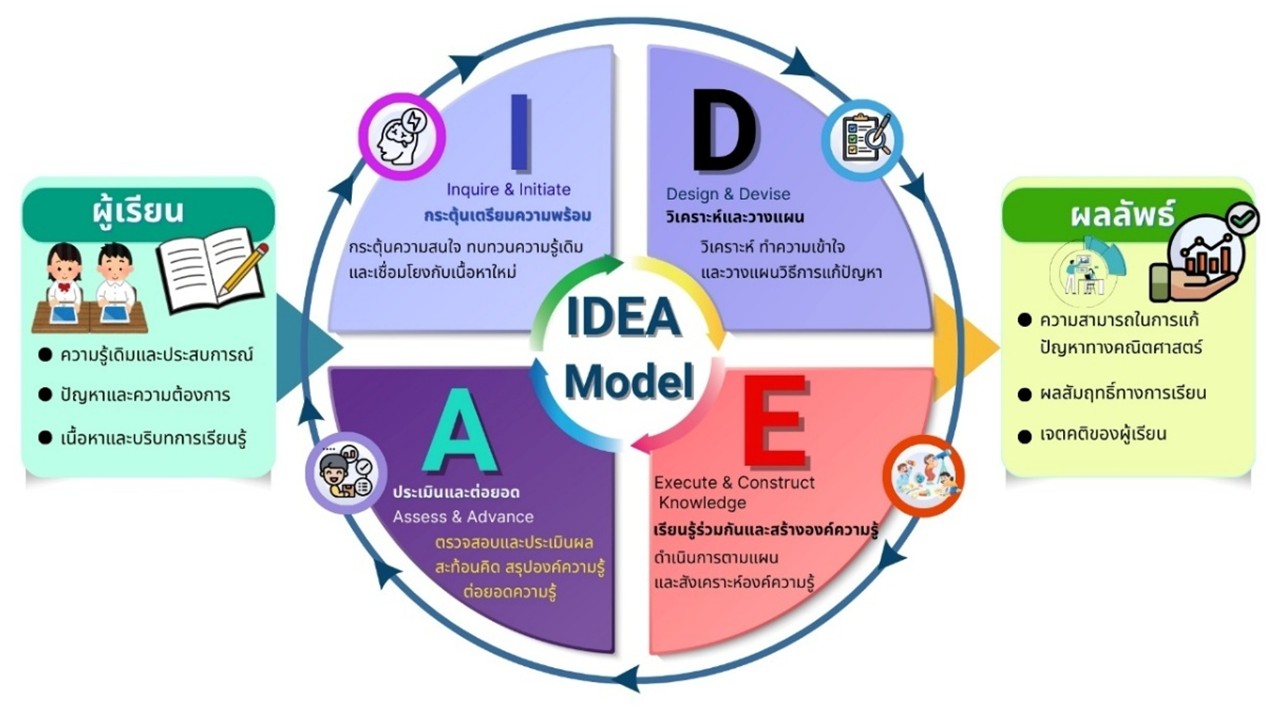
This research aimed to: (1) develop an instructional model based on the IDEA Model integrated with Polya’s problem-solving process to achieve an efficiency criterion of 75/75; (2) compare students’ mathematical problem-solving ability with a 70 percent criterion; (3) compare students’ learning achievement before and after instruction; and (4) examine students’ satisfaction with the instructional model. The sample consisted of 33 Grade 10 students from Classroom 2, selected by cluster random sampling, with the classroom as the sampling unit. The research instruments included lesson plans, a mathematical problem-solving ability test, a learning achievement test, and a satisfaction questionnaire. Data were analyzed using percentage, mean, standard deviation, and t-tests. The results revealed that: (1) the developed instructional model comprised four components: principles, objectives, instructional activities, and assessment and evaluation. The instructional process based on the IDEA Model included four stages: (1) Inquire & Initiate (I), (2) Design & Devise (D), (3) Execute & Construct Knowledge (E), and (4) Assess & Advance (A). The model achieved an efficiency of 78.97/78.49, which was higher than the specified criterion. (2) Students’ mathematical problem-solving ability was significantly higher than the 70 percent criterion. (3) Students’ post-learning achievement was significantly higher than their pre-learning achievement at the .05 level. (4) Students’ overall satisfaction with the instructional model was at the highest level.
Keywords: IDEA Model, Mathematical Problem Solving, Learning Achievement, Conic Sections
Article Details

This work is licensed under a Creative Commons Attribution-NonCommercial-NoDerivatives 4.0 International License.
References
กระทรวงศึกษาธิการ. (2560). ตัวชี้วัดและสาระการเรียนรู้แกนกลางกลุ่มสาระการเรียนรู้คณิตศาสตร์ (ฉบับปรับปรุง พ.ศ. 2560). โรงพิมพ์ชุมนุมสหกรณ์การเกษตรแห่งประเทศไทย.
จุฬาภรณ์ บุญศรี. (2560). การพัฒนาชุดการเรียนรู้ เรื่อง การประยุกต์แก้โจทย์ปัญหาด้วยสมการ สำหรับนักเรียนชั้นประถมศึกษาปีที่ 6. โรงเรียนบ้านโคกหินช้าง.
ชลดา บุญแสน. (2563). การพัฒนาความสามารถในการแก้ปัญหาทางคณิตศาสตร์โดยใช้การเรียนรู้แบบใช้ปัญหาเป็นฐาน (วิทยานิพนธ์ครุศาสตรมหาบัณฑิต). มหาวิทยาลัยราชภัฏมหาสารคาม.
ชิดชนก ตะโกพร. (2565). การพัฒนารูปแบบการเรียนรู้เพื่อส่งเสริมความสามารถในการแก้ปัญหาทางคณิตศาสตร์ (วิทยานิพนธ์ปรัชญาดุษฎีบัณฑิต). มหาวิทยาลัยศิลปากร. https://ithesis-ir.su.ac.th/dspace/bitstream/123456789/4296/1/61253902.pdf
นฤกวิน วัฒนรัตน์. (2565). การพัฒนาการจัดกิจกรรมการเรียนรู้โดยใช้กระบวนการแก้ปัญหาของโพลยาร่วมกับเทคนิคการตั้งคำถามแบบโสเครติส (การค้นคว้าอิสระ). มหาวิทยาลัยนเรศวร. https://nuir.lib.nu.ac.th/dspace/bitstream/123456789/5945/3/NaruekawinWattanarat.pdf
ทิศนา แขมมณี. (2564). ศาสตร์การสอน: องค์ความรู้เพื่อการจัดกระบวนการเรียนรู้ที่มีประสิทธิภาพ (พิมพ์ครั้งที่ 24). สำนักพิมพ์จุฬาลงกรณ์มหาวิทยาลัย.
วิไลลักษณ์ วังวลสินธุ์. (2560). การพัฒนารูปแบบการจัดการเรียนรู้โดยใช้เทคนิค TGT. http://research.otepc.go.th/files/ฉบับสมบูรณ์_lwkrwoc3.pdf
วิระสิทธิ์ มาตอำพร. (2563). การจัดการเรียนรู้โดยใช้ปัญหาเป็นฐานร่วมกับแนวคิดการศึกษาชั้นเรียน (วิทยานิพนธ์วิทยาศาสตรมหาบัณฑิต). มหาวิทยาลัยมหาสารคาม. https://202.28.34.124/dspace/bitstream/123456789/1162/1/60010283018.pdf
ศศิธร โมลา. (2560). การเรียนรู้แบบสืบเสาะหาความรู้ 5Es ร่วมกับกระบวนการแก้ปัญหาของโพลยา(วิทยานิพนธ์การศึกษามหาบัณฑิต). มหาวิทยาลัยบูรพา. https://buuir.buu.ac.th/bitstream/1234567890/7367/1/Fulltext.pdf
สายใจ ปินะกาพัง. (2560). การพัฒนารูปแบบการเรียนการสอนคณิตศาสตร์ (วิทยานิพนธ์การศึกษามหาบัณฑิต). มหาวิทยาลัยมหาสารคาม.
สายชล สุกร. (2562). การพัฒนาสมรรถนะการแก้ปัญหาแบบร่วมมือของผู้เรียน (วิทยานิพนธ์การศึกษามหาบัณฑิต). มหาวิทยาลัยนเรศวร.
สถาบันส่งเสริมการสอนวิทยาศาสตร์และเทคโนโลยี (สสวท.). (2560). คู่มือการใช้หลักสูตรคณิตศาสตร์.
อภิสิทธิ์ สางรัมย์. (2566). การพัฒนาการเรียนรู้ตามแนวทาง GPAS 5 Steps (วิทยานิพนธ์มหาบัณฑิต). มหาวิทยาลัยรามคำแหง.
Akhsanul, I. (2014). The implementation of the Polya method in solving Euclidean geometry problems. University of Muhammadiyah.
Bloom, B. S. (1956). Taxonomy of educational objectives. Longmans.
Nneji, S. O. (2015). Effect of Polya’s problem solving model on students’ achievement. Mediterranean Journal of Social Sciences, 3(6), 41–48.
Piaget, J. (1972). Science of education and the psychology of the child. Orion Press.
Polya, G. (1985). How to solve it. Princeton University Press.
Williams, W. (2003). The relationship between response to adversity and student achievement (Doctoral dissertation). Cardinal Stritch University.
