
Charismatic Leadership of Administrators Affecting Work Motivation of Teachers in Schools under Mukdahan Primary Educational Service Area
Article Sidebar
Main Article Content
Abstract
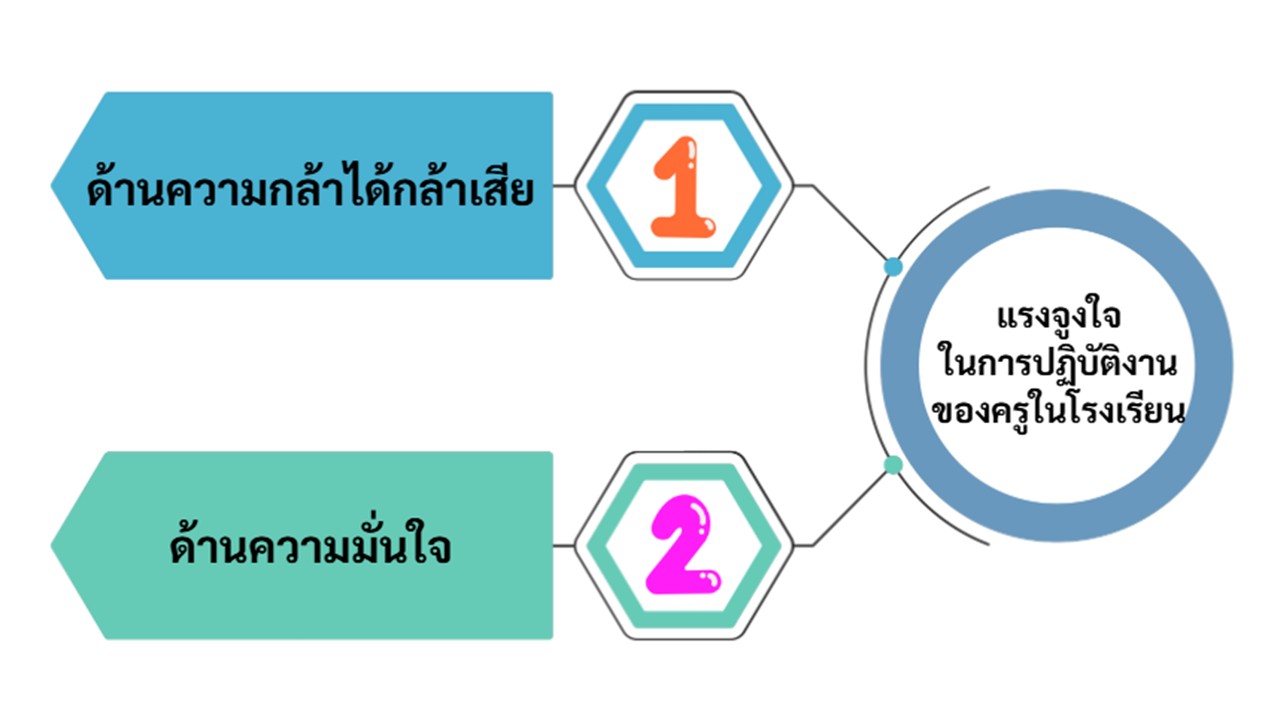
The purpose of this research was to 1) examine the level of charismatic leadership among school administrators. 2) Study the level of work motivation of teachers in schools. 3) Study the relationship between the charismatic leadership of administrators and the work motivation of teachers in schools. 4) Study the predictive power of the charismatic leadership of administrators affecting work motivation of teachers in schools, and 5) Study the guidelines for improving the charismatic leadership of administrators affecting work motivation of teachers in schools. The sample group in this research consisted of 356 participants, including school administrators and teachers, selected through a multi-stage random sampling technique. The data collection tool was a 5-point Likert-scale questionnaire. Statistical methods used for data analysis included frequencies, percentages, means, standard deviations, Pearson correlation coefficients, and stepwise multiple regression analysis. The findings were as follows. 1) The charismatic leadership of administrators in schools, overall, was at a high level. 2) The work motivation of teachers in schools, overall, was at a high level. 3) The charismatic leadership of administrators and work motivation of teachers in schools had a high positive relationship that was statistically significant at the .01 level. 4) The charismatic leadership of administrators, specifically in the areas of risk-taking and self-confidence, can significantly predict the work motivation of teachers in schools, with a predictive power of 64.20%, and a standard error of the estimate at .24. 5) The guideline for improving the charismatic leadership of administrators affecting work motivation of teachers in schools comprised two aspects, namely risk-taking and self-confidence.
Keywords: Charismatic Leadership, Work Motivation, Administrators
Article Details

This work is licensed under a Creative Commons Attribution-NonCommercial-NoDerivatives 4.0 International License.
References
ขจรศักดิ์ ธรรมธัชกุล. (2564). ภาวะผู้นำของผู้บริหารสถานศึกษาที่ส่งผลต่อแรงจูงใจในการปฏิบัติงานของครู [วิทยานิพนธ์ครุศาสตรมหาบัณฑิต]. มหาวิทยาลัยราชภัฏสกลนคร.
ชยพล เพชรพิมล. (2556). การศึกษาทฤษฎีบารมี. (วิทยานิพนธ์ปรัชญาดุษฎีบัณฑิต). มหาวิทยาลัยศิลปากร.
ฐิติยา รัตนายน. (2560). การวิเคราะห์องค์ประกอบคุณลักษณะภาวะผู้นำแบบบารมีของผู้บริหารสถานศึกษาสังกัดสำนักงานเขตพื้นที่การศึกษาประถมศึกษาปทุมธานี เขต 1. วารสารครุศาสตร์อุตสาหกรรม, 16(2), 106-114.
ณรงค์วิทย์ ตรีพงษ์รัตนกุล. (2559). ภาวะผู้นำเชิงศรัทธาบารมีที่ส่งผลต่อแรงจูงใจในการปฏิบัติงานของครู สังกัดสำนักงานเขตพื้นที่การศึกษามัธยมศึกษา เขต 25. วารสารศึกษาศาสตร์, 10(2), 34-40.
ณัฐธิดา สุระเสนา, เพ็ญผกา ปัญจนะ, และไชยา ภาวะบุตร. (2564). ความสัมพันธ์ระหว่างภาวะผู้นำของผู้บริหารโรงเรียนกับแรงจูงใจในการปฏิบัติงานของครู ในสังกัดสำนักงานเขตพื้นที่การศึกษามัธยมศึกษา เขต 21. วารสารการบริหารการศึกษาและภาวะผู้นำ, 10(37), 1–10.
ทักษิณ มวลมนตรี. (2564). ความสัมพันธ์ระหว่างภาวะผู้นำเชิงวิสัยทัศน์ของผู้บริหารโรงเรียนและแรงจูงใจในการปฏิบัติงานของครู สังกัดสำนักงานเขตพื้นที่การศึกษาประถมศึกษามุกดาหาร [วิทยานิพนธ์การศึกษามหาบัณฑิต]. มหาวิทยาลัยราชภัฏสกลนคร.
นิภาพร น่าเยี่ยม. (2558). การศึกษาภาวะผู้นำแบบบารมีกับแรงจูงใจที่ส่งผลต่อประสิทธิผลของการบริหารสหกรณ์ ภายใต้เครือข่ายอิสลามแห่งประเทศไทย. (วิทยานิพนธ์รัฐประศาสนศาสตรมหาบัณฑิต). จุฬาลงกรณ์มหาวิทยาลัย.
บุญวัฒน์ คำชูราษฎร์, สายันต์ บุญใบ, และระภีพรรณ ร้อยพิลา. (2564). ความสัมพันธ์ระหว่างพฤติกรรมทางการบริหารของผู้บริหารสถานศึกษากับแรงจูงใจในการปฏิบัติงานของครูในสังกัดสำนักงานเขตพื้นที่การศึกษาประถมศึกษาบึงกาฬ. วารสารการบริหารการศึกษาและภาวะผู้นำ, 10(37), 1–12.
บุษยมาส ผาดี. (2563). ภาวะผู้นำของผู้บริหารสถานศึกษาในศตวรรษที่ 21 ที่ส่งผลต่อแรงจูงใจในการปฏิบัติงานของครู สังกัดสำนักงานเขตพื้นที่การศึกษาประถมศึกษาระยอง เขต 1 [วิทยานิพนธ์ครุศาสตรมหาบัณฑิต]. มหาวิทยาลัยราชภัฏรำไพพรรณี.
มัณฑนา ชุมปัญญา. (2563). ภาวะผู้นำการเปลี่ยนแปลงของผู้บริหารสถานศึกษาที่ส่งผลต่อแรงจูงใจในการปฏิบัติงานของครู สังกัดสำนักงานเขตพื้นที่การศึกษาประถมศึกษาสกลนคร เขต 2 [วิทยานิพนธ์ครุศาสตรมหาบัณฑิต]. มหาวิทยาลัยราชภัฏสกลนคร.
วัชระ คงแสนคำ (2565). รูปแบบการพัฒนาภาวะผู้นำเชิงศรัทธาบารมีของผู้บริหารสถานศึกษาขนาดเล็ก. (วิทยานิพนธ์ปรัชญาดุษฎีบัณฑิต). มหาวิทยาลัยราชภัฏมหาสารคาม.
วาสินี สุวรรณคาม (2565). รายงานการประชุมนำเสนอผลงานวิจัยระดับชาติ ครั้งที่ 4 ความสุขและคุณภาพชีวิตที่ดีอย่างยั่งยืนในยุคสังคมดิจิทัล: ภาวะผู้นำเชิงบารมีของผู้บริหารสถานศึกษา. กรุงเทพฯ: มหาวิทยาลัยราชภัฏสวนสุนันทา.
ศิริพร จันทศรี. (2550). การศึกษาแรงจูงใจในการปฏิบัติงานของครูโรงเรียนเอกชนสังกัดสำนักบริหารงานคณะกรรมการส่งเสริมการศึกษาเอกชน ที่มีระดับการรับรู้ความสามารถของตนแตกต่างกัน. (ปริญญานิพนธ์ศึกษาศาสตรมหาบัณฑิต). มหาวิทยาลัยศรีนครินทรวิโรฒ.
อษรารักษ์ อุ่นวิเศษ, สายันต์ บุญใบ, และละม้าย กิตติพร. (2560). แรงจูงใจในการปฏิบัติงานของครูที่ส่งผลต่อประสิทธิผลโรงเรียน สังกัดองค์การบริหารส่วนจังหวัดสกลนคร. วารสารการบริหารการศึกษาและภาวะผู้นำ, 5(20), 1–10.
อารีรัตน์ จีนแส. (2562). ภาวะผู้นำแบบบารมีของผู้บริหารโรงเรียน สังกัดสำนักงานเขตพื้นที่การศึกษาประถมศึกษาสระบุรี เขต 1. (วิทยานิพนธ์ครุศาสตรมหาบัณฑิต). มหาวิทยาลัยเทคโนโลยีราชมงคลธัญบุรี.
Alderfer, C. P. (1972). Existence, relatedness, and growth: Human needs in organizational settings. Free Press.
ass, B. M. (1985). Leadership and performance beyond expectations. Free Press.
Conger, J. A., & Kanungo, R. N. (1987). Toward a behavioral theory of charismatic leadership in organizational settings. Academy of Management Review, 12(4), 637–647. https://doi.org/10.5465/amr.1987.4306715
Herzberg, F. (1959). The Motivation to Work. New York: John Wiley & Sons Inc.
Herzberg, F., Mausner, B., & Snyderman, B. B. (1959). The motivation to work. John Wiley & Sons.
House, R. J. (1976). A 1976 theory of charismatic leadership. In J. G. Hunt & L. L. Larson (Eds.), Leadership: The cutting edge (pp. 189–207). Southern Illinois University Press.
House, R. J. (1977). A Theory of Charismatic Leadership. Southern Ill: University Press.
House, R. J., Delbecq, A., Taris, T., & Sully de Luque, M. (2001). Charismatic Theory of Leadership: An Empirical Test of CEOs. [n.p.].
Howell, J. P., & Costley, D. L. (2001). Understanding Behaviors for Effective Leadership. New Jersey: Prentice Hall.
Lussier, R. N., & Achua, C. F. (2001). Leadership: Theory Application Skill Development. Washington: South-Western College.
McClelland, D. C. (1985). Human Motivation. Cambridge. Cambridge University Press Management.
McClelland, D. C. (1985). Human motivation. Scott, Foresman.
Nahavandi, A. (2000). The Art and Science of Leadership. (2nd ed.). Upper Saddle River, NJ: Prentice Hall.
Shamir, B., House, R. J., & Arthur, M. B. (1993). The motivational effects of charismatic leadership: A self-concept based theory. Organization Science, 4(4), 577–594. https://doi.org/10.1287/orsc.4.4.577
Weber, M. (1947). The theory of social and economic organization (A. M. Henderson & T. Parsons, Trans.). Oxford University Press.
