
A Development Model of Spiritual Leadership for School Administrators under the Jurisdiction of the Nong Khai Secondary Educational Service Area Office
Article Sidebar
Main Article Content
Abstract
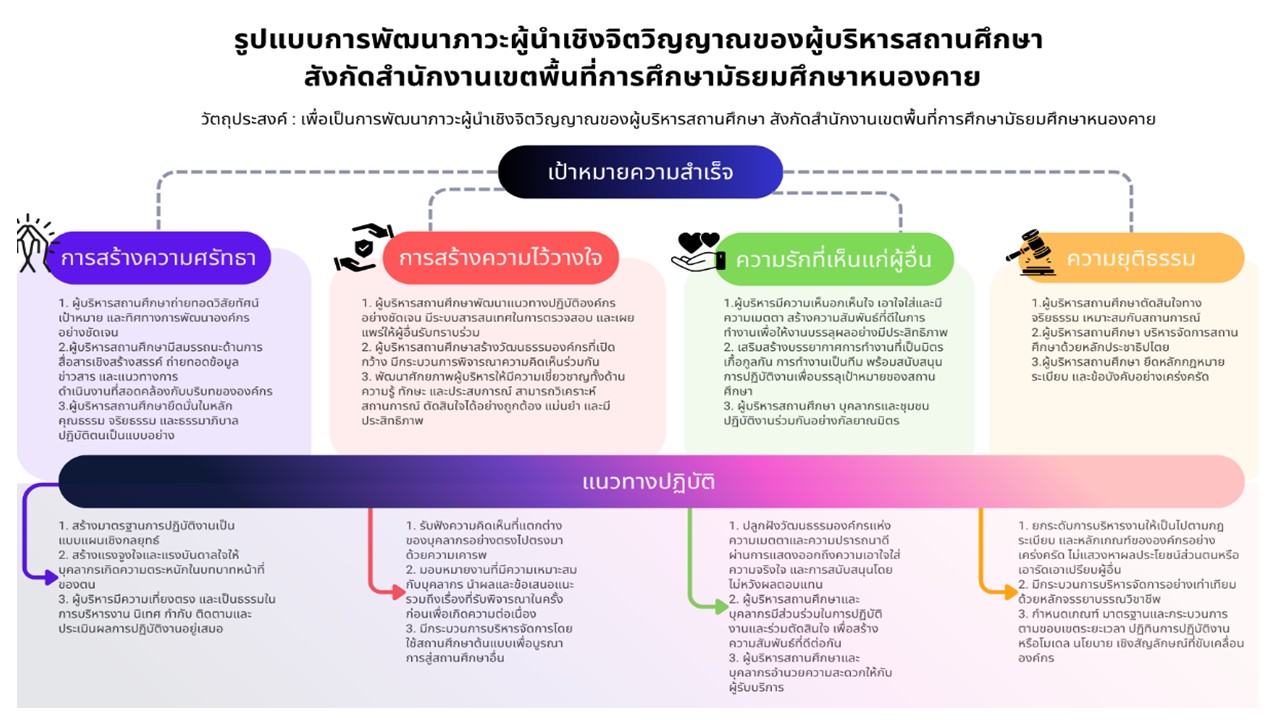
This research aimed to: 1) examine the components and indicators of spiritual leadership among school administrators under the Nong Khai Secondary Educational Service Area Office; 2) validate the goodness-of-fit of the indicator model; and 3) propose and evaluate the model. This study employed a mixed-methods research design. The sample consisted of 320 administrators and teachers selected through multi-stage random sampling. The research instrument was a five-point rating scale questionnaire with content validity indices ranging from 0.67 to 1.00 and an overall reliability coefficient of 0.921. The findings revealed that: 1) the components and indicators comprised four components and twelve indicators, namely: (1) faith building with three indicators, (2) trust building with three indicators, (3) altruistic love with three indicators, and (4) justice with three indicators; 2) the developed indicator model demonstrated a good fit with the empirical data; and 3) the proposed model was evaluated at the highest level in terms of appropriateness, feasibility, and usefulness.
Keywords: Spiritual Leadership, Leadership, School Administrators
Article Details

This work is licensed under a Creative Commons Attribution-NonCommercial-NoDerivatives 4.0 International License.
References
กัลยา วานิชย์บัญชา. (2559). สถิติสำหรับงานวิจัย. สามลดา.
ขันธ์ชัย โชติตันติทรสกุล, ปณิธาน วรรณวัลย์, เกษกนก วรรณวัลย์, เพียงแข ภูผายาง, และเพ็ญนภา สุขเสริม. (2566). ภาวะผู้นำทางจิตวิญญาณของผู้บริหารสถานศึกษาในยุคดิจิทัล. Dhammathas Academic Journal. 23(4), 297-308..
จิราวรรณ อนันตพัฒน์, และศันสนีย์ จะสุวรรณ. (2564). ภาวะผู้นำเชิงจริยธรรมของผู้บริหารสถานศึกษาในศตวรรษที่ 21. ใน อนันตพัฒน์ (บ.ก.), การประชุมวิชาการนำเสนอผลงานวิจัยระดับชาติและนานาชาติ ครั้งที่ 14 บัณฑิตวิทยาลัย มหาวิทยาลัยราชภัฏสวนสุนันทา.
ดวงพร พุ่มจำปา. (2568). การวิเคราะห์องค์ประกอบภาวะผู้นำเชิงจิตวิญญาณของผู้บริหารสถานศึกษา สังกัดสำนักงานเขตพื้นที่การศึกษามัธยมศึกษาพิจิตร [วิทยานิพนธ์ปริญญามหาบัณฑิต, มหาวิทยาลัยนเรศวร]. มหาวิทยาลัยนเรศวร
นุจรินทร์ สายพิณ. (2565). จิตวิญญาณและอุดมการณ์ของผู้บริหารสถานศึกษายุคใหม่ [วิทยานิพนธ์ปริญญามหาบัณฑิต, มหาวิทยาลัยราชภัฏรำไพพรรณี]. คณะครุศาสตร์ มหาวิทยาลัยราชภัฏรำไพพรรณี
ปนัดดา ศรีรังษ์. (2567). การศึกษาองค์ประกอบภาวะผู้นำเชิงจิตวิญญาณของผู้บริหารสถานศึกษา. วารสารคณะครุศาสตร์ มหาวิทยาลัยราชภัฏสกลนคร, 8(3), 61-74.
ระพีพัฒน์ พันธะ. (2567). แนวทางการพัฒนาภาวะผู้นำเชิงจิตวิญญาณของผู้บริหารสถานศึกษา สังกัดสำนักงานเขตพื้นที่การศึกษาประถมศึกษาหนองคาย เขต 1 [วิทยานิพนธ์ปริญญามหาบัณฑิต, มหาวิทยาลัยขอนแก่น]. มหาวิทยาลัยขอนแก่น
รัตติกรณ์ จงวิศาล. (2566). ภาวะผู้นำ: ทฤษฎี การวิจัย และแนวทางสู่การพัฒนา (พิมพ์ครั้งที่ 5). สำนักพิมพ์แห่งจุฬาลงกรณ์มหาวิทยาลัย.
ลัดดา จุลวงศ์. (2563). การบริหารสถานศึกษาด้วยภาวะผู้นำเชิงจิตวิญญาณ. วารสารวิทยาลัยการศึกษา มหาวิทยาลัยพะเยา, 15(1), 17-30.
วรินทร พลมณี. (2567). องค์ประกอบและตัวบ่งชี้ภาวะผู้นำเชิงจิตวิญญาณของผู้บริหารสถานศึกษาสังกัดสำนักงานคณะกรรมการการศึกษาขั้นพื้นฐานในภาคตะวันออกเฉียงเหนือ [ดุษฎีนิพนธ์ปริญญาดุษฎีบัณฑิต, มหาวิทยาลัยวงษ์ชวลิตกุล]. คณะศึกษาศาสตร์ มหาวิทยาลัยวงษ์ชวลิตกุล
สำนักงานเขตพื้นที่การศึกษามัธยมศึกษาหนองคาย. (2568). ข้อมูลพื้นฐาน. https://www.sesaonk.go.th
สำนักงานคณะกรรมการการศึกษาขั้นพื้นฐาน. (2568). นโยบายการศึกษาของกระทรวงศึกษาธิการ ประจำปีงบประมาณ พ.ศ. 2568–2569. สำนักงานเลขาธิการสภาการศึกษา.
สุพจน์ ประไพเพชร, สราวุฒิ กุลแดง, ราตรี เลิศหว้าทอง, และสุดสวาสดิ์ ประไพเพช. (2566). ภาวะผู้นำ: แนวคิด ทฤษฎี และองค์ประกอบ. วารสารครุศาสตร์ปัญญา, 2(1), 59-73.
เฟื่องฟ้า เมฆฉาย. (2567). การศึกษาภาวะผู้นำเชิงจิตวิญญาณของผู้บริหารสถานศึกษาที่ส่งผลต่อความพึงพอใจ [วิทยานิพนธ์ปริญญามหาบัณฑิต, มหาวิทยาลัยราชภัฏนครราชสีมา]. คณะครุศาสตร์ มหาวิทยาลัยราชภัฏนครราชสีมา
Fry, L. W., et al. (2017). Spiritual leadership: Current status and agenda for future research and practice. Journal of Management, Spirituality & Religion. https://www.tandfonline.com/loi/rmsr20
Hair, J. F., Black, W. C., & Babin, B. J. (2010). Multivariate data analysis: A global perspective (7th ed.). Pearson Education.
Hedger, M. D. (2021). The impact of spiritual leadership on the leadership practices of public-school superintendents [Doctoral dissertation, Lindenwood University]. ProQuest Dissertations Publishing.
Mohd Fadle Mohd Isa. (2024). Spiritual leadership practices among primary school headmasters: Insights from selected school leaders in Negeri Sembilan, Malaysia. International Journal of Research and Innovation in Social Science (IJRISS), 9(3). https://doi.org/10.47772/IJRISS.2025.903000
Oh, J., & Wang, J. (2020). Spiritual leadership: Current status and agenda for future research and practice. Journal of Management, Spirituality & Religion. https://www.tandfonline.com/doi/abs/10.1080/14766086.2020.1728568
Rahman El Junusi. (2022). The impact of spiritual global leadership on innovation and organizational performance: An examination of leadership integration models in Islamic higher education institutions [Doctoral dissertation, Walisongo State Islamic University].
