
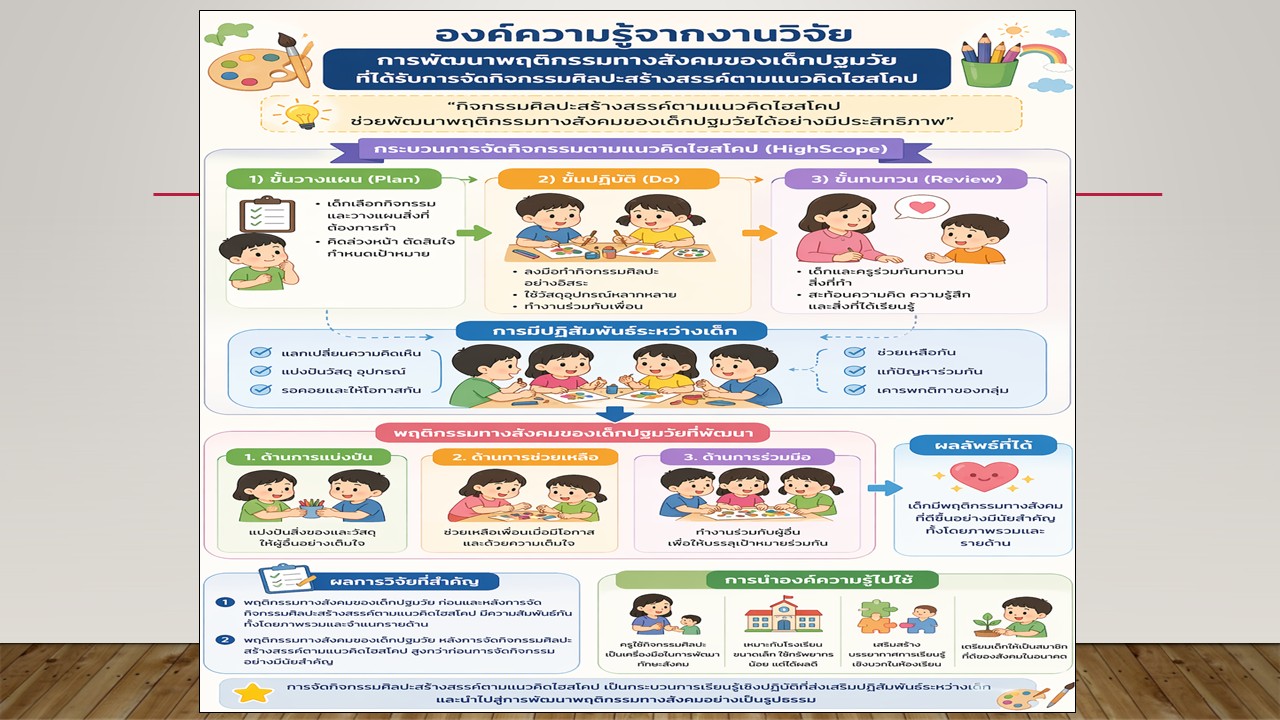
Development of Preschool Children’s Social Behaviors through Creative Arts Activities Based on The High/Scope Approach
Article Sidebar
Main Article Content
Abstract
The purposes of this research were to: 1) study the relationship of preschool children’s social behaviors before and after implementation of creative arts activities based on the HighScope approach. and 2) compare preschool children’s social behaviors before and after implementation of creative arts activities based on the HighScope approach. The population in this research consisted of 16 preschool children, boys and girls, aged between 5 and 6 years, studying at Kindergarten level 3 in the 1st semester of the academic year 2024 at Ban Nong Nok Municipal School in Nan Province. The research instruments were 24 creative arts activities based on the High/Scope approach for Kindergarten level 3 lesson plans, with an IOC of 1.00, and a preschool children’s social behavior observation form covering 3 aspects: sharing, assisting, and cooperating, with an IOC of 1.00. The experiment lasted 8 weeks, 3 days a week, with 50 minutes per session for the creative arts activities. The statistics used to analyze data were mean, standard deviation, and chi-square test. The research results revealed that: 1. Preschool children’s social behaviors before and after implementation of creative arts activities based on the HighScope approach showed relationships in overall and in each aspect. 2. Preschool children’s social behaviors after the implementation of creative arts activities based on the HighScope approach were higher than before the experiment.
Keywords: Creative Arts Activities, HighScope Approach, Social Behaviors, Pre-school Children
Article Details

This work is licensed under a Creative Commons Attribution-NonCommercial-NoDerivatives 4.0 International License.
References
กรรณิการ์ สุริยะมาตร. (2560). การพัฒนากิจกรรมเสรีตามแนวคิดของไฮสโคปในการพัฒนาพฤติกรรมทางสังคมของเด็กปฐมวัย. ปริญญาครุศาสตรมหาบัณฑิต สาขาวิชาหลักสูตรและการเรียนการสอน บัณฑิตวิทยาลัย มหาวิทยาลัยราชภัฏมหาสารคาม.
กระทรวงศึกษาธิการ. (2560). หลักสูตรการศึกษาปฐมวัย พุทธศักราช 2560. กรุงเทพฯ : โรงพิมพ์ คุรุสภาลาดพร้าว.
กัลยารัตน์ ประเสริฐศรี. (2561). ผลการจัดกิจกรรมศิลปะสร้างสรรค์แบบกลุ่มคละอายุที่มีต่อความสามารถ ในการเข้าใจแบบรูปและความสัมพันธ์ และพฤติกรรมทางสังคม ของเด็กปฐมวัย โรงเรียนบ้านบุตาวงษ์ จังหวัดบุรีรัมย์. ปริญญาศึกษาศาสตรมหาบัณฑิต แขนงวิชาหลักสูตรและการสอน สาขาวิชาศึกษาศาสตร์ มหาวิทยาลัยสุโขทัยธรรมาธิราช.
ชนิดา รักษาวงศ์. (2563). ผลของการจัดกิจกรรมศิลปะสร้างสรรค์ตามแนวคิดไฮสโคปที่มีต่อพฤติกรรมการรู้หนังสือขั้นต้นของเด็กปฐมวัย โรงเรียนพิชญบัณฑิต 2 จังหวัดอุดรธานี. วิทยานิพนธ์ สาขาวิชาการศึกษาปฐมวัย, มหาวิทยาลัยราชภัฏพระนคร.
มยุรี คนซื่อ. (2562). ผลการจัดกิจกรรมศิลปะสร้างสรรค์ต่อพัฒนาการด้านสังคมของนักเรียนชั้นอนุบาลปีที่ 3 โรงเรียนสาธิตมหาวิทยาลัยราชภัฏร้อยเอ็ด. วิทยานิพนธ์ครุศาสตรมหา-บัณฑิต สาขาวิชาหลักสูตรและการเรียนการสอน มหาวิทยาลัยราชภัฏร้อยเอ็ด.
โรงเรียนเทศบาล(บ้านหนองนก). (2567). รายงานการประเมินตนเองของโรงเรียนเทศบาล(บ้านหนองนก). น่าน : โรงเรียนเทศบาล(บ้านหนองนก)
วรนาท รักสกุลไทย. (2554). ไฮสโคป (High Scope) กับการพัฒนาเด็กปฐมวัย” ในรวมนวัตกรรมทฤษฎีการศึกษาปฐมวัยสู่การประยุกต์ใช้ในห้องเรียน. กรุงเทพฯ : สาราเด็ก.
สุรางค์ โค้วตระกูล. (2564). จิตวิทยาการศึกษา. กรุงเทพฯ : สำนักพิมพ์แห่งจุฬาลงกรณ์มหาวิทยาลัย.
สำนักงานคณะกรรมการการศึกษาขั้นพื้นฐาน. (2561). คู่มือหลักสูตรการศึกษาปฐมวัยพุทธศักราช2560 (สำหรับเด็กอายุ 3-6 ปี). กรุงเทพฯ : กระทรวงศึกษาธิการ.
Bagci, B. (2025). The effect of prosocial behavior psychoeducation program on problematic behaviors and self-regulation skills of 5-6-year-old children. International Journal of Modern Education Studies, 9(1), 198–229.
Cai, L. (2022). The High-Scope curriculum support for early childhood development: Take active learning in young children as an example. Proceedings of the 2021 International Conference on Social Development and Media Communication (SDMC 2021). Atlantis Press. https://doi.org/10.2991/assehr.k.220105.237
Cartier, F. (2024, January 12). Introduction to the HighScope approach. QAPPD. https://qappd.com/wp-content/uploads/2024/01/Introduction-to-the-HS-Approach-2024-FC.pdf
Eastern Connecticut State University. (2023). Creative arts with young children. Center for Early Childhood Education. https://www.easternct.edu/center-for-early-childhood-education/supporting-development/creative-arts.html
Gungordu, N. (2025). Empathy and creativity as foundations and predictors of how prosocial behavior develops in preschool age children. International Journal of Child Care and Education Policy. https://doi.org/10.1186/s40723-025-00147-0
Hatching Dragons. (2025, June 25). Exploring the HighScope approach to early years education. https://www.hatching-dragons.com/blog/exploring-the-highscope-approach-to-early-years-education
HighScope Educational Research Foundation. (2021). The HighScope preschool curriculum: What, how, and why. HighScope Press. https://highscope.org/wp-content/uploads/2021/03/HighScope_Preschool_What-How-Why-50.pdf
HighScope Educational Research Foundation. (2021). Preschool curriculum. https://highscope.org/what-we-offer/the-highscope-curriculum/preschool-curriculum/
Holochwost, S. J., Goldstein, T. R., & Wolf, D. P. (2021). Delineating the benefits of arts education for children's socioemotional development. Frontiers in Psychology, 12, 624712. https://doi.org/10.3389/fpsyg.2021.624712
Lynch, M. (2025, May 6). What are HighScope preschool programs? https://www.drmattlynch.com/what-are-highsc
