
Factors Associated with Safe Motorcycle Riding Behavior Among Upper Secondary School Students in Pak Tho District, Ratchaburi
Article Sidebar
Main Article Content
Abstract
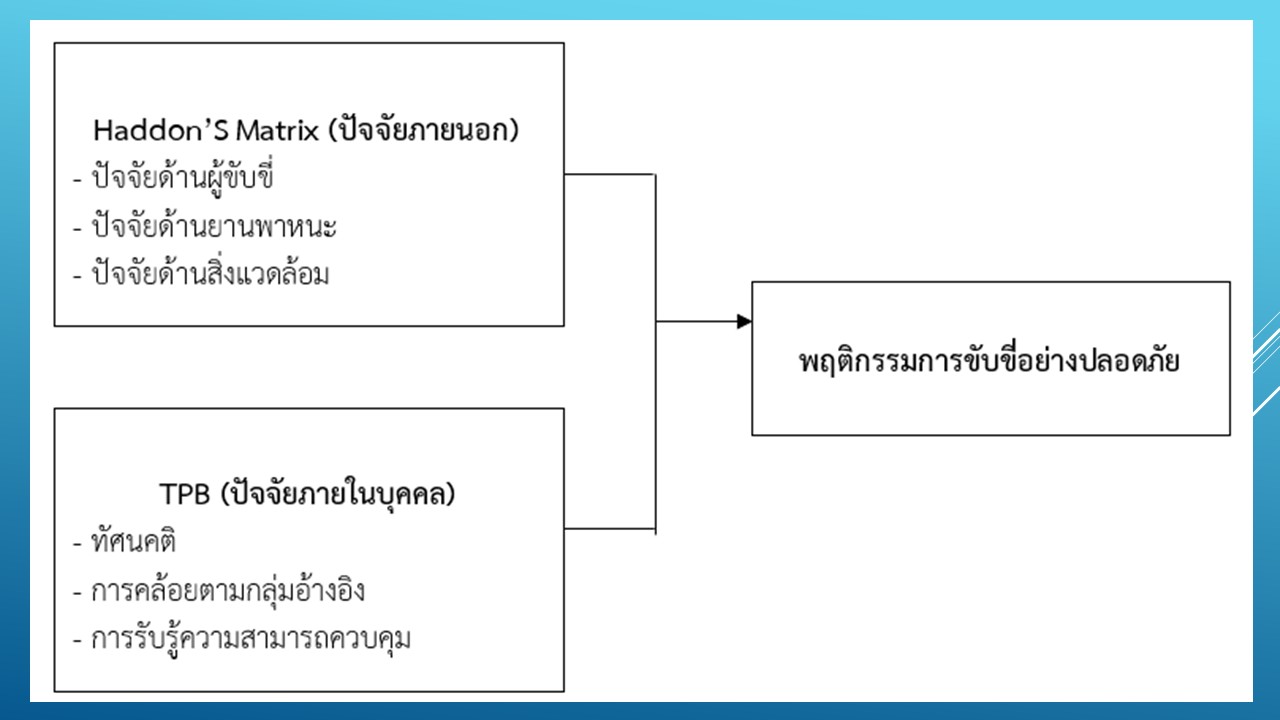
This cross-sectional descriptive study aimed to examine factors associated with safe motorcycle riding behavior among upper secondary school students in Pak Tho District, Ratchaburi Province. Haddon's Matrix Model was applied with the Theory of Planned Behavior (TPB) to analyze the determinants of safe riding behavior. The sample comprised 315 upper secondary school students from non-boarding schools who had ridden motorcycles within the past three months and were residing and studying in Pak Tho District. Sample size was estimated using the Daniel (1999) formula for proportion estimation with finite population correction (Z = 1.96, p = 0.5, d = 0.05, N = 1,300), yielding a minimum of 296 cases plus a 5% adjustment for non-response. Data were collected via self-administered questionnaires. Descriptive statistics (frequency, percentage, mean, and standard deviation) and the Pearson Chi-square test were employed for data analysis, with statistical significance set at p < 0.05. The findings indicated that 81.0% of students did not possess a driver's license; meanwhile, 51.1% of them had previously experienced a road traffic accident. Overall, the majority of the samples (55.6%, n = 175) demonstrated a high level of safe riding behavior (Mean = 20.12, S.D. = 5.18, total possible score = 26), whereas 33.7% and 10.8% of them showed moderate and low levels, respectively. Gender (χ² = 4.252, p = 0.039), knowledge (χ² = 16.789, p < 0.001), attitude (χ² = 13.842, p = 0.001), subjective norms (χ² = 18.191, p < 0.001), perceived behavioral control (χ² = 12.696, p = 0.002), vehicle-related factors (χ² = 26.648, p < 0.001), and environmental factors (χ² = 18.325, p < 0.001) were significantly associated with safe motorcycle riding behavior. Schools and local public health authorities should integrate Haddon's Matrix–TPB-based interventions to strengthen attitudes, peer norms, and self-efficacy alongside vehicle inspection and environmental safety practices.
Keywords: Behavior, Riding, Motorcycle, Students, Upper Secondary School
Article Details

This work is licensed under a Creative Commons Attribution-NonCommercial-NoDerivatives 4.0 International License.
References
กมลวรรณ คุ้มวงษ์ และคณะ. (2562). ปัจจัยทำนายพฤติกรรมความปลอดภัยในการขับขี่จักรยานยนต์ ของนักเรียนชายระดับมัธยมศึกษาตอนปลายในภาคตะวันออก. วารสารคณะพยาบาลศาสตร์ มหาวิทยาลัยบูรพา, 27(4), 42–52.
กระทรวงคมนาคม. (2566). การวิเคราะห์สถานการณ์อุบัติเหตุทางถนนของกระทรวงคมนาคม พ.ศ. 2565. กรุงเทพฯ: สำนักงานนโยบายและแผนการขนส่งและจราจร. https://www.otp.go.th/ uploads/tiny_uploads/PDF/2566-11/RoadAccidentAna2565_final.pdf
กุลธิดา ท่าทราย และคณะ. (2564). ปัจจัยที่มีผลต่อพฤติกรรมเสี่ยงในการเกิดอุบัติเหตุจากการขับขี่รถจักรยานยนต์ของนักเรียนชั้นมัธยมศึกษา. วารสารความปลอดภัยและสุขภาพ, 14(1), 50–67.
ฌัชชา คำมูล และคณะ. (2566, 24-26 พฤษภาคม). การศึกษาปัจจัยที่มีอิทธิพลต่อพฤติกรรมการขับขี่รถจักรยานยนต์ที่ไม่ปลอดภัย: กรณีศึกษา นักศึกษามหาวิทยาลัยในจังหวัดนครราชสีมา [เอกสารนำเสนอ]. การประชุมวิศวกรรมโยธาแห่งชาติ ครั้งที่ 28: เรื่อง ความท้าทายด้านวิศวกรรมโยธาหลังการระบาดใหญ่, ภูเก็ต, ประเทศไทย.
เนตรนภา สร้อยแก้ว และปรกช สิริสุวัณณ์. (2563). ปัจจัยในการขับขี่ที่ก่อให้เกิดอุบัติเหตุจากการใช้รถจักรยานยนต์ : กรณีศึกษา นักเรียน สถานศึกษาอาชีวศึกษา จังหวัดสระบุรี. วารสารวิชาการมหาวิทยาลัยอีสเทิร์นเอเชีย ฉบับวิทยาศาสตร์และเทคโนโลยี, 14(2), 266–277.
สำนักข่าวออนไลน์ Hfocus. (2567). ไทยเสียชีวิตจากอุบัติเหตุทางถนน วันละ 48 ราย กลายเป็นผู้พิการตลอดชีวิตปีละ 10,000 คน. https://www.hfocus.org/content/2024/11/32256
สำนักงานสาธารณสุขจังหวัดราชบุรี. (2565). สรุปสถานการณ์การบาดเจ็บและเสียชีวิตจากอุบัติเหตุทางถนน จังหวัดราชบุรี. http://www.rbpho.moph.go.th/upload-file/doc/files/25072022-035052-4251.pdf
Ajzen, I. (1991). The theory of planned behavior. Organizational Behavior and Human Decision Processes, 50(2), 179–211.
Bloom, B. S. (1968). Learning for mastery (UCLA – CSEIP Evaluation Comment, 1[2]). University of California.
Daniel, W. W., & Cross, C. L. (1999). Biostatistics: A foundation for analysis in the health sciences (8th ed.). John Wiley & Sons.
Haddon, W. Jr. (1980). Advances in the epidemiology of injuries as a basis for public policy. Public Health Reports, 95(5), 411–421.
Jalaludin, J., Widyaningsih, N., & Dwiatmoko, H. (2021). Theory of planned behavior application on motorcycle rider safety behavior. ASTONJADRO, 11(1), 198–206.
Northwest Portland Area Indian Health Board (NPAIHB). (2024). Haddon matrix basics. https://www.npaihb.org/images/epicenter_docs/injuryprevention/HaddonMatrix-Basics.pdf
Setiaji, R., & Arianto, M. E. (2023). Factors related to safety riding behaviors among grade XII students of SMKN 3 Mandau Duri. Periodicals of Occupational Safety and Health, 2(2), 96–104.
World Health Organization (WHO). (2023). Global status report on road safety 2023. Geneva: World Health Organization. https://www.who.int/publications/i/item/ 9789240086517
