
Strategies for Developing Mindful Leadership of Secondary School Administrators
Article Sidebar
Main Article Content
Abstract
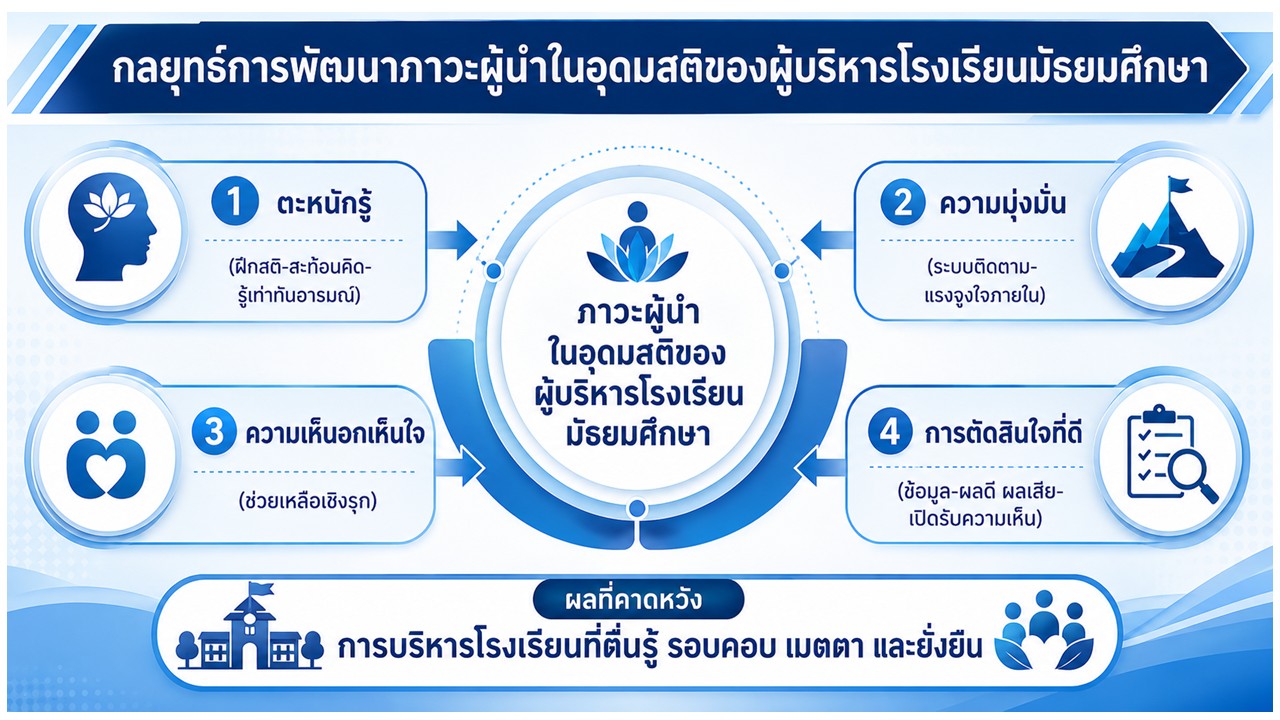
The purposes of this research were: 1) to conduct a needs assessment for the development of mindful leadership among secondary school administrators; 2) to develop strategies for enhancing mindful leadership among secondary school administrators; and 3) to evaluate the appropriateness and feasibility of the strategies for developing mindful leadership among secondary school administrators. A multiphase mixed-methods research approach was employed, involving a sample of 214 secondary school administrators in the northern region. Data were collected using a 5-point Likert-scale questionnaire with content validity indices ranging from 0.80 to 1.00 and an overall reliability coefficient of .98. The statistical methods used for data analysis included frequency, percentage, mean, standard deviation, the Priority Needs Index (PNI_modified), and content analysis derived from interviews. The research findings revealed that: 1) the overall needs assessment for developing mindful leadership was identified as having a high level of urgency (PNI_modified = 0.30). The aspects were ranked from highest to lowest as follows: good decision-making, empathy, self-awareness, and commitment; 2) the strategies for developing mindful leadership among secondary school administrators consisted of four main strategies: Strategy 1: Developing open-minded and systematic decision-making; Strategy 2: Fostering proactive compassion and empathetic leadership; Strategy 3: Developing deep self-awareness for mindful leadership; and Strategy 4: Empowering internal motivation and commitment toward excellence in leadership; and 3) the evaluation results indicated that the appropriateness and feasibility of the strategies were at very high and high levels, respectively.
Keywords: Leadership Development, Mindful Leadership, Secondary School Administrators
Article Details

This work is licensed under a Creative Commons Attribution-NonCommercial-NoDerivatives 4.0 International License.
References
บุญชม ศรีสะอาด. (2554). การวิจัยเบื้องต้น (พิมพ์ครั้งที่ 9). สุวีริยาสาส์น.
สำนักงานเลขาธิการสภาการศึกษา. (2560). แผนการศึกษาแห่งชาติ พ.ศ. 2560–2579. บริษัท
พริกหวานกราฟฟิค จำกัด.
สุวิมล ว่องวาณิช. (2562). การวิจัยประเมินความต้องการจำเป็น. (พิมพ์ครั้งที่ 4). สำนักพิมพ์
แห่งจุฬาลงกรณ์มหาวิทยาลัย.
เสถียร วงค์คม. (2562). การพัฒนาโมเดลความสัมพันธ์เชิงโครงสร้างตัวบ่งชี้ภาวะผู้นำอุดมสติ
สำหรับผู้บริหารโรงเรียนประถมศึกษา. ศึกษาศาสตรดุษฎีบัณฑิต สาขาวิชาการบริหาร
การศึกษา บัณฑิตวิทยาลัยมหาวิทยาลัยมหามกุฏราชวิทยาลัย.
Bass, B. M., & Avolio, B. J. (Eds.). (1994). Improving organizational effectiveness
through transformational leadership. Sage Publications.
Chiok Foong Loke, J. (2001). Leadership behaviours: Effects on job satisfaction,
productivity and organizational commitment. Journal of NursingManagement, 9(4), 191–204. https://doi.org/10.1046/j.1365-2834.2001.00231.x
Creswell, J. W., & Creswell, J. D. (2022). A concise introduction to mixed methods
research (2nd ed.). SAGE Publications.
Goetz, J. L., Keltner, D., & Simon-Thomas, E. (2010). Compassion: An evolutionary
analysis and empirical review. Psychological Bulletin, 136(3), 351–374.
https://doi.org/10.1037/a0018807
Hargreaves, A., & Fink, D. (2005). Sustainable leadership. Jossey-Bass.
Hsieh, C. C. (2018). Developing mindfulness in school leadership. Journal of
Educational Administration and Policy, 69–86.
Kabat-Zinn, J. (2003). Mindfulness-based interventions in context: Past, present, and
future. Clinical Psychology: Science and Practice, 10(2), 144–156.
Mahfouz, J. (2018). Mindfulness training for school administrators: Effects on well-
being and leadership. Journal of Educational Administration, 56(6), 602–619.
Meyer, J. P., & Allen, N. J. (1991). A three-component conceptualization of
organizational commitment. Human Resource Management Review, 1(1), 61–89. https://doi.org/10.1016/1053-4822(91)90011-Z
Partin, J. M. (2022). A systematic review of mindfulness in school principals.
Education Leadership Review, 23(1), 1–16.
Rupprecht, S., Falke, P., Kohls, N., Tamdjidi, C., Wittmann, M., & Kersemaekers, W.
(2019). Mindful leader development: How leaders experience the effects of
mindfulness training on leader capabilities. Frontiers in Psychology, 10, Article
https://doi.org/10.3389/fpsyg.2019.01081
Tan, C. (2023). Mindful school leadership and educational well-being. Educational
Leadership Review, 10–11.
