
The Learning Management Model in Digital Age for Secondary Schools
Article Sidebar
Main Article Content
Abstract
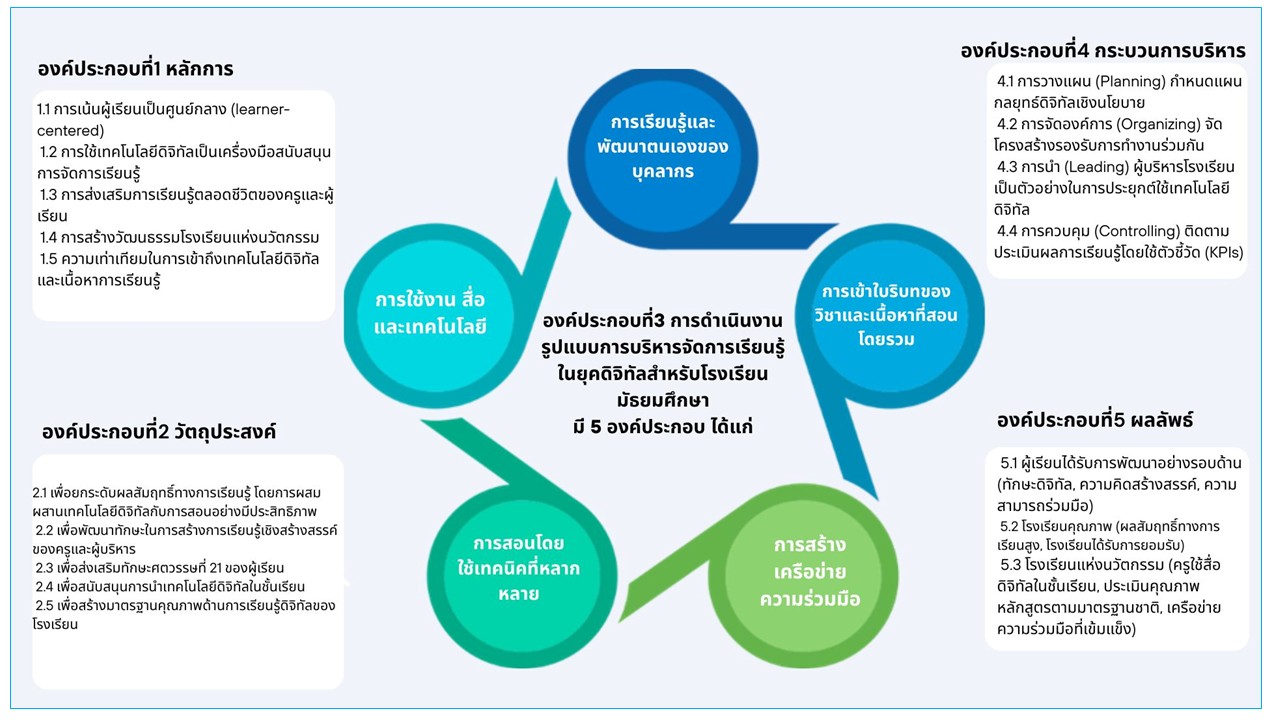
The purpose of this research was to 1) assess the need for management of learning in the digital age for secondary schools, 2) create a model for managing learning in the digital age for secondary schools, and 3) evaluate the model for managing learning in the digital age for secondary schools by using mixed-method research with a multi-phase approach. The sample comprised 214 secondary school administrators in the northern region, using a 5-point Likert scale questionnaire, which exhibited content validity between 0.80-1.00 and an overall reliability of .97. The statistics used for data analysis included frequency, percentage, mean, standard deviation, priority needs assessment techniques, and content analysis from interviews. The research findings revealed that 1) the overall need for management of learning in the digital age for secondary schools showed a pressing need (PNImodified = 0.20), 2) The model for managing learning in the digital age for secondary schools consists of: 1) principles promoting adaptability and innovation, 2) objectives aimed at enhancing the quality of learning and preparing learners for the digital era, and 3) five components: (1) self-learning and development of personnel, (2) utilization of digital technology media, (3) understanding the context of subjects and overall content, (4) teaching using various techniques, and (5) creating collaborative networks. 4) The management process follows the P-O-L-C framework to achieve outcomes, and 5) the results regarding feasibility and usefulness were overall rated at a high to very high level.
Keywords: Model, Learning Management, Digital Age
Article Details

This work is licensed under a Creative Commons Attribution-NonCommercial-NoDerivatives 4.0 International License.
References
จิติมา วรรณศรี. (2564). การบริหารจัดการศึกษายุคดิจิทัล. พิษณุโลก: รัตนสุวรรณการพิมพ์.
ฉัตรชัย หวังมีจงมี, และองอาจ นัยพัฒน์. (2560). สมรรถนะของครูไทยในศตวรรษที่ 21: ปรับการเรียนเปลี่ยนสมรรถนะ.สถาบันเสริมศึกษาและทรัพยากรมนุษย์ มหาวิทยาลัยธรรมศาสตร์,12(2), 47-63.
ชัชชญา พีระธรณิศร์. (2563). ความท้าทายการจัดการศึกษาในยุค Disruptive Change ของผู้บริหารสถานศึกษา. ศึกษาศาสตร์สาร มหาวิทยาลัยเชียงใหม่, 4(2), 126-139.
ทิศนา แขมมณี. (2557). ศาสตร์การสอน: องค์ความรู้เพื่อการจัดกระบวนการเรียนรู้ที่มีประสิทธิภาพ (พิมพ์ครั้งที่ 18). กรุงเทพฯ: สำนักพิมพ์แห่งจุฬาลงกรณ์มหาวิทยาลัย.
ประกอบ ตันมูล. (2559). การพัฒนารูปแบบการบริหารการเปลี่ยนแปลงของผู้บริหารที่ส่งผลต่อประสิทธิผลด้านวิชาการของสถานศึกษา สังกัดสานักงานเขตพื้นที่การศึกษาประถมศึกษา สกลนคร เขต 1 (ปริญญานิพนธ์ปริญญาดุษฎีบัณฑิต). สกลนคร: มหาวิทยาลัยราชภัฏ สกลนคร.
ปรียาพร วงศ์อนุตรโรจน์. (2553). การบริหารงานวิชาการ. กรุงเทพฯ: ศูนย์สื่อเสริมกรุงเทพ.
ปัณณทัต กาญจนะวสิต. (2561). โลกยุค 4.0. สืบค้น 20 เมษายน 2563, http://www.dsdw2016.dsdw.go.th/doc_pr/ndc_2560-2561/8455m.html
พระราชวุธ ปญฺญาวชิโร. (2561). การบริหารสถานศึกษาในยุคดิจิทัล ตามหลักสัปปุริสธรรม 7 โรงเรียนพระปริยัติธรรม แผนกสามัญศึกษา จังหวัดขอนแก่น (วิทยานิพนธ์ปริญญา มหาบัณฑิต). อยุธยา: มหาวิทยาลัยมหาจุฬาลงกรณราชวิทยาลัย.
มหาวิทยาลัยราชภัฏวไลยอลงกรณ์ ในพระบรมราชูปถัมภ์. (2557). คู่มือการจัดระบบการเรียน การสอนที่เน้นผู้เรียนเป็นสำคัญ (พิมพ์ครั้งที่ 2). ปทุมธานี: ศูนย์เรียนรู้การผลิตและการจัดการธุรกิจสิ่งพิมพ์ดิจิตอล มหาวิทยาลัยราชภัฏวไลยอลงกรณ์ ในพระบรมราชูปถัมภ์.
มานะ สินธุวงษานนท์. (2562). กลยุทธ์การพัฒนาผู้เรียนสู่ความเป็นพลเมืองในศตวรรษที่ 21.วารสารนาคบุตรปริทรรศน์ มหาวิทยาลัยราชภัฏนครศรีธรรมราช, 11(2), 118-129.
เยาวดี วิบูลย์ศรี. (2545). การวัดผลและการสร้างแบบสอบผลสัมฤทธิ์ (พิมพ์ครั้งที่ 3). กรุงเทพฯ: จุฬาลงกรณ์มหาวิทยาลัย.
วิจารณ์ พาณิช. (2557). วิถีสร้างการเรียนรู้เพื่อศิษย์ (พิมพ์ครั้งที่ 3). กรุงเทพฯ: ตถาตา พับลิเคชั่น.
วิชัย ประสิทธิวุฒิเวชช์. (2542). การพัฒนาหลักสูตรสานต่อที่ท้องถิ่น. กรุงเทพฯ: เลิฟแอนด์ลิพ เพรส.
วิรัตน์ เกตุเรือง, สุกัญญา แช่มช้อย, และฉลอง ชาตรูประชีวิน. (2559). รูปแบบการบริหารการจัดการเรียนรู้ภาษาอังกฤษเพื่อการสื่อสารสำหรับนักเรียน ของโรงเรียนขยายโอกาสขนาดเล็ก. วารสารศึกษาศาสตร์ มหาวิทยาลัยนเรศวร, 19(3), 313-328.
สำนักงานเลขาธิการสภาการศึกษา. (2546). รูปแบบการบริหารจัดการสถาบันอุดมศึกษาแนวใหม่.กรุงเทพฯ: พริกหวานกราฟฟิค.
สำนักงานเลขาธิการสภาการศึกษา. (2563). รายงาน เรียนออนไลน์ยุคโควิด-19: วิกฤตหรือโอกาส การศึกษาไทย. กรุงเทพฯ: สืบค้นจาก http://backoffice.onec. go.th/uploads/Book/1779-file.pdf
สำนักงานเลขานุการของคณะกรรมการยุทธศาสตร์ชาติ และสำนักงานคณะกรรมการพัฒนาเศรษฐกิจ และสังคมแห่งชาติ. (2561). ยุทธศาสตร์แห่งชาติ. สืบค้นจาก http://nscr.nesdb.go.th/
สุกัญญา แช่มช้อย. (2560). การบริหารสถานศึกษาในยุคดิจิทัล. พิษณุโลก: พิษณุโลกดอทคอม.
อมลรดา พุทธินันท์, ธร สุนทรายุทธ, และพงศ์เทพ จิระโร. (2561). รูปแบบการบริหารงานวิชาการ สู่ความเป็นเลิศของโรงเรียน สังกัดองค์กรปกครองส่วนท้องถิ่น. วารสารราชนครินทร์, 15(34), 31-37.
Baglama, B., Evcimen, E., Altinay, F., Sharma, R.C., Tlili, A., Altinay, Z., … Celebi, M. (2022). Analysis of digital leadership in school management and accessibility of nimation-designed game-based learning for sustainability of education for children with special needs. Sustainability, 14, 1-12.
Creswell, J. W., & Creswell, J. D. (2022). A Concise Introdution to Mixed Methods Research (2nd ed.). SAGE Publications.
Good, C.V. (1975). Dictionary of education. New York: McGraw-Hill.
Hills, P.J.A. (1982). Dictionary of education. London: Routledge & Kegan Payi.
Moore, K.D. (1992). Classroom teaching skills (2nd ed.). New York: McGraw-Hill.
Napate, S., Maity, P., & Baheti, P. (2020). Digital transformation of management education. American International Journal of Business Management, 3(9), 19-23.
Smith, R., & Lynch, D. (2010). Rethinking teacher education: Teacher education in the knowledge age. Sydney: AACLM.
Yusuf, H. (2019). Education management in the age of digitality and social media: Exploring the utilization of digitality and social media to improve the management of further education from a methodological perspective (Master’s thesis). U.S.A.: The University of Boston.
