
The Results of Learning Management in a Gamification Environment Based on Active Learning Concept to Enhance Reflective Thinking and Thai Writing Ability for Communication of Grade 11 Students Under the Secondary Educational Service Area Office Bangkok 1
Article Sidebar
Main Article Content
Abstract
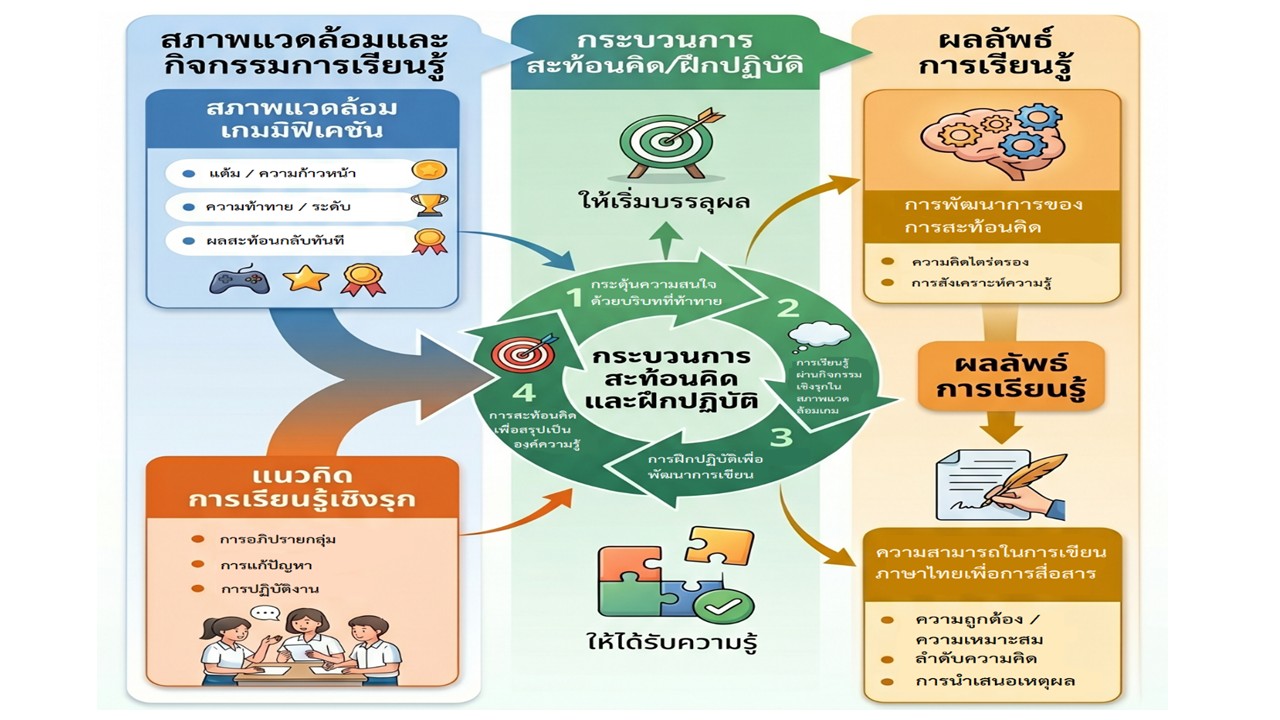
Communication through Thai writing is a competency that fundamentally requires reflective thinking processes. The application of a gamification environment integrated with active learning is thus a crucial innovation to address learning problems and elevate such competency. The objectives of this research were to study the development of reflective thinking and Thai writing ability for communication during learning through learning management activities in a gamification environment based on the active learning concept, and to compare the learning achievement in Thai language for communication before and after the intervention. The research employed a one-group pretest-posttest quasi-experimental design with repeated measures. The sample, obtained through cluster random sampling, consisted of 124 Grade 11 students at Benchamarachalai School under the Royal Patronage during the first semester of the 2024 academic year. The research instruments comprised learning management plans, a reflective thinking measurement scale, a writing assessment form, and a learning achievement test. Data were analyzed using mean, standard deviation, Repeated Measures Analysis of Variance (ANOVA), and dependent samples t-test. The research results revealed that the learners exhibited a continuously significant increase in their developmental scores regarding reflective thinking and Thai writing ability for communication across all testing periods. Additionally, the post-test learning achievement in the Thai language was higher than the pre-test at a statistical significance level of 0.05. The instructional management model integrating gamification with active learning consists of 4 steps: 1) stimulating interest through challenging contexts, 2) learning via active activities within a game environment, 3) practicing to develop writing skills, and 4) engaging in reflective thinking to conceptualize the body of knowledge. These steps serve as mechanisms facilitating the development of the classroom into a space of psychological safety and mitigating learning anxiety.
Keywords: Gamification, Active Learning, Reflective Thinking, Repeated Measures, Thai Writing for Communication
Article Details

This work is licensed under a Creative Commons Attribution-NonCommercial-NoDerivatives 4.0 International License.
References
จุฬาลักษณ์ พัฒนมาศ และพิณพนธ์ คงวิจิตต์. (2565). การพัฒนามโนทัศน์หลักการใช้ภาษาไทยและความผูกพันในการเรียนภาษาไทยของนักเรียนชั้นมัธยมศึกษาปีที่ 1 โดยใช้แนวคิดเกมมิฟิเคชั่นร่วมกับเทคนิคเพื่อนช่วยเพื่อน. วารสารครุศาสตร์ จุฬาลงกรณ์มหาวิทยาลัย, 50(2), 1-13.
https://doi.org/10.14456/educu.2022.13
ชุณพฤทธิ์กร จิรบวรกิจ, และจิรภัทร ศรีสุข. (2566). กลวิธีทางภาษาที่ใช้ในการสะท้อนคิด ในสถานการณ์การสนทนาการเรียนรู้วิชาภาษาไทยและภาษาอังกฤษของนักเรียนระดับมัธยมศึกษาตอนปลาย [รายงานการวิจัยฉบับสมบูรณ์]. มหาวิทยาลัยธรรมศาสตร์.
เบญจพร พลไกร. (2565). การพัฒนาความสามารถด้านการอ่านสะกดคำภาษาไทย โดยใช้การจัดการเรียนรู้เชิงรุก (Active Learning) ร่วมกับแนวคิดเกมิฟิเคชั่น (Gamification) สำหรับนักเรียนที่มีภาวะ ถดถอยทางการเรียนรู้ (Learning loss) ในสถานการณ์การโควิด-19 ชั้นประถมศึกษาปีที่ 3 [การค้นคว้าอิสระปริญญาการศึกษามหาบัณฑิต, มหาวิทยาลัยนเรศวร].
ปุณชญา ศิวานิพัทน์ และพักตร์พริ้ง พลหาญ. (2568). การพัฒนาทักษะการเขียนภาษาไทยเพื่อการสื่อสารโดยใช้แบบฝึกการเขียนเชิงสร้างสรรค์ ตามรูปแบบการสอนซินเนคติกส์. วารสารวิจัยและพัฒนาอนุ
ภูมิภาคลุ่มน้ำโขง, 4(2), 50-62.
https://so14.tci-thaijo.org/index.php/RDGMSJournal/article/view/1419/999
โรงเรียนเบญจมราชาลัย ในพระบรมราชูปถัมภ์. (2566). รายงานการประเมินตนเองของสถานศึกษา SAR ปีการศึกษา 2564. โรงเรียนเบญจมราชาลัย ในพระบรมราชูปถัมภ์.
วชิรพรรณ ทองวิจิตร. (2566). การพัฒนารูปแบบการเรียนรู้เชิงประสบการณ์ร่วมกับเกมมิฟิเคชันแบบออนไลน์ ที่เสริมสร้างสมรรถนะความฉลาดทางดิจิทัลของนักเรียนชั้นประถมศึกษาตอนปลาย [รายงานการวิจัย]. กองทุนพัฒนาเทคโนโลยีเพื่อการศึกษา.
ศิริกัญญา แก่นทอง. (2564). การพัฒนาการจัดการเรียนการสอนเพื่อส่งเสริมการสะท้อนคิดของนักศึกษาครู
มหาวิทยาลัยนราธิวาสราชนครินทร์ในรายวิชาสันติศึกษาสำหรับครู. วารสารมหาวิทยาลัยนราธิวาสราชนครินทร์ สาขามนุษยศาสตร์และสังคมศาสตร์, 8(2), 180-197.
https://so05.tci-thaijo.org/index.php/pnuhuso/article/view/249849
สถาบันทดสอบทางการศึกษาแห่งชาติ (องค์การมหาชน). (2568). สรุปผลการทดสอบทางการศึกษาระดับชาติขั้นพื้นฐาน (O-NET) ชั้นมัธยมศึกษาปีที่ 6 ปีการศึกษา 2567. สถาบันทดสอบทางการศึกษาแห่งชาติ.
สิรามล วัฒนบุตร. (2566). การพัฒนากิจกรรมการเรียนรู้โดยใช้การสะท้อนคิดร่วมกับบอร์ดเกม เพื่อส่งเสริมความสามารถในการเขียนเพื่อการสื่อสารบนพื้นที่สาธารณะ สำหรับนักเรียนชั้นมัธยมศึกษาปีที่ 5 [วิทยานิพนธ์ปริญญาการศึกษามหาบัณฑิต, มหาวิทยาลัยนเรศวร].
สุพรรษา เข็มทอง และกฤธยากาญจน์ โตพิทักษ์. (2568). การพัฒนาผลสัมฤทธิ์ทางการเรียนภาษาไทย เรื่อง ชนิดของคำของนักเรียนชั้นประถมศึกษาปีที่ 6 โดยใช้การจัดการเรียนรู้แบบร่วมมือเทคนิค STAD ร่วมกับเทคนิคเกมมิฟิเคชัน. วารสารมณีเชษฐาราม วัดจอมมณี, 8(3), 869-881.
https://so07.tci-thaijo.org/index.php/JMCR/article/view/7436/5010
Adams, S. P., & Du Preez, R. (2022). Supporting student engagement through the gamification of learning activities: A design-based research approach. Technology, Knowledge and Learning, 27(1), 119-138. https://doi.org/10.1007/s10758-021-09500-x
Alt, D., Raichel, N., & Naamati-Schneider, L. (2022). Higher education students' reflective journal writing and lifelong learning skills: Insights from an exploratory sequential study. Frontiers in Psychology, 12, 707168. https://doi.org/10.3389/fpsyg.2021.707168
Bonwell, C. C., & Eison, J. A. (1991). Active Learning: Creating Excitement in the Classroom. ASHE-ERIC Higher Education Report, Washington DC: School of Education and Human Development, George Washington University.
Deci, E.L., & Ryan, R.M. (1985). Intrinsic Motivation and Self-Determination in Human Behavior. Plenum Press. http://dx.doi.org/10.1007/978-1-4899-2271-7
Deterding, S., Dixon, D., Khaled, R., & Nacke, L. (2011). From game design elements to gamefulness: defining "gamification". In Proceedings of the 15th International Academic MindTrek Conference: Envisioning Future Media Environments (pp. 9-15). https://doi.org/10.1145/2181037.2181040
Dewey, J. (1933). How we think: A restatement of the relation of reflective thinking to the educative process. D.C. Heath & Co.
Gibbs, G. (1988). Learning by doing: A guide to teaching and learning methods. Further Education Unit.
Li, L., Hew, K. F., & Du, J. (2024). Gamification enhances student intrinsic motivation, perceptions of autonomy and relatedness, but minimal impact on competency: A meta-analysis and systematic review. Educational Technology Research and Development, 72(2), 765-796. https://doi.org/10.1007/s11423-023-10337-7
Nilubol, K., & Sitthitikul, P. (2025). Exploring the Transformative Effects of Gamified Learning on Writing and Metacognition in an EFL University Context: An Account of Blended Learning Landscape. LEARN Journal: Language Education and Acquisition Research Network, 18(1), 513–551. https://doi.org/10.70730/BUGM2855
Piaget, J. (1964). Development and learning. Piaget rediscovered: A report of the conference on cognitive skills and curriculum development, 7-20.
Tribble, C. (1996). Writing. Oxford University Press.
