
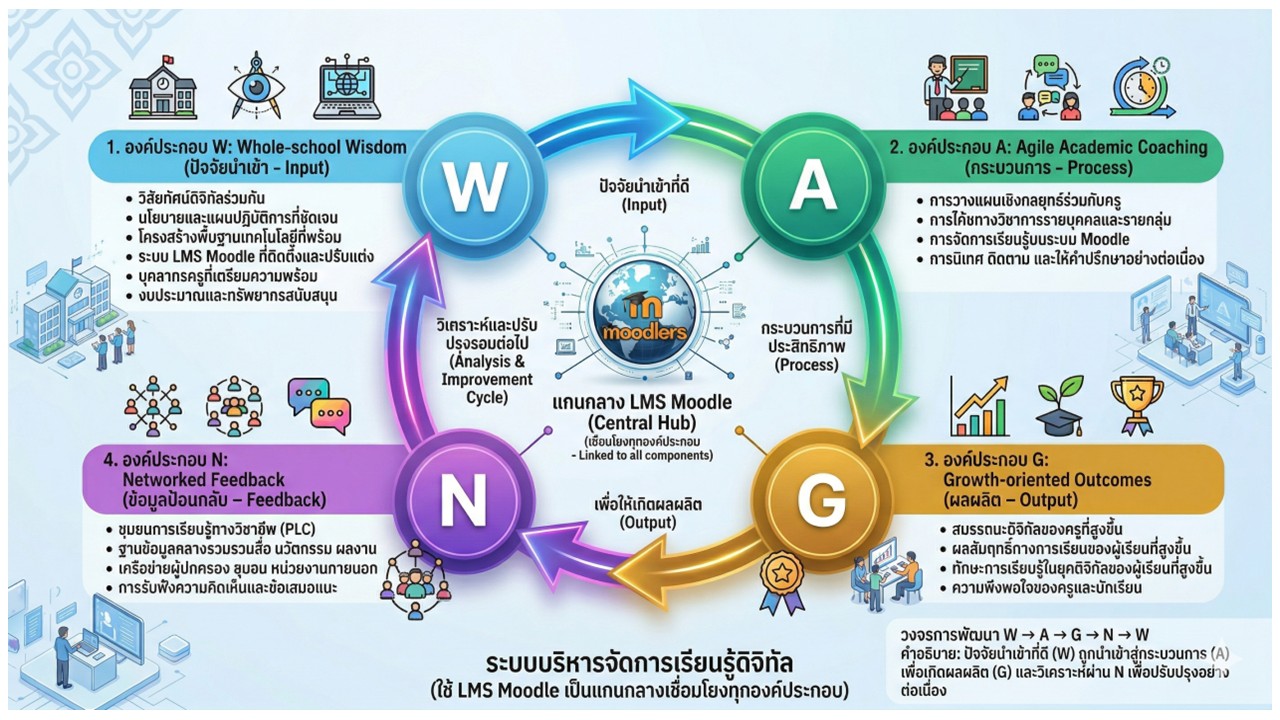
Development of the WANG Digital Learning Management Model on LMS Moodle to Enhance Teachers' Digital Competence and Students' Learning Achievement at Wangmuang Pittayakom School
Article Sidebar
Main Article Content
Abstract
The Development of a Digital Learning Management Model "WANG Model" on LMS Moodle Platform to strengthen Teachers' Digital Competence and Students' Learning Achievement at Wangmuang Pittayakom School. The purposes of this research were: 1) to study the current conditions, problems, and needs for digital learning management at Wangmuang Pittayakom School; 2) to develop the WANG Model digital learning management model on the LMS Moodle platform; 3) to implement the developed model, evaluate and refine the final model, and 4) to examine teacher and student satisfaction with the implementation of the WANG Model. The research employed a four-phase Research and Development (R&D) approach based on Borg and Gall's (1989) framework: Phase 1 (Rl) investigated current situations and needs with 26 key informants; Phase 2 (Dl) involved designing and validating the draft model with nine experts; Phase 3 (R2) implemented the model with 18 teachers and 284 students during the second semester of the 2025 academic year, using a one-group pretest-posttest design; and Phase 4 (D2) evaluated and finalized the model. Data were analyzed using mean, standard deviation, and dependent samples t-test. The research findings were as follows: 1. The current situation revealed that 72.2% of teachers had only foundational-level digital competence, used technology unsystematically, lacked skills for designing digital learning activities, and had limited opportunities for continuous professional development. Teachers expressed needs for individualized coaching and professional learning communities (PLC). 2. The draft WANG Model was rated by experts at the highest level of appropriateness, and the final version was certified at the highest level. 3. After implementation, teachers' digital competence scores were significantly higher than before the experiment at the .05 level. Students' learning achievement scores and digital learning skills scores were also significantly higher than before the experiment at the .05 level. 4. Both teachers and students reported the highest level of satisfaction with the WANG Model.
Keywords: Management Model, Digital Learning, LMS Moodle, Digital Competence, Learning Achievement
Article Details

This work is licensed under a Creative Commons Attribution-NonCommercial-NoDerivatives 4.0 International License.
References
กุลชัย กุลตวนิช. (2565). การบริหารสถานศึกษาในยุคดิจิทัล. สำนักพิมพ์แห่งจุฬาลงกรณ์มหาวิทยาลัย.
กระทรวงศึกษาธิการ. (2566). นโยบายและจุดเน้นกระทรวงศึกษาธิการ ประจำปีงบประมาณ พ.ศ. 2567. https://ops.moe.go.th/policy-and-focus-moe-fiscal-year-2024/
คุรุสภา. (2562). ข้อบังคับคุรุสภาว่าด้วยมาตรฐานวิชาชีพ (ฉบับที่ 4) พ.ศ. 2562. https://www.ratchakitcha.soc.go.th/DATA/PDF/2562/E/068/T_0018.PDF
จิราภรณ์ ปกรณ์. (2565). โมเดลภาวะผู้นำดิจิทัลสำหรับผู้บริหารสถานศึกษา สังกัดสำนักงานคณะกรรมการการศึกษาขั้นพื้นฐาน [ดุษฎีนิพนธ์ปริญญาดุษฎีบัณฑิต, มหาวิทยาลัยศรีนครินทรวิโรฒ]. http://ir-ithesis.swu.ac.th/dspace/handle/123456789/1915
เจียระไน กาญจนะโกมล, สุดใจ พันธุ์ศรี, กาญจนา อุปสาร, และ ธนภณ พันธุ์ศรี. (2567). การจัดการเรียนรู้แบบผสมผสานที่ส่งผลต่อสมรรถนะผู้เรียนในสังกัดสำนักงานเขตพื้นที่การศึกษามัธยมศึกษาอุบลราชธานี อำนาจเจริญ. วารสารวิชาการมหาวิทยาลัยการจัดการและเทคโนโลยีอีสเทิร์น, 21(1), 213–222.
ชัยนาจ ปั้นสันเทียะ. (2559). การพัฒนาบทเรียนออนไลน์ด้วย Moodle LMS รายวิชาคอมพิวเตอร์และเทคโนโลยีสารสนเทศ สำหรับนักศึกษามหาวิทยาลัยเทคโนโลยีพระจอมเกล้าพระนครเหนือ วิทยาเขตระยอง [วิทยานิพนธ์ปริญญามหาบัณฑิต, มหาวิทยาลัยเทคโนโลยีพระจอมเกล้าพระนครเหนือ].
บุญญลักษม์ ตำนานจิตร. (2565). การจัดการเรียนการสอนด้วยบทเรียนออนไลน์ร่วมกับการเรียนแบบร่วมมือโดยใช้การเรียนรู้ผ่านการเล่าเรื่องด้วยสื่อดิจิทัล. วารสารพัฒนาเทคนิคศึกษา, 34(123), 4–12. https://doi.org/10.14416/j.ted.2022.06.014
ปริญญา ยวงทอง. (2564). การพัฒนาการจัดการเรียนการสอนออนไลน์ เรื่องระบบเครือข่ายคอมพิวเตอร์ สำหรับนักเรียนชั้นมัธยมศึกษาปีที่ 3 สังกัดสำนักงานเขตพื้นที่การศึกษามัธยมศึกษา เขต 7 [วิทยานิพนธ์ปริญญามหาบัณฑิต, มหาวิทยาลัยบูรพา].
พิชญาภัค สัจจะบันดาลใจ. (2565). การพัฒนาการจัดการสอนออนไลน์เชิงรุก เรื่องการเขียนโปรแกรมคอมพิวเตอร์สร้างฐานข้อมูลด้วยภาษา PHP และ MySQL สำหรับนิสิตปริญญาตรี สาขาเทคโนโลยีการศึกษา [วิทยานิพนธ์ปริญญามหาบัณฑิต, มหาวิทยาลัยบูรพา].
พิมพ์พรรณ เทพสุเมธานนท์. (2564). การพัฒนาสมรรถนะดิจิทัลของครูในโรงเรียนมัธยมศึกษา สังกัดสำนักงานคณะกรรมการการศึกษาขั้นพื้นฐาน โดยใช้รูปแบบการฝึกอบรมแบบผสมผสาน. วารสารเทคโนโลยีและสื่อสารการศึกษา, 16(21), 45–62.
ภูรีรัตน์ สุกใส. (2565). ความสัมพันธ์ระหว่างภาวะผู้นำดิจิทัลของผู้บริหารสถานศึกษากับความเป็นองค์กรแห่งนวัตกรรมของสถานศึกษาระดับมัธยมศึกษาในจังหวัดอุตรดิตถ์ [การค้นคว้าอิสระปริญญามหาบัณฑิต, มหาวิทยาลัยนเรศวร]. https://nuir.lib.nu.ac.th/dspace/handle/123456789/5513
มณฑิรา จิตต์จันทร์. (2566). การพัฒนาสมรรถนะดิจิทัลของครูโรงเรียนชายแดน สังกัดสำนักงานเขตพื้นที่การศึกษามัธยมศึกษา. วารสารศึกษาศาสตร์ มหาวิทยาลัยนเรศวร, 25(3), 78–94.
มาเรียม นิลพันธุ์. (2558). วิธีวิจัยทางการศึกษา (พิมพ์ครั้งที่ 9). ศูนย์วิจัยและพัฒนาทางการศึกษา คณะศึกษาศาสตร์ มหาวิทยาลัยศิลปากร.
แฝงกมล เพชรเกลี้ยง. (2563). การเรียนรู้แบบผสมผสาน Blended Learning. วารสารการจัดการทางการศึกษาปฐมวัย, 2(2), 63-76. https://so02.tci-thaijo.org/index.php/ECEM/article/view/254801/171424
โรงเรียนวังม่วงพิทยาคม. (2568). รายงานการประเมินตนเองของสถานศึกษา (Self-Assessment Report: SAR) ปีการศึกษา 2567. http://wangmuangpittayakom.com/documentschool
รุ่งชัชดาพร เวหะชาติ. (2563). การบริหารจัดการเรียนรู้ในยุคดิจิทัล. โรงพิมพ์มหาวิทยาลัยทักษิณ.
ศิริวรรณ ฉัตรมงคลกุล, สมชาย เทพแสง, และ ณัฐนันท์ จันทร์ทิม. (2565). การพัฒนารูปแบบการบริหารจัดการเรียนรู้ผ่านระบบออนไลน์สำหรับสถานศึกษาสังกัดสำนักงานคณะกรรมการการศึกษาขั้นพื้นฐาน. วารสารครุศาสตร์ จุฬาลงกรณ์มหาวิทยาลัย, 50(1), 1–15.
ศุภกฤต ดิษฐสุวรรณ. (2566). รูปแบบการพัฒนาสมรรถนะการใช้เทคโนโลยีดิจิทัลในการจัดการเรียนรู้ของครูเพื่อยกระดับคุณภาพผู้เรียน โรงเรียนเตรียมอุดมศึกษาพัฒนาการสุวรรณภูมิ. Journal of Roi Kaensarn Academi, 8(3), 194–214.
สมพร อินทร์สุข. (2564). การใช้ชุมชนการเรียนรู้ทางวิชาชีพ (PLC) เพื่อพัฒนาครูด้านเทคโนโลยีการศึกษาในโรงเรียนมัธยมศึกษา. วารสารวิทยาลัยครุศาสตร์ มหาวิทยาลัยธุรกิจบัณฑิตย์, 5(1), 33–48.
สิรินาถ ชอ้อนชม, และ ภาสพิชญ์ ชูใจ มิเชล. (2567). การพัฒนาบทเรียนออนไลน์ร่วมกับการเรียนรู้แบบเพื่อนช่วยเพื่อนเพื่อเสริมผลสัมฤทธิ์ทางการเรียนรายวิชาวิทยาศาสตร์และเทคโนโลยี. ใน การประชุมวิชาการระดับชาติด้านนวัตกรรมการเรียนรู้ทางวิทยาศาสตร์และเทคโนโลยี ครั้งที่ 4 (NCLIST 2024) (หน้า 299–306). มหาวิทยาลัยเทคโนโลยีพระจอมเกล้าธนบุรี.
สำนักงานคณะกรรมการการศึกษาขั้นพื้นฐาน. (2564). คู่มือการประเมินสมรรถนะครู. โรงพิมพ์ชุมนุมสหกรณ์การเกษตรแห่งประเทศไทย.
สำนักงานคณะกรรมการการศึกษาขั้นพื้นฐาน. (2566). นโยบายและจุดเน้นสำนักงานคณะกรรมการการศึกษาขั้นพื้นฐาน ประจำปีงบประมาณ พ.ศ. 2567–2568. https://chan1.net/c/uYZ8y8HssjPm
สำนักงานเขตพื้นที่การศึกษามัธยมศึกษาหนองคาย. (2566). แผนพัฒนาการศึกษาขั้นพื้นฐาน (พ.ศ. 2566–2570). https://kku.world/mzpz96
สำนักงานเลขาธิการสภาการศึกษา. (2566). รายงานการศึกษาไทย พ.ศ. 2565/2566. พริกหวานกราฟฟิค.
สุวิมล ว่องวาณิช. (2563). การวิจัยทางการศึกษา: หลักการและกระบวนการ. สำนักพิมพ์แห่งจุฬาลงกรณ์มหาวิทยาลัย.
โสวนีย์ จงแดง, และ อภิชาติ เลนะนันท์. (2566). พัฒนาครูด้านการจัดการเรียนรู้แบบผสมผสานเพื่อพัฒนาทักษะการแก้ปัญหาของนักเรียน โรงเรียนบ้านกลาง สังกัดสำนักงานเขตพื้นที่การศึกษาประถมศึกษาชุมพร เขต 1. วารสาร มจร อุบลปริทรรศน์, 8(2), 1–15.
หทัยชนก พรหมสว่างศิลป์. (2566). การพัฒนารูปแบบการบริหารงานวิชาการในยุคดิจิทัลของโรงเรียนมัธยมศึกษาขนาดใหญ่ สังกัดสำนักงานเขตพื้นที่การศึกษามัธยมศึกษากาญจนบุรี [วิทยานิพนธ์ปริญญามหาบัณฑิต, มหาวิทยาลัยคริสเตียน].
อนุสรา กุลวงษ์. (2564). ปัจจัยที่ส่งผลต่อความสำเร็จในการใช้ระบบบริหารจัดการเรียนรู้ของครูในโรงเรียนมัธยมศึกษา สังกัดสำนักงานคณะกรรมการการศึกษาขั้นพื้นฐาน. วารสารเทคโนโลยีและสื่อสารการศึกษา, 16(21), 67–82.
Al-Ajmi, N. H., & Aljazzaf, Z. M. (2020). Factors influencing the use of learning management systems in secondary schools. International Journal of Information and Education Technology, 10(9), 678–684. https://doi.org/10.18178/ijiet.2020.10.9.1440
Bates, A. W. (2019). Teaching in a digital age: Guidelines for designing teaching and learning (2nd ed.). Tony Bates Associates Ltd. https://pressbooks.bccampus.ca/teachinginadigitalagev2/
Bertalanffy, L. von. (1968). General system theory: Foundations, development, applications. George Braziller.
Black, P., & Wiliam, D. (1998). Assessment and classroom learning. Assessment in Education: Principles, Policy & Practice, 5(1), 7–74. https://doi.org/10.1080/0969595980050102
Borg, W. R., & Gall, M. D. (1989). Educational research: An introduction (5th ed.). Longman.
Branch, R. M. (2009). Instructional design: The ADDIE approach. Springer. https://doi.org/10.1007/978-0-387-09506-6
Brown, A. L. (1992). Design experiments: Theoretical and methodological challenges in creating complex interventions. Journal of the Learning Sciences, 2(2), 141–178. https://doi.org/10.1207/s15327809jls0202_2
Cohen, L., Manion, L., & Morrison, K. (2018). Research methods in education (8th ed.). Routledge.
Cole, J., & Foster, H. (2022). Using Moodle: Teaching with the popular open source course management system (4th ed.). O'Reilly Media.
Collins, A. (1992). Toward a design science of education. In E. Scanlon & T. O'Shea (Eds.), New directions in educational technology (pp. 15–22). Springer.
Dweck, C. S. (2006). Mindset: The new psychology of success. Random House.
Ellis, R. K. (2009). Field guide to learning management systems. ASTD Learning Circuits. https://www.td.org/~/media/Files/Publications/LMS_fieldguide_20091.pdf
Hord, S. M. (1997). Professional learning communities: Communities of continuous inquiry and improvement. Southwest Educational Development Laboratory. https://eric.ed.gov/?id=ED410659
IDEO. (2012). Design thinking for educators (2nd ed.). IDEO.
International Society for Technology in Education. (2018). ISTE standards for education leaders. https://www.iste.org/standards/iste-standards-for-education-leaders
Joyce, B. R., & Weil, M. (2000). Models of teaching (6th ed.). Allyn and Bacon.
Lunenburg, F. C., & Ornstein, A. C. (2021). Educational administration: Concepts and practices (7th ed.). Sage Publications.
OECD. (2023a). PISA 2022 results (Volume I): The state of learning and equity in education. OECD Publishing. https://doi.org/10.1787/53f23881-en
OECD. (2023b). OECD digital education outlook 2023: Towards an effective digital education ecosystem. OECD Publishing. https://doi.org/10.1787/c74f03de-en
Partnership for 21st Century Learning. (2019). Framework for 21st century learning. Battelle for Kids. http://static.battelleforkids.org/documents/p21/P21_Framework_Brief.pdf
Rice, W. (2020). Moodle 3.8 complete guide: Unlock the power of Moodle to create engaging and effective learning experiences. Packt Publishing.
Scherer, R., Howard, S. K., Tondeur, J., & Siddiq, F. (2021). Profiling teachers' readiness for online teaching and learning in higher education: Who's ready? Computers in Human Behavior, 118, Article 106675. https://doi.org/10.1016/j.chb.2020.106675
Sheninger, E. (2019). Digital leadership: Changing paradigms for changing times (2nd ed.). Corwin Press.
Taechatanasat, P. (2018). A multilanguage blended learning approach for Thai agricultural science students [Doctoral dissertation, Edith Cowan University]. Edith Cowan University Research Online. https://ro.ecu.edu.au/theses/2055/
Thorne, K. (2003). Blended learning: How to integrate online and traditional learning. Kogan Page.
UNESCO. (2018). UNESCO ICT competency framework for teachers (Version 3). United Nations Educational, Scientific and Cultural Organization. https://unesdoc.unesco.org/ark:/48223/pf0000265721
UNESCO. (2023). Global education monitoring report 2023: Technology in education — A tool on whose terms? UNESCO Publishing. https://unesdoc.unesco.org/ark:/48223/pf0000385723
Wang, W., Xi, Y., & Liu, P. (2024). The connotation, composition and emergence mechanisms of digital leadership under complex adaptive systems theory. Chinese Journal of Management, 21(4), 475–483. https://doi.org/10.3969/j.issn.1672-884x.2024.04.001
Watson, W. R., & Watson, S. L. (2021). An argument for clarity: What are learning management systems, what are they not, and what should they become? TechTrends, 65(4), 452–461. https://doi.org/10.1007/s11528-021-00623-1
Zhao, Y., Pinto Llorente, A. M., & Sánchez-Gómez, M. C. (2022). Digital competence in higher education research: A systematic literature review. Computers & Education, 168, Article 104212. https://doi.org/10.1016/j.compedu.2021.104212
