
Transformational Leadership of School Administrators in Partnership School under the Office of the Basic Education Commission in the Northeast: Multiple Case Studies
Article Sidebar
Main Article Content
Abstract
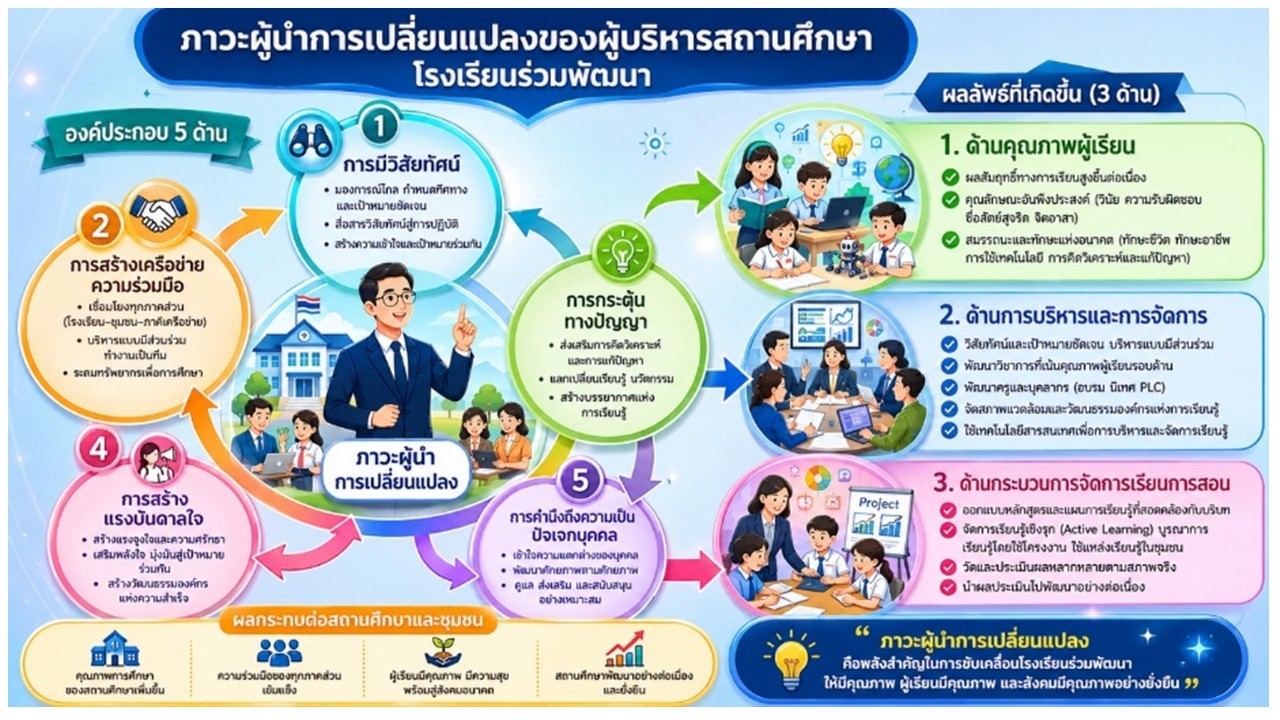
This research aimed to: (1) examine the characteristics of transformational leadership among school administrators and (2) investigate the outcomes resulting from the implementation of transformational leadership. The study was conducted in three case-study schools participating in the Partnership School Project (Generations 1–3) under the Office of the Basic Education Commission in Northeastern Thailand. The study used a qualitative approach in three phases: Phase 1 examined the characteristics of transformational leadership, Phase 2 involved a multiple case study, and Phase 3 consisted of a focus group discussion. Five key informants, including school administrators, teachers, educational personnel, and related stakeholders, were selected through purposive sampling based on the criterion of having at least five years of relevant experience. Data were collected through in-depth interviews, participant observation, field notes, document analysis, and focus group discussions. Data were analyzed using content and inductive analysis, and trustworthiness was verified through triangulation. The findings revealed five dimensions of transformational leadership: vision, collaborative networking, intellectual stimulation, inspirational motivation, and individualized consideration. The outcomes of transformational leadership were identified in three areas: (1) student quality, including academic achievement, desirable characteristics, and future competencies and skills; (2) administration and management through participatory management, professional development, supportive learning environments, and information technology systems; and (3) teaching and learning processes through curriculum design, student-centered learning activities, and learning assessment and evaluation.
Keywords: Transformational Leadership, Partnership School, Multiple Case Study
Article Details

This work is licensed under a Creative Commons Attribution-NonCommercial-NoDerivatives 4.0 International License.
References
กชกร เนียมท่าเสา. (2566). ภาวะผู้นำการเปลี่ยนแปลงในศตวรรษที่ 21. วารสารบริหารการศึกษา มศว, 20(38), 39-50. https://ejournals.swu.ac.th/index.php/EAJ/article/view/15611/12545
จัตุพร แปวไธสง. (2563). การศึกษาการมีส่วนร่วมของกลุ่มชุมชนในการบริหารการศึกษาของโรงเรียนร่วมพัฒนา (Partnership School) จังหวัดบุรีรัมย์. วารสารวิทยาลัยนครราชสีมา, (1), รายงานสืบเนื่องการประชุมวิชาการ. http://journal.nmc.ac.th/th/admin/Journal/2563Vol12No1_133.pdf
ชำนาญ คำปัญโญสีโนทัย. (2559). ภาวะผู้นำการเปลี่ยนแปลงของผู้บริหารสถานศึกษาโรงเรียนในฝัน: พหุกรณีศึกษา (วิทยานิพนธ์ครุศาสตรดุษฎีบัณฑิต). มหาวิทยาลัยราชภัฏสกลนคร.
ณัฐกิจ บัวชม, วีระวัฒน์ อุทัยรัตน์. (2558). รูปแบบการพัฒนาภาวะผู้นำการเปลี่ยนแปลงของผู้บริหารโรงเรียนมัธยมศึกษาในโครงการโรงเรียนมาตรฐานสากล. วารสารวิชาการมหาวิทยาลัยอีสเทิร์นเอเชีย ฉบับสังคมศาสตร์และมนุษยศาสตร์, 5(2), 215–229. https://so01.tci-thaijo.org/index.php/EAUHJSocSci/article/view/48459/40256
ณัฐชรัตน์ แก้วก่า. (2563). การพัฒนางานสู่ความสำเร็จตามโครงการโรงเรียนประชารัฐในโรงเรียนบ้านนาคอกควาย สังกัดสำนักงานเขตพื้นที่การศึกษาประถมศึกษานครพนม เขต 1 (วิทยานิพนธ์ปรัชญาดุษฎีบัณฑิต). มหาวิทยาลัยราชภัฏสกลนคร.
ณัฐธีรา มีจันทร์. (2562). สมรรถนะผู้บริหารสถานศึกษาในโครงการโรงเรียนร่วมพัฒนา สังกัดสำนักงานคณะกรรมการการศึกษาขั้นพื้นฐาน (วิทยานิพนธ์ศึกษาศาสตรมหาบัณฑิต สาขาวิชาการบริหารการศึกษา). มหาวิทยาลัยเทคโนโลยีราชมงคลธัญบุรี.
ถวิล ศรีใจงาม, & วีสิรินธร สินจินดาวงศ. (2558). การพัฒนารูปแบบภาวะผู้นำการเปลี่ยนแปลงของผู้บริหารโรงเรียนมัธยมศึกษา สังกัดสำนักงานเขตพื้นที่การศึกษามัธยมศึกษา เขต 1 และเขต 2. วารสารวิชาการมหาวิทยาลัยอีสเทิร์นเอเชีย, 5(3), 169–170. https://so01.tci-thaijo.org/index.php/EAUHJSocSci/article/view/44701/37054
ในตะวัน กำหอม. (2568). การวัดจริยธรรมกับการศึกษา. สำนักพิมพ์สยามจุลมลฑล.
บรรพต สรวนรัมย์. (2564). การศึกษาผลการติดตาม ตรวจสอบ ประเมินผลและนิเทศการศึกษาการจัดการศึกษาของสถานศึกษาในสำนักงานเขตพื้นที่การศึกษาประถมศึกษาบุรีรัมย์ เขต 3. สำนักงานเขตพื้นที่การศึกษาประถมศึกษาบุรีรัมย์ เขต 3.
วรพล ศรีเทพ. (2568). การบริหารสถานศึกษาแบบบูรณาการ: แนวทางสู่ความยั่งยืนด้วยการออกแบบที่ครอบคลุมและยืดหยุ่น. โรงเรียนไทยรัฐวิทยา 102 (บ้านเกาะเต่า).
Bass, B. M. (1985). Leadership and Performance Beyond Expectations. New York: Free Press.
Bass, B. M., & Avolio, B. J. (1994). Transformational leadership development: Manual for the multifactor leadership questionnaire. Consulting Psychologists Press.
Bennis, W., & Nanus, B. (1985). Leaders: The strategies for taking change. Harper & Row.
Braun, J. B. (1991). An analysis of principal leadership vision and its relationship to school climate (Doctoral dissertation). Dissertation Abstracts International, 52(4), 1139A
Burns, J. M. (1978). Leadership. New York: Harper & Row.
Daft, R. L. (2008). The new era of management (2nd ed.). Thomson South-Western.
Fullan, M. (2001). Leading in a culture of change. Jossey-Bass.
Leithwood, K., & Jantzi, D. (2000). Principals and teacher leadership effects: A replication. School Leadership & Management, 20(4), 415–434. https://doi.org/10.1080/713696963
Rogers, C. R. (1961). On becoming a person: A therapist’s view of psychotherapy. Houghton Mifflin.
Senge, P. M. (1990). The fifth discipline: The art and practice of the learning organization. Doubleday/Currency.
Sergiovanni, T. J. (2001). The principalship: A reflective practice perspective (4th ed.). Allyn & Bacon.
